
I got the call on a Tuesday afternoon. A VP of sales at a mid-market SaaS company had just watched a demo for a visitor-identification tool, and the demo showed that 12% of her traffic mapped to named companies. 'That can't be right,' she said. 'We get thousands of visits a week.'
I've been doing revenue operations for about six years, and I've handled 200+ rush-order prospecting jobs—last-minute lists, same-day enrichments, portal launches where the CRM data turned into a dumpster fire. Maybe 180 of those under 48 hours, I'd have to check the system. The point isn't the count. It's that I've seen the exact same pattern every time: the problem isn't the visitor ID tool. It's the pipeline around it.
What you think the problem is
Most B2B sales teams know they should be identifying website visitors. The question I get more than any other: 'How can a B2B sales team identify website visitors?' You want to see which accounts are on your pricing page, what they downloaded, who the decision makers are, and get to them before someone else does.
So you buy a tool. You add a JavaScript snippet. You wait a week. And your dashboard still shows 87% 'Unknown.' Your first instinct is to blame the vendor. I get it, and honestly, some vendors deserve it. But after years of emergency data projects, I can tell you: most of the time the identification tool is doing exactly what it can. The failure is in what happens before and after that one lookup.
Why the 'simple lookup' model breaks
Visitor ID is a supply chain, not a switch
Reverse IP lookup only works when the IP address actually belongs to a company network. Coming from a Starbucks wifi or a mobile network? Gone. Coming from LinkedIn's IP with a personal profile? Gone. It's not a bug; it's a limitation baked into the internet. So when someone promises to 'identify all visitors,' they cannot.
Beyond that, you need enrichment. Company name leads to firmographics. Firmographics need to match contacts. Contacts need email addresses. Then those email addresses need validation. Each step has a drop-off rate. If you're lucky, 60% of your identified accounts will survive to a usable contact. That's not a bad tool—that's basic math.
I'm not a data engineer, so I can't speak to building your own IP-to-company database. What I can tell you from an ops perspective is that you need to know where in the chain the drop-off happens. If you don't, you'll blame the wrong link.
API rate limits silently kill automation
Here's the part most people don't see coming: API rate limit errors. The enrichment provider doesn't care that you need 5,000 records before tomorrow. Their API will accept 100 calls per minute, and when you exceed that, you get throttled. If your automation platform doesn't handle retries correctly, thousands of rows quietly come back blank.
I've watched this happen on a real project. The platform showed 'Connection successful,' but exported rows were missing 3,000 companies. Nobody noticed until the sales team started dialing and half the numbers were non-existent. That's why so many 'automation platform reviews' start sounding the same.
The surprise wasn't that the data was messy. It was how fast a broken validation step could kill a project.
API email validation is the step everyone skips
Then there's API email validation. It sounds boring, so teams ignore it.
But validation is not just 'does this email look like an email?' A decent API email validation service checks the mailbox, the domain, the catch-all status, and syntax. A weak one only checks syntax. If you use the weak one, you'll see a bounce rate of 10-20% within the first week. On a new domain, that's enough to ruin your sender reputation for months.
And here's the bitter pill: a lot of 'verified email lists' on the market are lists where someone ran a cheap validation step once. 'Verified' is doing a lot of work in that sentence.
This is also where the transparency point matters. I've learned to ask 'what's NOT included?' before I ask 'what's the price?' The vendor who lists all fees upfront—even if the total looks higher—usually costs less in the end.
What this really costs
Ignoring the pipeline isn't free. Let me give you a picture.
Last quarter, an enterprise client needed an 'emergency' list of 3,000 decision makers from accounts visiting their website. We processed the records in a day. After firmographic matching, we had 2,100. After dedup with their CRM, 1,700. After contact enrichment, 1,250. After validation? 1,030. That's a 65% loss from the original. If the team had bought 3,000 leads, they'd have wasted the difference.
That's not a throwaway line. It's real money. SDRs spend hours on companies that don't match ICP. Worse, they call existing customers because the tool didn't have a CRM cross-check. I've seen a deal get disqualified—not by a competitor, but by an SDR accidentally pitching the same product to a customer who'd just renewed.
The longer-term cost is deliverability. Bounce rates over 5% can trigger filters at Gmail, Outlook, and Yahoo. Once your domain gets flagged, every sequence you send to real prospects also lands in spam. I've seen a startup pay $800 extra in rush fees to a new provider, only to realize the previous list had burned their domain. That's the most expensive outcome of weak validation.
And if you're doing automated outreach, be careful about the claims you make. Per FTC guidelines, your advertising claims need to be truthful and non-misleading. If you're sending an email that says 'I saw you on our pricing page' to someone who only visited through a shared office IP, you're not being accurate. That's a legal risk as well as a deliverability problem.
The fix: Build a workflow, not a wish
So what should a B2B sales team actually do?
Use a platform that can chain the steps together with error handling. Not a copy-paste script that dies at midnight. Not a 'just connect this and forget it' promise. The recent wave of Relevance AI reviews, pros cons, and platform comparisons is happening for a reason: the category is finally designed for non-engineers.
From my experience with the Relevance AI automation platform, its main advantage is natural-language workflow building. You can tell it, 'Take unidentified visitors from my CRM, enrich company and contact data from our provider, verify email addresses, and only add them to the sequence if verification confidence is above 95%.' The platform then handles the workflow steps, retries, and fallback rules in a way a generic automation connector won't.
Quick pros and cons from an ops perspective:
- Pro: You define the business rule in plain language, not in code. That means fewer broken steps during a weekend emergency.
- Pro: The built-in retry handling helps with API rate limits. If the enrichment API says 'slow down,' the workflow pauses and retries instead of dropping rows.
- Con: You still need to monitor it. I do not care how smart the AI is—if a new enrichment field stops being populated, someone has to notice. That someone is usually me, on a Saturday.
- Con: Volume pricing can creep up. Ask what a 10,000-row monthly run costs with email validation included. If the answer is 'umm,' you haven't priced the whole workflow.
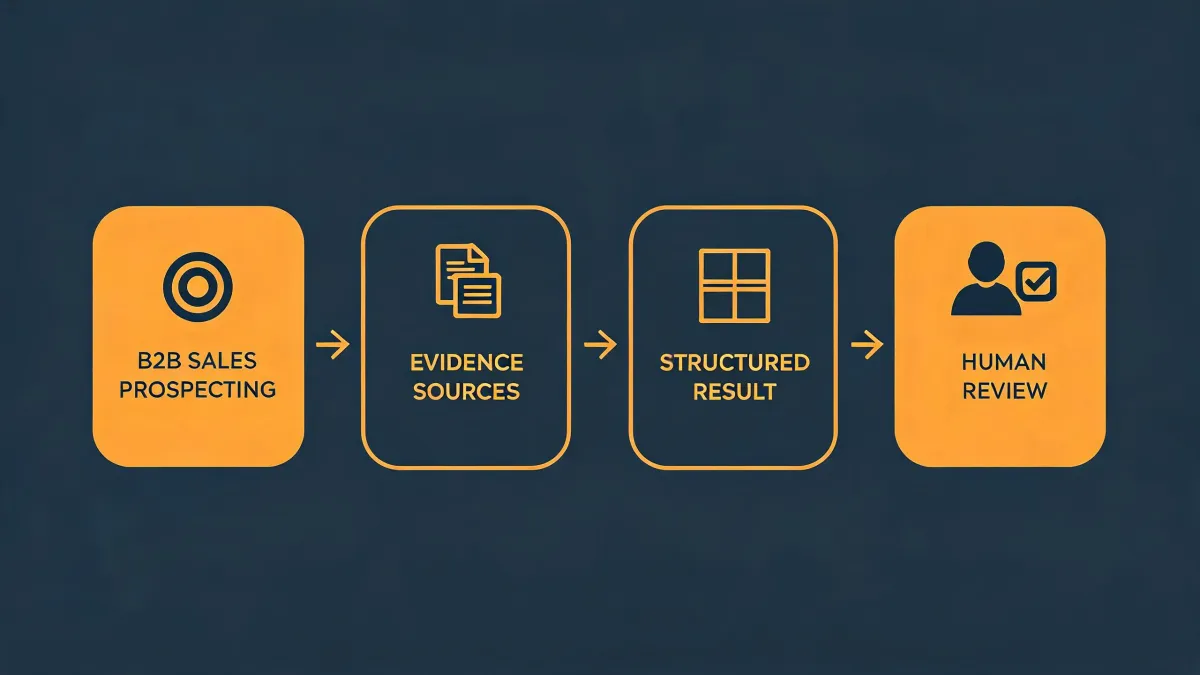
No one can guarantee response rates or revenue outcomes. Run from any vendor who says otherwise. What a good automation platform can do is give you a defensible chain: identify, enrich, validate, route. That's how a B2B sales team identifies website visitors without poisoning its own funnel.
My experience is mostly with mid-market SaaS teams. If you're at an enterprise with a data engineering team, you can build parts of this yourself. But if you're a RevOps team drowning in 20 SaaS subscriptions, you probably need the workflow platform first, the credibility second, and the emergency 'please fix this tonight' calls less often.
At least, that's been my experience after one too many Friday-night rush emails.