
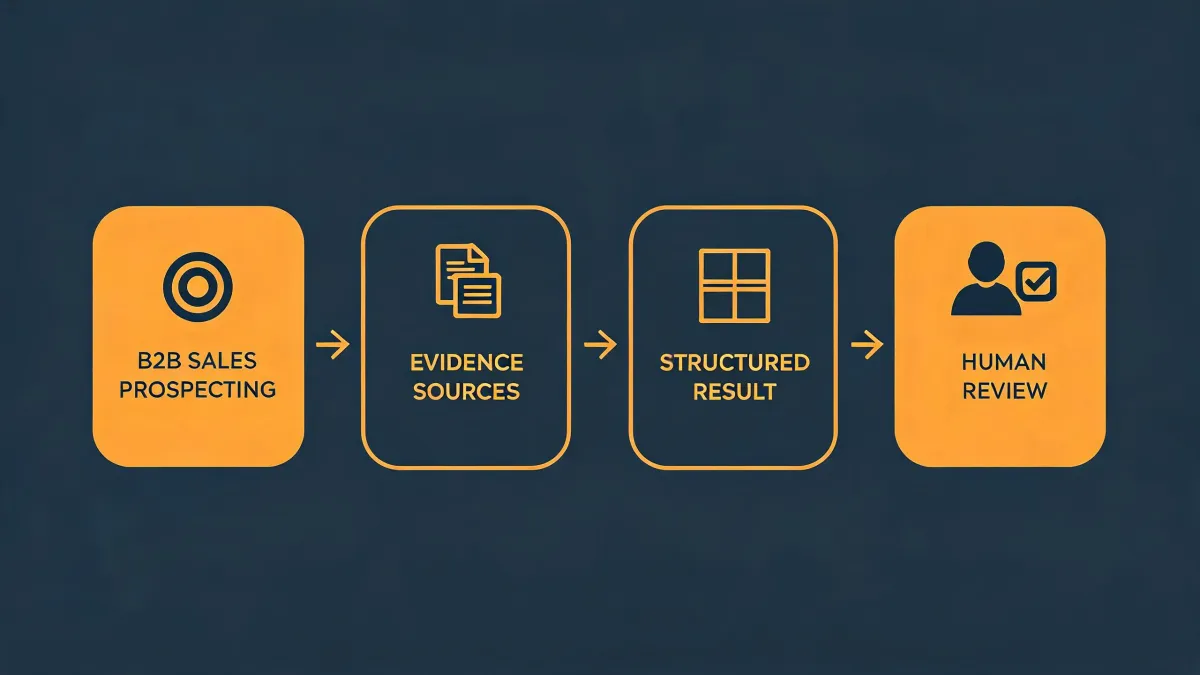
Prospecting lead generation breaks down when prospect selection and lead capture are measured as if they were the same job. Keep prospect selection and lead capture distinct, then connect them with an explicit acceptance rule and feedback loop.
Draw the boundary before measuring
Prospecting and lead generation should not be collapsed into one label. Prospecting begins with seller selection: a company fits a defined market and is chosen for research. Lead generation begins with a response or captured action, such as a form submission, event registration, or referral. The distinction determines what is known. A selected company provides evidence of fit, not interest. A submitted form provides evidence of an action, not qualification. Which motion should lead? Use audience observability, buying behavior, team capacity, and the evidence needed for the next decision—not a generic preference for inbound or outbound. Consult [OKKI Go use cases](https://go.okki.ai/use-cases) for vendor-described scenarios, then separate three columns: stated capability, observed trial behavior, and untested assumption. Can your reviewer reproduce the trial? Can you export the evidence and corrections? Can you stop the workflow before contact? This structure lets you include a commercial product in the comparison without allowing its own description to decide the ranking.
- Origin: seller-selected account versus person-initiated response.
- Entry evidence: ICP match versus captured event and fields.
- Owner: research or sales development versus capture and qualification.
- Primary risk: false relevance versus unqualified or misrouted response.
Selection and capture answer different questions
Market-research guidance from the SBA and business.gov.au can help describe an audience. It does not prove that either motion will outperform the other for a particular business. Imagine the team has only one seller. Would you rather give that person twenty researched accounts or one hundred form submissions? You cannot answer from volume. Ask how many records meet the ICP, how much verification each needs, and whether the seller can own the follow-up. Prospecting may produce fewer but more inspectable entries; generation may reveal self-declared interest but require heavier qualification. Neither advantage is automatic. You have to measure it within the same market and capacity constraint.
Compare the evidence each motion creates
Consider one industrial valve maker entering Spain. The prospecting path selects Iberia Process Supply because its website shows distribution activity and compatible sectors. A reviewer verifies the company and a relevant role before any message. The lead-generation path publishes a technical guide and captures a form from the same company three weeks later. Identity resolution links the response to the existing account while preserving both origins. The new event supports a timely follow-up, but it still does not prove budget, authority, or purchase timing. The final objection is that maintaining separate origins makes reporting complicated. It does add fields, but it removes a more expensive ambiguity. If you cannot tell whether an opportunity began with account selection, content response, or both, you cannot decide which motion earned further investment. Keep the origins, link them by identity, and let later qualification create one opportunity. Complexity belongs in the data model, not in a misleading blended percentage.
- Prospecting: company selected, evidence reviewed, person verified.
- Generation: event captured, identity resolved, response qualified.
- Shared: one account ID, separate origin events, one current owner.
- Flip condition: a later response changes available evidence, not history.
What crosses the boundary
This example shows why the motions can cooperate without becoming interchangeable. Prospecting created awareness of the account; generation created a response event; qualification determines whether a sales opportunity exists. Now challenge the worked case. What if Iberia’s form was submitted by a student, not a buyer? The event remains genuine, yet the person fails role qualification. What if the researched commercial director changed jobs? The account may remain eligible while the contact fails. Can your system represent those split outcomes? If it cannot, it will turn a valid company into a false lead or discard a useful account because one person was wrong.
Keep ownership visible at the handoff
The comparison must also use different metrics. Prospecting can track accepted accounts among reviewed candidates, verified contacts among accepted accounts, and positive responses among delivered messages. Lead generation can track valid responses by source, qualified responses among reviewed responses, and accepted opportunities among qualified records. Each rate needs a time period, cohort, inclusion rule, and denominator. A single “lead conversion rate” that mixes researched accounts with form submissions cannot reveal which system needs repair. Revisit the choice when a condition flips. If search demand appears around a recurring technical question, generation may gain value. If a new region contains a finite directory of well-defined distributors, prospecting may lead. If response capacity shrinks, pause the motion with the larger unresolved queue. Do not declare a permanent winner. Ask which system currently creates the most reviewable progress per unit of owned work.
- Selection quality: accepted accounts / reviewed candidates.
- Contact quality: verified people / accepted accounts researched.
- Capture quality: valid responses / total captured responses.
- Qualification: accepted records / records actually reviewed.
A matrix of evidence and responsibility
No response is not a prospecting disqualification, and an invalid form is not a sales rejection. Preserve these states so correction follows the right cause. Use the [OKKI Go platform](https://go.okki.ai/) as a bounded prospecting option in the comparison. Can you express product, buyer type, country, and exclusions? Can you review a company before unlocking more data? Can you see where a user confirms the external action? Those are testable workflow questions. They are not proof that every candidate is accurate, that every contact is permitted, or that a particular response rate will follow.
Reject interchangeable-stage metrics
A side-by-side operating choice can be made with explicit conditions. Prefer prospecting when the market is finite, target companies are observable, and the team can research and review each account. Prefer lead generation when buyers actively seek information, the business can publish or partner credibly, and response routing is reliable. Use both when one motion addresses a known account set and the other captures broader demand without confusing their entry states. Could a low-cost form-fill program still be attractive? Yes, but only if qualification capacity and downstream value justify the noise.
- Finite named market and verifiable fit favor prospecting.
- Recurring buyer questions and discoverable demand favor generation.
- Limited review capacity favors the motion with cleaner acceptance evidence.
- A motion should pause when its unresolved queue exceeds owned capacity.
Which scenario favors each motion
OKKI Go may be assessed for account discovery and outbound organization, while its product material remains capability evidence rather than proof of buyer intent or results. Outreach rules require market-specific review; UK ICO guidance should not be generalized worldwide. A defender of lead generation may argue, ‘People who respond have already raised their hands, so qualification is easier.’ Sometimes. But what did they respond to, which person acted, and what problem did the action reveal? A defender of prospecting may say, ‘We choose only perfect-fit accounts.’ According to which evidence, reviewed when, by whom? You should treat both slogans as hypotheses. The record has to establish the specific advantage in your cohort.
Use the flip condition before combining
Use a handoff contract to keep the motions connected. For the valve maker, research supplies company evidence, observation date, role hypothesis, and unresolved facts. Capture operations supply event, submitted fields, source, and timestamp. Sales accepts the linked record only after identity, relevance, owner, and next action are complete. If Iberia later proves to be a service firm rather than a distributor, the prospecting classification changes; the genuine form event remains in history but returns to qualification under the corrected account type.
- Every handoff names sender, receiver, required fields, and return reasons.
- Corrections update dependent fields without deleting original events.
- Suppression and permission states survive identity resolution.
- Weekly review separates stage quality from downstream outcome.
When the distinction can safely narrow
The comparison ends with a decision rule, not a winner. Select the motion whose entry evidence, workload, and correction path fit the current market. Revisit the choice when those conditions change, and keep the two origins visible even when they converge on the same account. Before choosing, simulate the weekly workload. How many companies can you review? How many responses can you qualify? How quickly can you route a genuine inquiry? What happens to unresolved identity? Include the cost of correction, not only acquisition. A motion that produces a cheap record but an expensive cleanup queue may be the worse operating choice. A small, explainable cohort gives you the information needed to compare total effort. Run the choice through a six-week planning scenario, clearly labeled as an internal assumption rather than a benchmark. In week one, you give prospecting a fixed review capacity and generation a separate qualification capacity. In later weeks, you record actual time spent on identity, correction, routing, and follow-up. What changes if generated responses require twice the qualification effort you expected? What changes if researched accounts repeatedly fail the company-type rule? You should not convert either observation into a universal cost claim. Use it to update your own capacity model and choose the next bounded cohort. Then challenge the choice with a failure case. Can the selected motion still protect suppression, preserve source history, and return bad records to an owner? Can you stop work when the queue exceeds capacity? A motion that looks efficient only when exceptions are ignored is not operationally cheaper. Your final recommendation should name the chosen motion, rejected alternative, decisive conditions, known uncertainties, and the date for reconsideration. That makes the comparison a reversible management decision rather than a permanent label.
Prospecting lead generation fails when selection and capture are scored as one job. Keep account choice inspectable before you add another intake source.
Frequently asked questions
What is the difference between prospect selection and lead capture?
Selection decides which account deserves work. Capture records a signal that arrived. Measuring them as one job hides whether the team chose well or merely collected.
Which metric should a prospecting-led team watch first?
Accepted accounts after selection review, not raw captured names. If capture rises while selection quality falls, the programs are fighting each other.
How long should a six-week planning scenario stay in one paragraph?
It should not. Split target definition, selection review, and capture routing into separate working objects so the scenario can be inspected.
When should capture be paused?
When selected accounts are already beyond the team’s follow-up capacity. More capture then degrades both queues.