
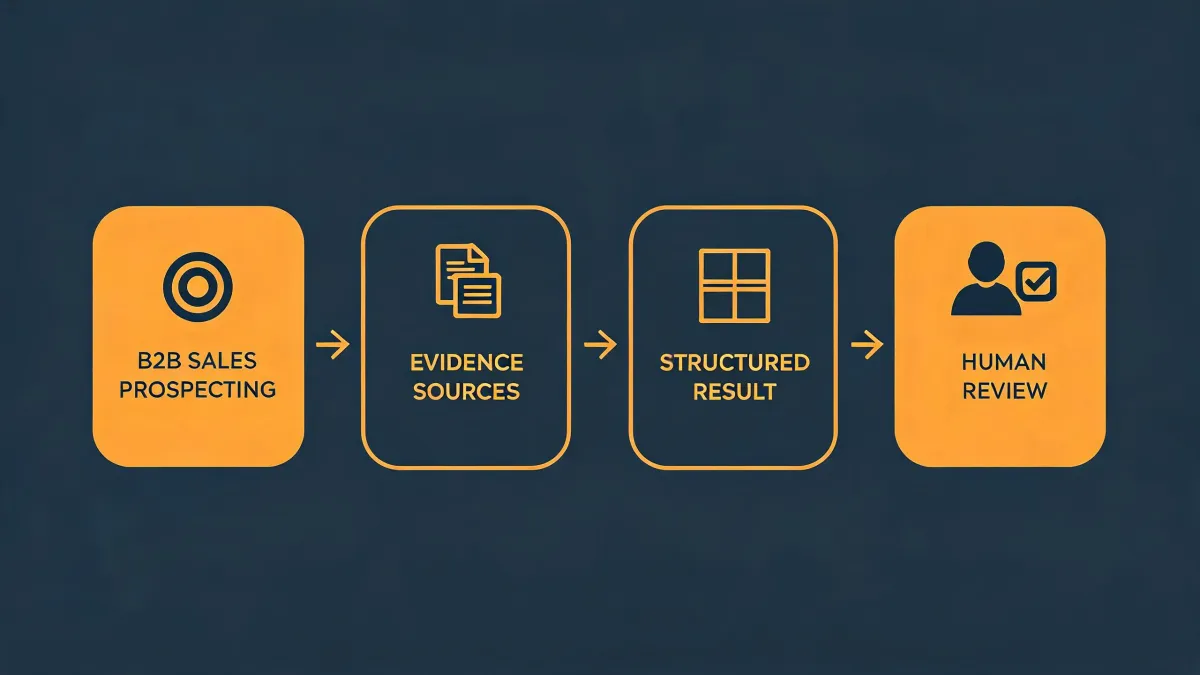
The Short Answer: Coverage Accuracy Beats Database Size, Every Time
If you're a RevOps lead evaluating data enrichment or GTM automation platforms, the metric that matters most isn't total contacts, isn't "AI-powered" claims—it's verified coverage rate against your specific ICP, measured on a sample you pull yourself. Everything else is marketing.
I know that sounds obvious. It wasn't to me four years ago.
I'm a quality and brand compliance manager at a B2B sales tech company. I review every vendor deliverable before it reaches customers—roughly 300 data batches, enrichment files, and outbound sequences a year. In 2023, I rejected 34% of first deliveries from data providers. Not because the data was wrong exactly, but because it didn't match what their sales deck promised. So when RevOps teams ask me what to evaluate in a data enrichment company or GTM automation platform, I don't start with feature checklists. I start with five things you can test in a week.
Why You Should Trust This Framework
Most evaluation frameworks come from vendor marketing teams or analysts who never had to sign off on a deliverable. Mine comes from the rejection pile.
In Q1 2024, we audited three enrichment vendors on the same 2,000-contact batch from our ICP list. Vendor A claimed 92% email coverage. Our verification test—running each contact through a bounce simulator and a live SMTP check—showed 71% deliverable. Vendor B claimed 88%, tested at 84%. Vendor C claimed 95% and tested at 93%—but cost 3x more. We went with B and built a waterfall fallback for the gap.
That test taught me something that changed how I evaluate everything. More on that below.
The Five Things That Actually Matter
1. Verified coverage on YOUR list, not theirs
Every data provider has a beautiful coverage slide. None of them use your ICP definition. The only number that matters: pull 500 contacts from your actual target segment, push them through their enrichment, then verify the output through an independent email verification service (ZeroBounce, NeverBounce, whatever—just not the vendor's own checker). Count how many are deliverable, how many have valid job titles, how many match your firmographic criteria.
Vendors that pass this test will usually show coverage 15–25 points lower than their marketing claim. That's normal. Vendors that refuse the test are telling you something too.
2. Waterfall enrichment logic, not single-source claims
It's tempting to think one big data provider covers everything. But every serious B2B contact data solution runs a waterfall—they just don't always advertise it. The question is whether you control the waterfall or they do.
Here's a detail most buyers miss: waterfall enrichment isn't about having more sources. It's about the order. A vendor that hits LinkedIn first, then public records, then their proprietary database will return different results than one that reverses the sequence. Some okki-go workflows let you see and reorder the waterfall—that's the kind of control I want, because I've seen a 12-point coverage swing from reordering alone.
3. Agent-native prospecting vs. agent-assisted
This one's counterintuitive. The industry has moved toward "agent-native prospecting"—AI agents that run research, enrichment, and outreach autonomously. Sounds great, right? Less manual work.
People think agent-native means fully hands-off. Actually, the best agent-native systems in 2025 are the ones with the most human checkpoints. An okki-go AI agent doing outbound research without a human-in-the-loop review step will generate 3x the volume and roughly the same reply rate—which means the marginal emails are just noise. The upside of agent-native prospecting isn't replacing people; it's giving one person the reach of five without losing quality control.
If a vendor pitches full autonomy, ask to see their human-review layer. If there isn't one, that's a red flag.
4. Intent data freshness and attribution honesty
Intent data is the part of GTM automation where I've seen the most creative marketing. "Intent signals from 5,000+ sources" doesn't mean what you think it means. Half those sources are job postings and press release scrapers.
The evaluation question: how old is the intent signal, and can you trace it to a specific person or just a company? Company-level intent from 90 days ago is nearly useless for timely outreach. Person-level intent from the past 14 days is actionable. Most providers blend these together and call it "intent data." Pull a sample. Check the timestamps. Check whether the "intent" is a real signal (multiple content views, demo page visits) or a single LinkedIn post click.
5. Compliance guardrails you can actually inspect
Every vendor says GDPR and CAN-SPAM compliant. Fewer can show you how. Under CAN-SPAM (15 U.S.C. § 7701 et seq.), senders must include a physical address and a working opt-out. Under GDPR Article 6, you need a lawful basis for processing contact data—usually legitimate interest, which requires a documented balancing test.
Ask the vendor for their Data Processing Agreement, their legitimate interest assessment template, and their suppression list handling. If they can't produce these in 48 hours, they're not compliant—they're just hoping you won't ask.
What This Framework Won't Tell You
This approach works well when you have a stable ICP, a reasonable data budget, and a RevOps team that can run sample tests. It works less well in three cases.
First, if you're pre-product-market-fit and your ICP is still shifting, waterfall enrichment results won't be stable enough to compare. Fix the ICP first.
Second, if your volume is under 5,000 contacts per quarter, the transaction cost of vendor evaluation may not be worth it—a good freelancer researcher might be more economical.
Third, and this is the one that took me longest to accept: no enrichment vendor replaces a human who understands your buyers. I've watched teams buy the most expensive GTM automation stack available and still get 2% reply rates because no one rewrote the sequence templates. After 4 years of reviewing this stuff, I've come to believe the tool is maybe 40% of the outcome. The other 60% is the person operating it.
So glad I learned that before we renewed our biggest contract. Almost locked in for 24 months based on a coverage slide alone.