
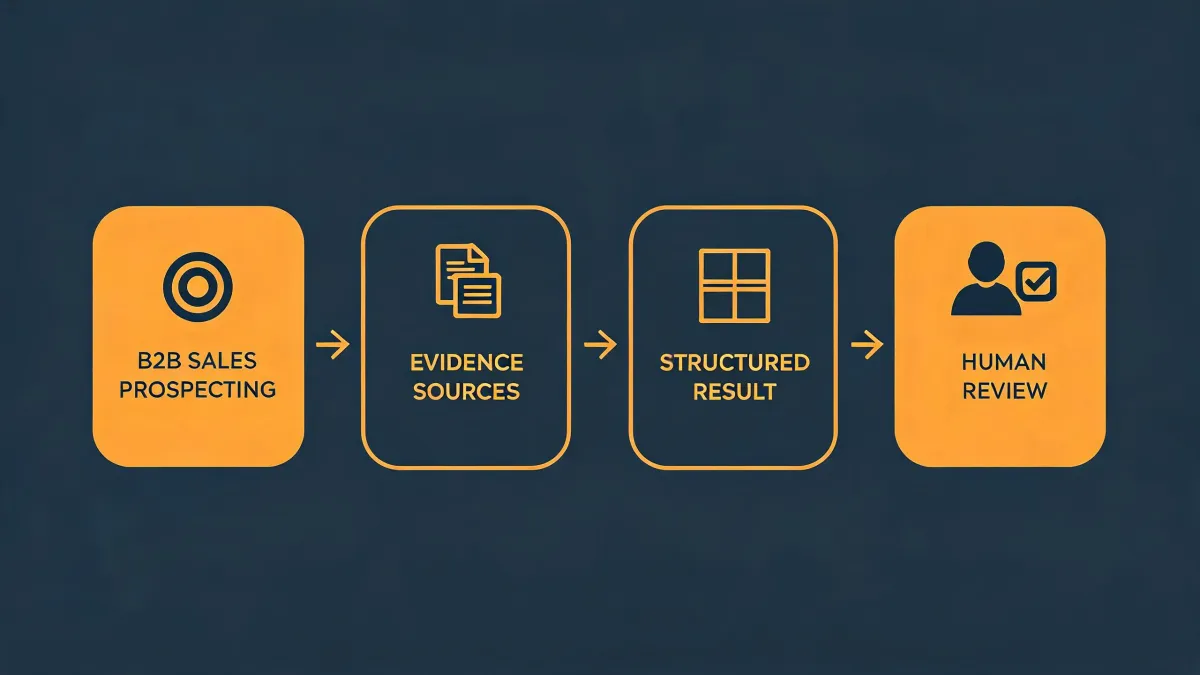
A sample cold email to a potential client is valuable only when it exposes the assumptions behind targeting and the ask, because copied wording cannot compensate for an unearned premise. Start with the evidence that makes the route and recipient appropriate, expose the assumptions behind the wording, and stop when the decision cannot be reviewed.
Read the assumptions before the sample
This sample assumes a business seller has verified three revenue-operations vacancies on a company careers page, offers a bounded routing worksheet, and has not confirmed whether the recipient owns lead assignment. Replace every bracketed fact from a current source. If the role, hiring context, jurisdiction, address, or contact route cannot be defended, do not use the wording. Replace leftover placeholders with a constructed sender block: name, role, organization, and postal address the sample actually uses.
- Observed fact: a dated careers page lists three revenue-operations vacancies.
- Inference: the hiring plan may create a need to review lead assignment.
- Unknown: whether Priya owns lead assignment or the hiring plan.
- Offer: a one-page worksheet mapping two routing handoffs and an exception owner.
- Ask: confirm relevance, refer an owner, or close.
- Stop: objection, opt-out, invalid identity, or unsupported premise.
- Ask a reviewer to highlight every word that depends on the careers-page source; unsupported role, workload, or timing claims are removed before the sample becomes a live draft.
The sample is not a performance claim
It illustrates a reasoning structure. It does not claim that the email will be delivered, opened, answered, or converted, and it is not presented as a customer case. For the sample is not a performance claim, attach each sample variable to its current source, permitted inference, reviewer choice, rejection condition, and recipient-side decision before adaptation. The sample assumes verified career-page hiring signals and a bounded routing worksheet. Copy the decision structure, not the sentences, and replace every fact before any reuse.
Use this complete first email
Subject: Lead routing and the revenue-operations hires. Hi Priya — your careers page lists three open revenue-operations roles. That may put lead-assignment handoffs under review, although I cannot tell whether your team owns them. I can send a one-page worksheet mapping two handoffs and an exception owner. Would that be relevant to your remit, or should I close the loop? — Alex, [company, postal address, and required preference information].
- The subject names the sourced event and workflow.
- The opening attributes the observation.
- “May” preserves the difference between evidence and inference.
- The role uncertainty is stated rather than hidden.
- The artifact has a defined size and purpose.
- The CTA permits relevance, referral, or closure.
- Keep the worksheet available for review before offering it, so “one-page” describes a real bounded output rather than placeholder value.
Why every sentence earns its place
Remove the public release and the reason for contact disappears. Remove the uncertainty and the message overclaims. Remove the defined artifact and the offer becomes vague. Remove the close option and the request becomes more burdensome. For why every sentence earns its place, attach each sample variable to its current source, permitted inference, reviewer choice, rejection condition, and recipient-side decision before adaptation.
Use a different sample for an ownership state
Subject: Owner for CRM assignment rules? Hi Jordan — your integration page documents a new CRM connection. I am trying to identify who reviews duplicate-account assignment before records enter that connection. If another function owns the rule, would you point me there? If it is not relevant, I will close this out. — Alex, [company and required details].
- This variant asks for routing rather than offering proof.
- It uses a different observable fact and recipient decision.
- It does not presume Jordan owns the problem.
- It avoids a meeting request before ownership is known.
- It accepts no reply or closure.
- Do not combine both samples into one multi-CTA email.
- Do not reuse the ownership version when a published route already names another function; follow the documented route instead of asking for a redundant referral.
When the alternative is better
Choose this ownership version when role evidence is weak but the organization-level workflow is verified. Choose the first version when the role connection is stronger and the recipient can evaluate the artifact. For when the alternative is better, attach each sample variable to its current source, permitted inference, reviewer choice, rejection condition, and recipient-side decision before adaptation.
Review data, sender, and wording together
FTC and ICO guidance establish context-dependent duties around accurate presentation, identity, data use, recipients, objections, and opt-outs. Microsoft guidance supports simulating representative leads and reviewing drafts with their research basis. OKKI Go can prepare a draft from approved company and product context, while the person confirms recipient, subject, and body.
- Check actual market and recipient type.
- Retain the source and observation date.
- Remove disputed or stale facts.
- Apply suppressions before drafting.
- Review the subject beside the complete body.
- Reject generated claims that exceed the source.
- Simulate an ordinary fit, ambiguous recipient, stale event, and prior objection; only the ordinary fit should reach final message approval.
Automation does not inherit permission
A system can make the sample fluent and still choose the wrong person or relationship between facts. Human review must decide whether the send is appropriate. For automation does not inherit permission, attach each sample variable to its current source, permitted inference, reviewer choice, rejection condition, and recipient-side decision before adaptation.
Test the decision, not the copied phrasing
Use a small eligible cohort and compare one meaningful decision structure at a time: proof offer versus ownership routing, for example. Keep sender, audience, source quality, and local send window stable. Classify qualified advances, referrals, corrections, objections, and opt-outs with delivered recipients as the denominator.
- Archive both exact messages.
- Show counts beside rates.
- Review whether recipients understood the promise.
- Return factual corrections to the source.
- Use OKKI Go status to separate delivery failures.
- Stop after complaint or suppression failures.
- After classification, compare what the recipient actually answered with the decision the sample requested. If replies repeatedly ask what the artifact contains, the offer was not bounded enough; if they correct ownership, revise the recipient rule before editing tone or adding more follow-ups.
- Compare the samples on qualified dispositions, not on which prose sounds warmer to the internal team.
This sample assumes verified career-page hiring signals and a bounded routing worksheet. Copy the decision structure rather than the sentences, and replace every fact before reuse. Hold sender, audience, and offer stable when you test proof-offer against ownership routing. A sample without labeled assumptions is a costume rather than a teaching object.
Measure qualified advances and corrections, not how polished the paragraph sounds. If the visible evidence cannot support the requested next step, shrink the ask. Do not ask a potential client to buy a whole service from an unverified premise.
The adaptation rule
Copy the order of reasoning, never the unverified facts. A useful sample makes its assumptions easy to replace, reject, and audit before a real person receives it. For the adaptation rule, attach each sample variable to its current source, permitted inference, reviewer choice, rejection condition, and recipient-side decision before adaptation.
Read the assumptions before you reuse a sample. The transferable part is the decision structure, not the finished sentences.
Frequently asked questions
What must a sample cold email declare before the body?
Its assumptions. The sample in this article assumes verified career-page hiring signals, a bounded routing worksheet, and no prior relationship. A sample without assumptions is a costume.
Can I copy the sample wording to another industry?
Only after you replace every fact. The useful object to copy is the decision structure—proof offer versus ownership routing—not the sentences.
What should a potential-client sample ask for?
One next step the visible evidence can support. It should not ask the reader to buy a whole service from an unverified premise.
How do you test a sample instead of admiring it?
Hold sender, audience, and offer stable and change one decision structure. Measure qualified advances and corrections, not how polished the paragraph sounds.