
-
The real question hiding under the permission question
-
How does LinkedIn scraping fit into an agent-native prospecting workflow?
-
Where buying intent signal actually comes from
-
What ignoring the difference actually costs you
-
What to ask when you evaluate Okki Go alternatives for agent-native prospecting
-
The actual answer
If you have typed 'what permissions does Okki Go require' into a search box, you are probably not overthinking it. I did the same thing in October 2025, with one tab open to a permission matrix, another tab open to our compliance checklist, and a prospecting deadline that felt like it was measured in hours. The short answer was easy to find.
Okki Go needs access to the places where your sales work already happens. In a standard setup, that means read and send access to Gmail or Outlook, a LinkedIn connection through a browser extension, and calendar access for booking. Depending on the plan, it can also ask for CRM read/write access and permission to store enrichment fields. The exact list changes by configuration, which is why the consent screen is still the only reliable source of truth.
Actually, no. Let me correct myself before that paragraph reads like an endorsement. Permission lists tell you what a tool could touch. They do not tell you why it needs to touch it. And after four years of building outbound data stacks for B2B sales teams, I have learned that the 'why' is where most AI SDR evaluations go wrong.
The real question hiding under the permission question
For context: I have handled data operations for roughly 130 prospecting rollouts, mostly for SDR teams at B2B SaaS companies. The teams that called me were usually in the same position you are in right now. A launch date is fixed, the list is due at the end of the week, and someone at the top just discovered that the current tool cannot tell a buying intent signal from a job title.
Here is the pattern I keep seeing. A tool requests a huge set of permissions not because it is a powerful agent, but because it is designed to borrow your identity and collect the information it needs. When a product is built on LinkedIn scraping, it needs your LinkedIn. When it wants to send email, it needs your Gmail. When it wants to book meetings, it needs your calendar. The permission prompt is a symptom, not an explanation.
I am not singling out Okki Go here. Every AI SDR in this category should have to justify why it asks for what it asks for. The better question is not 'what permissions does Okki Go require.' The better question is: what is the permission actually for, and what happens to the data it collects?
How does LinkedIn scraping fit into an agent-native prospecting workflow?
Let's talk about LinkedIn scraping, because that is usually the part that makes compliance nervous. A tool with LinkedIn access can search on your behalf, visit profiles, and extract names, titles, and company information. From the outside, it looks like a researcher working faster. The hidden part is that those actions are happening under your session, on your account, and against LinkedIn's rules.
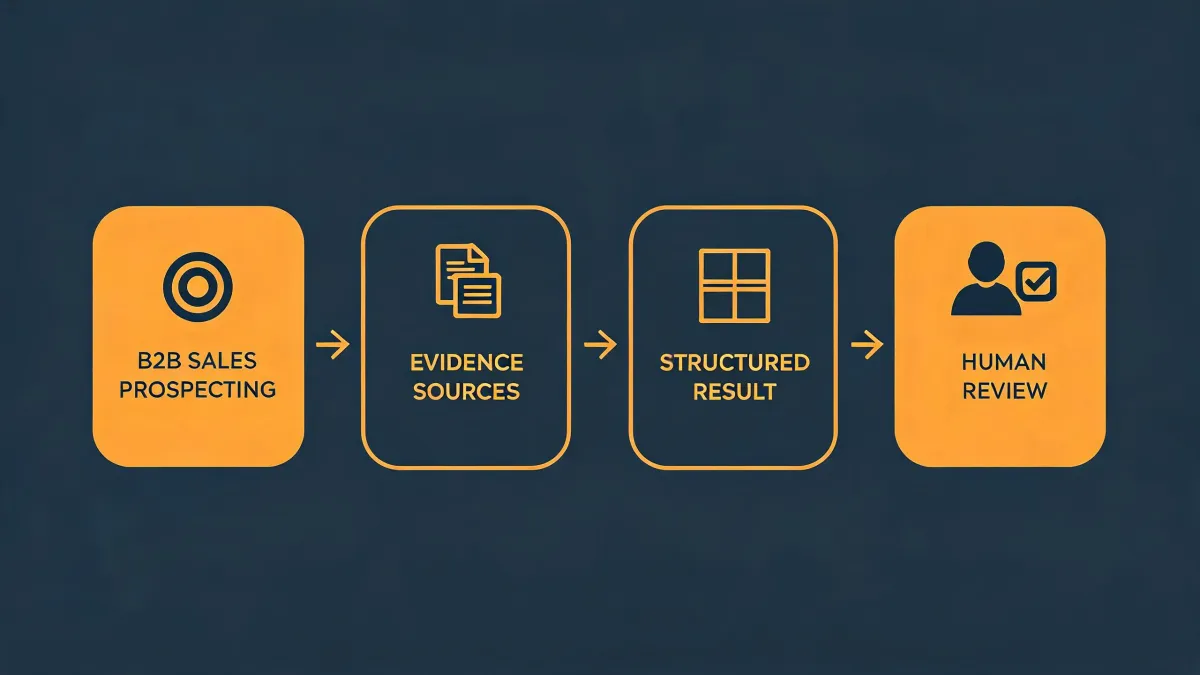
So how does LinkedIn scraping fit into an agent-native prospecting workflow? In a true agent-native workflow, it does not belong in the front seat. An agent-native system receives a research goal—find accounts like these, identify buying intent signals, enrich decision makers, verify emails—and then executes that plan against integrated data sources. It can use search, public data APIs, enrichment providers, and intent data. It does not need to borrow your personal LinkedIn account to function.
That is the difference between a native agent and a robotic wrapper. A robotic wrapper automates the steps a human would take, including the steps that put a human account at risk. A native agent works at the data layer.
LinkedIn scraping can still play a narrow role. It can help with contact discovery after intent is confirmed. If you already know an account is in-market, searching LinkedIn to find the right buyer is useful. The problem starts when scraping is the only source for both who to contact and whether to contact them. That gives you accuracy on job titles and zero visibility into buying behavior.
Where buying intent signal actually comes from
A buying intent signal is a behavior that suggests active purchase research. It might be a spike in searches around a specific problem. It might be multiple employees from the same account visiting your pricing page. It might be heavy consumption on review sites or content from competitor comparison pages. Some signals are first-party, meaning you see them in your own analytics. Others are third-party, collected and sold by buyer intent data providers.
Buyer intent data providers include platforms like 6sense, Bombora, G2 Intent, Madison Logic, and others. I am not going to pretend I have run identical head-to-head tests on all of them. What I can tell you is what the data looks like in practice.
A scraped LinkedIn profile can tell you that someone is a Head of Revenue at a 180-person cybersecurity company. It cannot tell you if that company is actively researching AI sales tools, whether budget has been allocated, or whether they just moved off a competitor. Those are intent signals. A title with the lights on is not an intent signal.
I remember the moment this clicked. In Q3 2025, I had two lists side by side for the same ideal customer profile. One list came from a tool connected to a founder's LinkedIn. Every lead had a relevant title and a company in our ICP. The other list came from an intent-based workflow. It was smaller and messier, and it included accounts where the real decision maker was not obvious. The first list looked better on paper. The second list produced conversations.
Why? Because the second list had something the first one did not. It had a reason to believe the account was looking. It had a buying intent signal attached to every row. The first list was full of people who matched a persona but were not in-market. Buyer intent providers would tell you that is the norm. Somewhere around five percent of your ICP accounts are actively in-market at any given moment, a rule that 6sense has popularized in buyer intent discussions. I can't vouch for the methodology in every vertical, but after watching campaigns play out, it matches what I see: most outbound fails because the account is not ready, not because the copy is bad.
What ignoring the difference actually costs you
Let me make this concrete. In November 2025, a client asked us to rescue a pipeline before a Q1 kickoff. Their previous provider had been running LinkedIn scraping for six months under a founder-level account. On paper, the database was full: thousands of leads, all VP or C-level, all with emails attached. In practice, more than 20 percent of those emails bounced when we ran verification, the founder's LinkedIn had been temporarily restricted twice, and not one lead in the entire export carried a buying intent signal.
Was the permission screen the problem? No. The permission screen looked normal. The problem was the architecture. The data lacked context. And we had very little time to fix it because the first sequence was already scheduled.
When you are in triage mode, you think about three things: time, feasibility, and worst case. Time: we had less than two days. Feasibility: we could rebuild the list, but not if we kept using the same data logic. Worst case: we would send another wave of irrelevant emails, burn more domain trust, and spend the next quarter explaining why the 'qualified' leads were not answering.
Here is the uncomfortable finding. The data risk was never in what the tool could access. It was in what the tool was doing with that access. It scraped generic profiles because it had no access to real buying intent. It then labeled those profiles qualified because they had the right title. That was the entire system.
Once I looked at the situation that way, I started evaluating Okki Go alternatives on a completely different dimension.
What to ask when you evaluate Okki Go alternatives for agent-native prospecting
If you search for Okki Go alternatives for agent-native prospecting, you will find plenty of comparison pages. Most of them compare features, pricing, and number of integrations. Those are table stakes. Here is what I actually compare:
- Where does the data come from? If the agent needs a personal LinkedIn login or a browser extension that acts as you, ask why. A native agent should be able to research accounts and contacts through APIs and data partners without borrowing your identity.
- How does it detect buying intent? Does it use buyer intent data providers, or does it only apply firmographic filters? Ask to see one example where an account was included because of an intent signal, not because of a title.
- What does the enrichment process look like? A single enrichment source will miss data and give you stale emails. Agent-native tools usually check multiple providers in sequence, using a waterfall enrichment model, and verify emails before they ever enter an outreach sequence.
- Where is the human? If the agent researches, scores, writes, and sends without a human checkpoint, you have given away too much control. The best setup keeps a person in the loop for final approval.
This set of questions is where okkigo won my team over, and I say that with full awareness that the names are awkwardly similar. Okkigo is not a clone of Okki Go. It is agent-native by design. It uses waterfall enrichment and intent data, it does not require a personal LinkedIn session, and every outreach plan goes through a human review loop. Those are not marketing bullet points. They are the answers to the questions above.
Now the honest caveat. I do not think okkigo is the right fit for every single team. If you are a solo founder who sends 15 emails a day and does not need a complex data stack, a simpler tool may be enough. If you sell into a market where the buying window is externally triggered, like a regulatory deadline, then title-based prospecting can work because timing is already decided for you. But if you run outbound with multiple SDRs and you care about data provenance, agent-native architecture is the difference between a system that gets better and a system that just gets faster at doing the wrong thing.
And if you do decide to compare Okki Go with more agent-native tools, do it side by side. Run the same ICP through both. Check the permission screens. Better yet, check the permission justifications. Then look at the data fields each one returns. That alone will tell you more than any comparison chart.
The actual answer
So, what permissions does Okki Go require? The accurate answer: it depends on your plan, and the consent screen is the source of truth. The more useful answer: do not let the permission question distract you.
Permissions matter less than what the tool does with them. If it scrapes LinkedIn through your account to build lists, you will get titles without buying intent signals, and you will carry the compliance risk. If it is agent-native, it will pull from data partners with the right intent signals, enrich through a waterfall process, verify emails, and ask a human before anything goes out.
The permission dialog is a list of requests. The architecture is the real answer. That is the thing I wish someone had told me before I spent a full week investigating the wrong question.
If you are in the middle of a rushed evaluation, and you probably are, since nobody does this research at leisure, start with the data. Ask how the tool knows a company is in-market. Then ask who does the prospecting: an agent that was built for the job, or a scraper wearing an agent costume?