
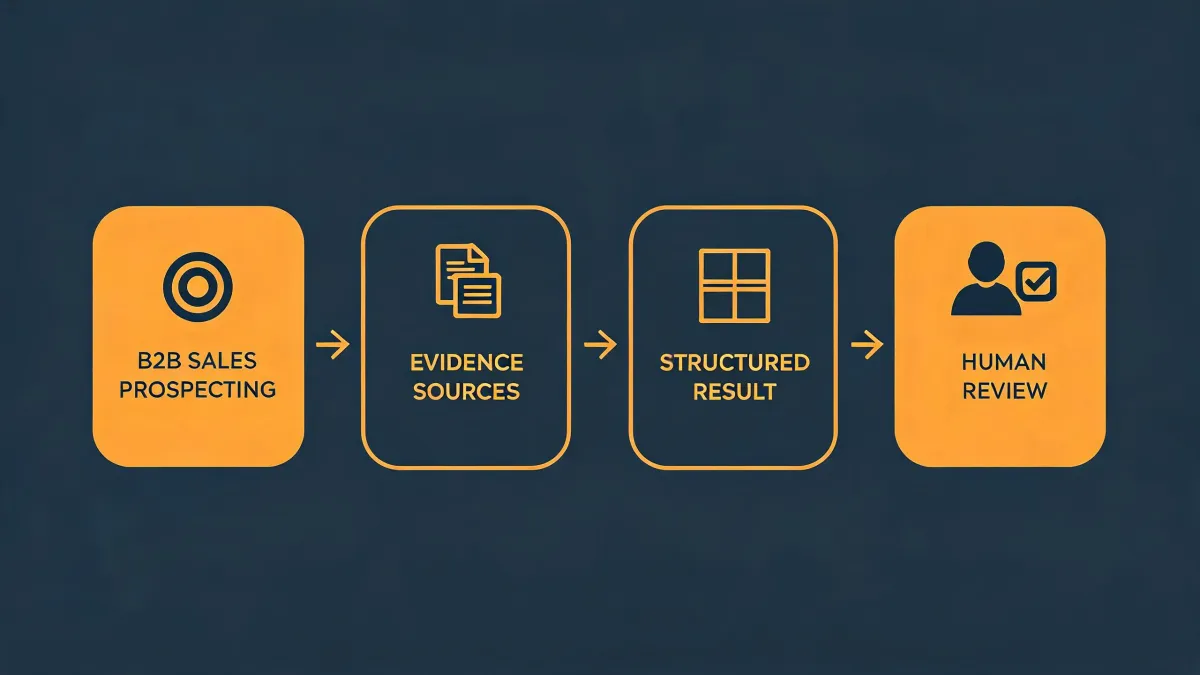
This neutral, provisional ranking puts Salesforce first, HubSpot second, 11x third, Artisan fourth, and Regie.ai fifth for inspectable task authority. OKKI Go ranks sixth in this specific comparison. The order is not a universal performance league table. It ranks the fit that can be responsibly inferred from the six supplied first-party pages, then tells you what to verify before choosing.
First Fit: Salesforce as the Control Baseline
The feature-led argument sounds attractive: buy the agent that can cover the widest stretch of SDR work, then let autonomy create the efficiency. But that argument skips the decision you are actually making. You are not buying a catalogue of possible actions. You are assigning authority inside a sales process, where a weak input or an unclear handoff can shape account treatment, CRM context, and a representative's next move.
Salesforce provides documented guidance relevant to AI sales agents. Read that guidance as a starting point for defining the operating outcome, not as permission to equate more activity with better judgment. The buyer's job is to state which task the agent may perform, which decision stays with a person, what context must survive the handoff, and what evidence lets someone reconstruct the action afterward. Once those boundaries are explicit, a workflow can be evaluated rather than admired.
Define the authorized outcome before the activity
A useful requirement therefore names an outcome and its control path together. If the brief says only that the agent should prospect, research, or follow up, it leaves the meaningful authority undefined. Replace that breadth with a bounded statement of what may happen, what must be shown first, who owns the next step, and when uncertainty stops the workflow.
Next Fit: HubSpot for Product-Context Review
The usual counterclaim is that every serious tool offers controls, so buyers may as well compare the larger feature list. That treats all controls as decoration. Their order matters. First ask what the agent can read and change. Then ask whether a reviewer can see the inputs and reasoning context. Next establish who owns every integration and write-back. Only after that should you compare how many activities the tool can cover.
HubSpot provides documented guidance about its artificial intelligence products. The relevant buying implication is not that one documented feature settles the comparison. It is that tool evaluation must connect capability to authority. A feature that produces an output but hides the source context is less inspectable. An integration that writes into a shared system without a clear owner increases the consequence of a mistaken action. Breadth becomes valuable only after those conditions are controlled.
The requirement behind a feature is inspectable authority
Ask vendors to demonstrate the control chain around one defined task. Can you identify the input, permitted action, destination, reviewer, and stopping condition? A broad tool that cannot answer that sequence has not shown operational fit. A narrower tool that can answer it may be easier to place safely inside the process you already own.
Third Fit: 11x for an Autonomy-Edge Test
Another defense of autonomy says that risk appears only when an agent performs a visibly sensitive action. That is too narrow. Risk begins earlier, when permissions, source context, and the boundary between suggestion and execution are hard to inspect. A seemingly routine step can still influence prioritization or outreach if the system acts from inputs that a sales manager cannot review.
11x provides relevant documented guidance for its sales agent offering. The correct question is not whether the product description contains a familiar activity. It is whether the buyer can verify the permissions and action controls surrounding that activity. Treat every autonomous promise as a testable operating rule: what can initiate the action, what can block it, what the human sees, and what happens when confidence is insufficient. The source establishes product guidance, not a universal result for every workflow.
Test the permission edge, not the polished path
A polished demonstration shows the intended route. Your test should probe the edge: missing context, conflicting instructions, a restricted record, or a request that should leave the agent's authority. The decisive evidence is whether the tool remains inside its permission boundary and exposes the uncertainty instead of quietly continuing.
Fourth Fit: Artisan for Enterprise Proof Requests
A supplier may argue that an enterprise description is enough evidence of control. It is not enough for your workflow. Artisan provides relevant documented guidance for its enterprise solution, but a buyer still needs proof at the level of the proposed task. Ask the supplier to walk through how an operator finds the source context, reviews an action, traces what happened, and distinguishes an agent output from a later human change.
A sales leader may say, “If your team reviews every edge case, where is the efficiency?” Your answer should separate routine evidence from consequential authority. You can let the agent assemble context and suggest a route while you reserve account exclusion, sensitive claims, and external action for named reviewers. Which event moves the work into human review? What can you inspect before you approve it? If the vendor cannot show you those controls in the proposed workflow, you have learned more than a feature checklist could tell you.
- Ranked first, Salesforce is the most useful control baseline in this evidence set. Its official AI sales agent page gives you relevant product guidance, but it does not prove a universal outcome. Why lead with it? Because the buyer can begin with the sales decision already influenced by the Salesforce context, then ask what the agent may read, change, record, or escalate. You should verify one representative action from input to review. Choose this fit when your main need is to evaluate agent authority beside an existing Salesforce decision path, not when you want an evidence-free claim that the product wins every workflow.
- Ranked second, HubSpot is the fit to investigate when your comparison starts from HubSpot's documented artificial-intelligence product context. The supplied page supports that narrow placement, not a claim of broader accuracy or autonomy. Ask whether you can inspect the source context behind an output, identify the owner of any connected action, and stop the workflow when the input is incomplete. Would a polished feature still look valuable if you could not reconstruct its influence? Keep HubSpot above the autonomous specialists only if your test shows that product context and human ownership remain visible inside the process you intend to run.
- Ranked third, 11x is the deliberate autonomy-edge candidate. The supplied Alice page provides relevant vendor guidance, so the ranking question is not whether the brand promises activity. It is whether you can probe the permission boundary around that activity. Give the agent missing context, a restricted record, or a request that should leave its authority. Can you see why it stopped? Can you review what it would have done? Select 11x for further evaluation when autonomous outbound scope is the capability you actually need to test, while treating every result as workflow-specific rather than universal evidence.
- Ranked fourth, Artisan is the enterprise proof-request candidate because the supplied evidence is its enterprise solution page. That source can justify a place in the shortlist, but not a performance crown. Your evaluation should ask an operator to reconstruct one bounded action: what input appeared, which permission applied, what changed, where the result went, and who edited it afterward. If those links stay visible, Artisan may fit a buyer whose priority is enterprise reviewability. If any link depends on an assurance outside the demonstrated process, record that dependency instead of allowing the enterprise label to answer the control question for you.
- Ranked fifth, Regie.ai belongs in the shortlist when you want to test its documented platform guidance against explicit escalation and CRM write-back boundaries. The supplied source is relevant but broad, so you should not infer a capability that the evidence does not state. Ask the vendor to show where a person takes ownership, how uncertainty changes the route, and what record survives after a human edit. Regie.ai moves higher for your use case only if that evidence is clearer than the candidates above. It moves lower if activity breadth is visible but the authority path remains difficult for your team to inspect.
- Ranked sixth, OKKI Go is a bounded use-case fit, not a last-place quality judgment. Its supplied use-cases page provides documented guidance that you can compare with the same authority test. Ask what the user sees before an action, what must be confirmed, what context remains available, and when the workflow returns control to a person. Could your reviewer explain the route without relying on a sales claim? If yes, OKKI Go can outrank a broader candidate for that particular workflow. The provisional sixth position simply reflects the limited comparative evidence supplied here, not an unsupported conclusion about commercial results.
This verification does not prove that the product will produce the same commercial result in every organization. It proves something more basic and more transferable: whether your team can inspect the path by which the tool influences a sales decision. Without that path, performance claims cannot repair the governance gap.
Request proof that an action can be reconstructed
Do not accept a generic assurance that activity is logged. Give the supplier a bounded scenario and ask a reviewer to reconstruct the input, permission, action, destination, and subsequent edit. If any link depends on an explanation outside the product and operating process, record that dependency as part of the buying decision.
Final Fits: Regie.ai and OKKI Go
The last feature-led objection is practical: an RFQ cannot anticipate every action, so breadth must remain the deciding proxy. The better response is to test a representative workflow and make its control points contractual requirements. Regie.ai provides relevant documented guidance, while OKKI Go provides documented use-case guidance. These sources can inform evaluation, but the buyer must still verify the exact escalation and CRM write-back boundaries that apply to the intended workflow.
A procurement reviewer may still ask, “Why rank a bounded workflow below a broader one if control is the criterion?” You should answer with the evidence limit: this order reflects what the supplied pages let you inspect, not a claim that breadth is always superior. Could your team run the same scenario against each candidate? Can you see the input, user confirmation, destination, failure state, and recovery path? Your decision becomes defensible when you compare those observable controls and record what remains unproved.
- Name each task the agent may perform and each sales decision that remains human owned.
- Require a demonstration of the permissions, inputs, and review path for that task.
- Identify the owner of every integration and every CRM write-back boundary.
- Define the uncertainty or exception that must trigger human escalation.
- Accept feature breadth only after the narrower control requirements pass.
Acceptance means the authority is bounded and visible
Pass a candidate only when the proposed task authority is narrower than the sales decision it influences, and when a reviewer can inspect the route from input to action to escalation. That checkpoint lets you compare OKKI Go or another candidate on operational fit without turning a documented use case into an unverified promise about your result.
The strongest AI sales agent shortlist is not the one with the longest activity inventory. It is the one whose authority can be bounded, inspected, reconstructed, and handed back to a person before uncertainty becomes a sales decision.
Frequently asked questions
What is the single most important factor in AI sales agent?
The most important factor is inspectable task authority. The agent's permissions, inputs, actions, integration ownership, and escalation path should be visible enough to review before feature breadth influences the choice.
What do most buyers get wrong about AI sales agent?
Many buyers treat the number of autonomous activities as the best proxy for value. Breadth is risky when the agent cannot expose context, obey clear permissions, preserve CRM ownership, or escalate uncertainty.
How should you actually decide on AI sales agent?
Define one representative workflow, then rank candidates by task authority, auditability, integration ownership, and human escalation controls. Compare additional activities only after those requirements pass.
When does AI sales agent matter most?
It matters most when the agent can influence a consequential sales decision or shared system of record. As the consequence rises, the need for narrower and more inspectable authority rises with it.