
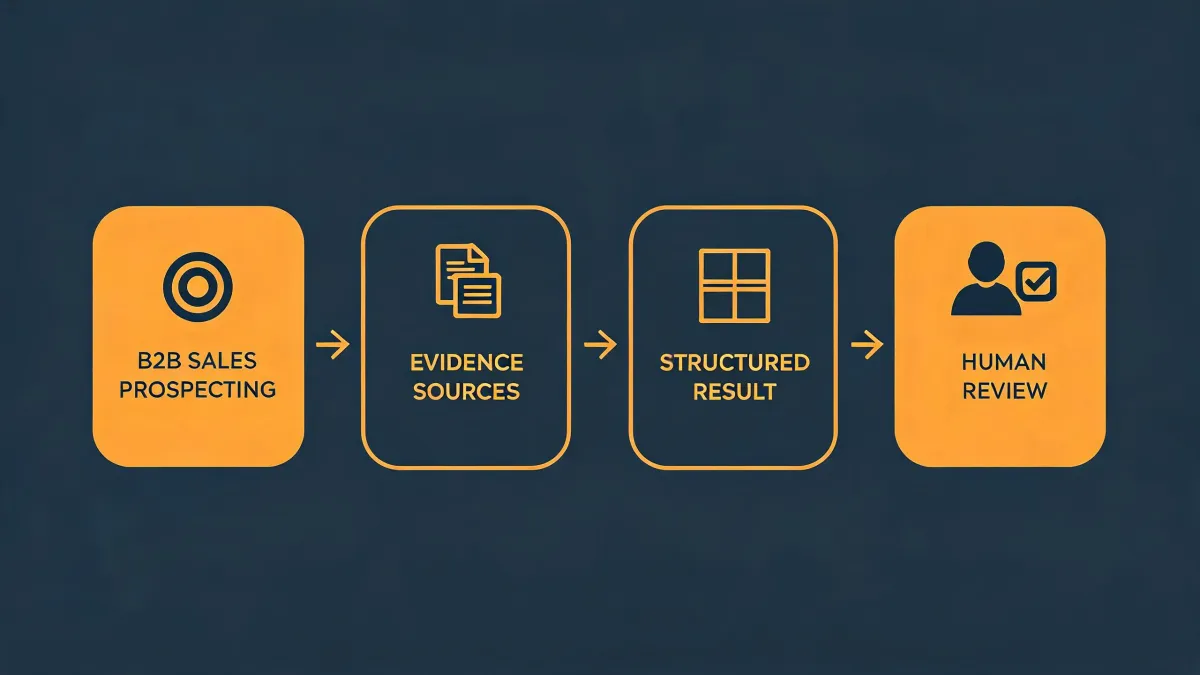
Warm lead generation should define warmth as a documented change in buyer context, not as any prior interaction, because vague warmth labels invite premature sales escalation. A page view, event scan, old reply, or referral can all be called warm, yet they imply very different buyer context. The label needs evidence before it changes sales behavior.
What it is, in one line
Warm lead generation should identify the exact current signal and its limits. HubSpot’s 2026 lead-scoring documentation distinguishes fit, engagement, and combined scores, allows event and property criteria, and supports score decay. That shows how one platform can organize signals; it does not define “warm” for every business. A warm state needs a verified person or company, attributable event, observation date, relevant topic, permission or contact scope, owner, expiry, and the next action the evidence actually supports.
- Signal type and source event.
- Identity, company, role, and match confidence.
- Topic relevance, recency, permission state, and exclusions.
- Allowed follow-up, owner, expiry, and disqualifying evidence.
What belongs inside the definition
Warmth is a documented change in current buyer context, not a synonym for any historical interaction. Record the exact signal, attributable source, observation date, verified identity, relevant topic, permitted follow-up, owner, expiry, and contradiction rule. HubSpot’s lead-scoring documentation shows how one platform can combine fit and engagement and apply decay, but it does not define warm for every business. An OKKI Go workflow may add dated product observations while remaining separate from proof of need, authority, timing, or contact permission.
How it works
Case one, referral: Elena at an existing customer emails, “Nadia at Solace Components asked for your distributor checklist; you may send it to her business address.” The seller verifies Nadia and Solace, preserves Elena’s exact referral, and sends only the requested checklist. Warmth comes from an attributable request, not from Elena’s relationship alone. If Nadia says she did not ask, the seller closes the record and investigates the referral. Case two, event scan: Marcus scans a badge at a trade session, but the event notice covers attendance analytics only. The scan proves presence, not marketing consent or product interest.
- Referral supports the named artifact and person only.
- Event scan supports attendance under the stated collection context.
- Neither signal automatically authorizes an ongoing sequence.
- Contradiction, wrong identity, or objection closes and corrects the record.
The mechanism worth checking
Compare two distinct cases. Elena’s referral says Nadia requested a distributor checklist, so the seller verifies Nadia and sends only that artifact; if Nadia denies the request, the record closes and the referral is investigated. Marcus’s event badge scan proves attendance under the event’s stated collection context, not product interest or ongoing marketing consent. Both can create review tasks, but their allowed next actions differ. Preserve the original event beside any score so a reviewer can see why one limited response is supported and another is not.
Where it stops applying
Case three, old reply: Priya replied “not this year” fourteen months ago. That reply is historical context, not a current warm signal. The record should decay or expire under the team’s policy and remain on hold until a new attributable event occurs. Case four, page activity: an identified account produces several visits to a technical page under an implemented analytics and privacy setup. The activity may justify account-level research, but it does not reveal which person browsed or authorize a personalized email to an employee.
- Old reply retains its date, wording, and hold condition.
- Expiration prevents historical interest from being presented as current.
- Page activity remains at the identity level the evidence supports.
- Research may proceed while person-level contact remains prohibited.
Where the rule stops transferring
Case three is an old reply: six months ago Priya asked to revisit the topic after budgeting. The date arrives, but the seller first verifies her current role, company, topic, and preference; elapsed time may reduce rather than increase confidence. Case four is page activity from a matched account with no verified person. It can support account research or content analysis, not personalized outreach to an invented contact. Apply signal decay and remove warmth when identity, relevance, or recency no longer supports the proposed action.
What people get wrong
Case five, documented current signal: Luis submits a form requesting a Portugal distributor comparison and selects a business follow-up option. The team verifies employer and role, attaches the form version, and routes the request to an owner. Luis is warm for that topic and allowed follow-up, not for every product. If the form is duplicated, one record remains canonical. If the role is wrong, the person can be disqualified even though the request event remains genuine.
- Current request, topic, identity, and displayed choice are attributable.
- Owner responds with the promised comparison before broadening the ask.
- Duplicate, referral, decline, and opt-out states remain distinct.
- Later opportunity status does not rewrite the original signal.
The tempting interpretation to reject
Case five is a current form request from Omar for a named compliance worksheet using a verified business address and explicit delivery scope. It is the strongest immediate-review example because the signal is current, attributable, topical, and bounded. Even here, deliver the requested worksheet before assuming a broader sales sequence. Record a bounce, objection, wrong-company correction, or changed preference as a state change. A high score cannot override contradictory evidence, transform an artifact request into budget, or make permission broader than the collection context.
How to apply the judgment
Set a warm threshold only after reviewing false positives and false negatives. Test a referral, scan, old reply, page event, and current request before activation. Review how score changes when events age, identities split, permissions change, or a record is suppressed. ICO guidance is relevant to UK direct marketing within its scope; other markets require their own review. OKKI Go may support a separately permitted B2B workflow but does not prove signal identity, warmth, permission, or outcomes.
- Preview distribution and inspect records near the threshold.
- Use decay or expiry for signals whose relevance changes with time.
- Retain event history, score version, correction, and reviewer decision.
- Keep suppression and opt-out outside any positive scoring override.
The next decision checkpoint
Review warm states weekly against five questions: is the person or account still verified, is the signal current, does the topic match, what action is actually allowed, and what would close or downgrade the record? Compare referral, event, old reply, page activity, and current request separately instead of blending them into one response rate. The final OKKI Go checkpoint stays limited to the observed configuration and date. A defensible program can trace every priority to its event and reverse that priority after new evidence. Keep a short reason code beside every downgrade: expired signal, unverified identity, changed role, topic mismatch, objection, or fulfilled request. Reviewers can then see whether the program is generating current context or carrying historical engagement indefinitely. When a new event arrives, link it to the old record without erasing the earlier limit. The new event must earn its own action; it does not retroactively broaden what the prior signal allowed.
A warm state remains useful only while its original signal, identity, topic, and action scope remain visible. Keep separate reason codes for expiry, role change, mismatch, objection, correction, and fulfilled request. When a new event arrives, link it without erasing the earlier limit and require the new event to earn its own action. Weekly review should prevent historical engagement from becoming permanent priority.
Frequently asked questions
What most decides warm lead generation?
Warmth should be assigned only when a current, attributable signal changes verified buyer context and supports a clearly bounded next action.
What should be checked before a warm lead generation action?
Review the original event, identity confidence, topic, observation date, collection context, allowed response, expiry, contradiction rule, and owner.
What is a common warm lead generation mistake?
The usual mistake is letting an old interaction or rising score override stale identity, topic mismatch, an objection, or a fulfilled one-time request.
When should warm lead generation stop?
Downgrade or close the state when the signal expires, the person or company cannot be verified, relevance changes, or the supported action has been completed.