
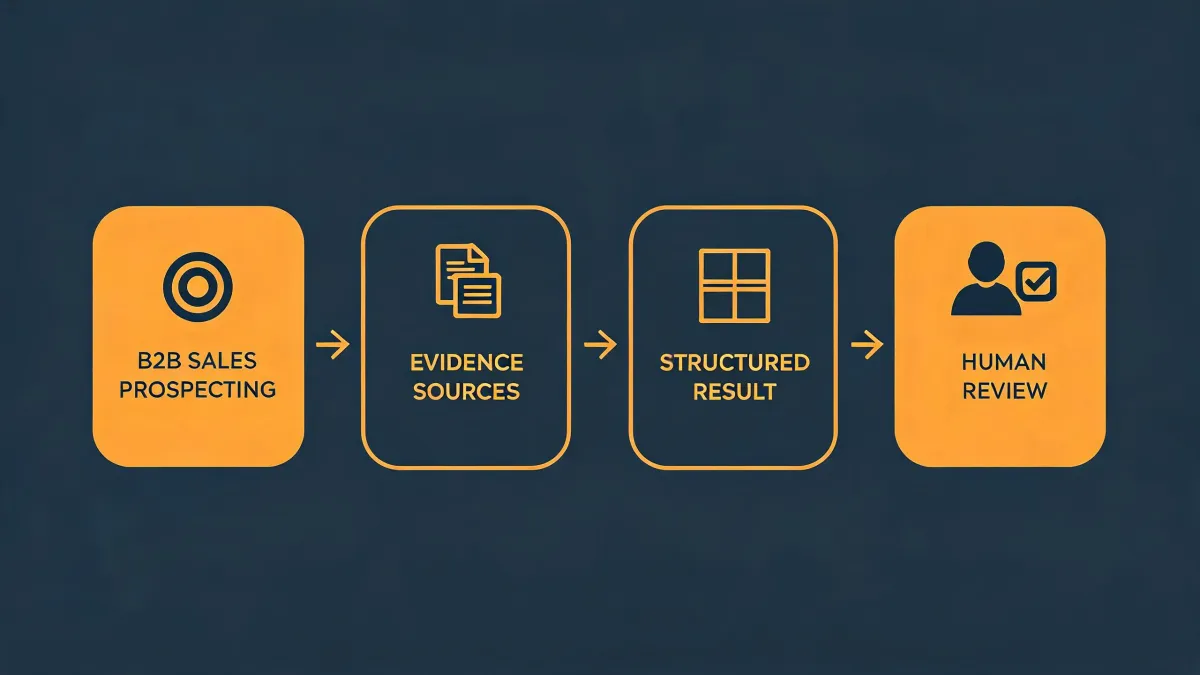
Learning how to cold email should begin with deciding who not to contact, because relevance is created by exclusion before it is expressed in copy. Start with the evidence that makes the route and recipient appropriate, expose the assumptions behind the wording, and stop when the decision cannot be reviewed.
Exclude, research, and define one decision
Learning how to cold email starts with deciding who should not receive the message. Write the target company, operating context, role, geography, exclusions, and stop states. Then find one current observation that makes a business question plausible. Separate the observation from your inference, and choose the smallest recipient decision that can confirm, correct, route, or decline it. Write exclusions and sender checks before copy. The first cohort should be small enough that every assumption is still recoverable.
- Exclude companies outside the supported market or product fit.
- Exclude recipients whose role connection cannot be verified.
- Suppress prior objections and invalid addresses.
- Record the source and observation date for the company fact.
- Write the inference with “may” rather than turning it into a diagnosis.
- Choose one ask: confirm relevance, route ownership, inspect proof, or decline.
- Keep the proof burden proportionate to the ask.
- Stop when identity, relevance, or contact context remains unresolved.
- Search for a current company source, then record exactly which sentence in that source supports the observation used in the message.
- Check the recipient role against a current employer source and leave ownership uncertain when the evidence does not establish it.
- Write one reason the record should be rejected; if no reviewer can imagine a stop state, the eligibility rule is too permissive.
- Decide who will receive a referral or correction before any email enters the sending queue.
Write the eligibility record
For each candidate, store the company fact, source, date, recipient role, reason that role is relevant, permitted next action, reviewer, and rejection reason. A later operator should reproduce the send decision without reading the writer’s mind. For write the eligibility record, keep the source, eligibility decision, exact message, human reviewer, recipient response, and next-cohort correction together so the tutorial remains operational. Write the exclusion list and the mailbox checks before the first paragraph. A finished draft cannot repair an ineligible recipient or an unready sender.
Move from observation to a bounded offer
A public expansion announcement may justify asking about a workflow affected by expansion. It does not prove the company has a problem, budget, or active project. Offer an inspectable example or a routing question instead of claiming the missing facts. For move from observation to a bounded offer, keep the source, eligibility decision, exact message, human reviewer, recipient response, and next-cohort correction together so the tutorial remains operational.
Prepare the sender and write the complete email
Check sender readiness before copy. Google publishes authentication and other sender requirements, with additional rules for certain bulk senders. FTC and ICO guidance add obligations that depend on market, recipient, data, and channel. After those checks, write the body in four moves: observed context, cautious connection, bounded proof, and one low-friction request.
- Use an accurate subject that previews the message.
- Open with the verified company observation.
- State the possible workflow consequence without diagnosing pain.
- Offer one relevant artifact or comparison.
- Ask for one decision the recipient can answer quickly.
- Identify the sender and preserve required preference handling.
- Use OKKI Go to review candidate companies before unlocking contacts.
- Confirm the recipient, subject, and body before sending.
- Render the complete message on a narrow mobile screen and confirm that the reason for contact and bounded request appear without an image.
- Send a controlled internal copy to verify identity, subject, body, required details, links, and preference handling.
- Use OKKI Go to prepare the human-reviewed draft only after the company and recipient have passed the eligibility record.
- Remove feature lists that do not help the recipient answer the one requested decision.
A complete first email
Subject: Distributor routing after the Germany launch. Hi Maya — your company’s public release says the distributor program is expanding into Germany. That may create a new routing review, although I cannot tell whether your team owns it. I can send a one-page example showing three exception fields used before first contact. Is that relevant to your remit, or should I close the loop? — Alex, [company and required contact details].
A complete first email: keep the source, eligibility decision, exact message, human reviewer, recipient response, and next-cohort correction together so the tutorial remains operational.
Why this draft is bounded
The message names a sourced event, labels the workflow connection as uncertain, offers a specific artifact, and accepts closure. It does not claim a revenue problem, invent urgency, or demand a meeting before the recipient confirms relevance. For why this draft is bounded, keep the source, eligibility decision, exact message, human reviewer, recipient response, and next-cohort correction together so the tutorial remains operational.
Send a small cohort, route replies, and improve
Release a small eligible cohort whose assumptions are still recoverable. Give replies an accountable owner and classify them as qualified advance, referral, factual correction, objection, opt-out, or noise. Follow up only when it adds information or reduces effort. A repeated request with no new value is not a learning sequence.
- Use delivered recipients as the response denominator.
- Separate provider failures from human silence.
- Honor objections and suppressions across every connected list.
- Correct company or role facts at the source.
- Review which eligibility rule produced each rejection.
- Compare reasons for contact before polishing minor wording.
- Pause after unexplained bounce, complaint, or authentication movement.
- Set a review date and one change for the next cohort.
- Use OKKI Go sending status to separate a provider failure from recipient silence, while a human owner classifies the commercial meaning of every reply.
- When a recipient corrects the company, role, timing, or workflow premise, treat that reply as operational evidence. Update the canonical record, withdraw stale drafts, notify the source owner, and check whether another queued contact inherited the same mistake before launching the revised cohort.
- Read every negative response for an upstream lesson: wrong company, wrong role, wrong inference, wrong timing, or inappropriate contact context.
- Keep the first email and follow-up in the same disposition record so the team can see whether the second touch added information.
- Compare the revised cohort with the same eligibility rule and denominator; otherwise the copy change cannot explain the result.
- Close records whose stop condition arrives rather than extending a sequence to satisfy a planned touch count.
Write the exclusion list before the first paragraph of the email. Finish mailbox authentication and the reply path before you increase cohort size. Classify the first-cohort replies before you increase volume. Wrong-role replies and unverifiable claims are rewrite signals, not send-more signals.
A materially different follow-up
Subject: Closing the distributor-routing note. Hi Maya — I sent a note about the Germany expansion and a three-field routing example. I have not confirmed that this belongs with your team, so I will close the thread after this message. If another owner handles it, a name is useful; otherwise no reply is needed. — Alex. This follow-up reduces obligation and supplies a clear stop.
A materially different follow-up: keep the source, eligibility decision, exact message, human reviewer, recipient response, and next-cohort correction together so the tutorial remains operational.
Learning how to cold email starts with exclusions, sender readiness, and a recoverable first cohort. Wording is a later step.
Frequently asked questions
What is the first step in how to cold email?
Write who should not receive the message: company, operating context, role, geography, and exclusions. Copy comes after the exclusion list.
What sender checks come before drafting?
Authentication and other current sender requirements, plus accurate identity and a working reply path. A finished paragraph cannot repair an unready mailbox.
How large should the first cohort be?
Small enough that every assumption is still recoverable. Give replies an owner and classify them before you increase volume.
When should you rewrite instead of send more?
When the first cohort shows wrong-role replies, opt-outs, or claims the recipient cannot verify. Volume will not correct a broken decision.