
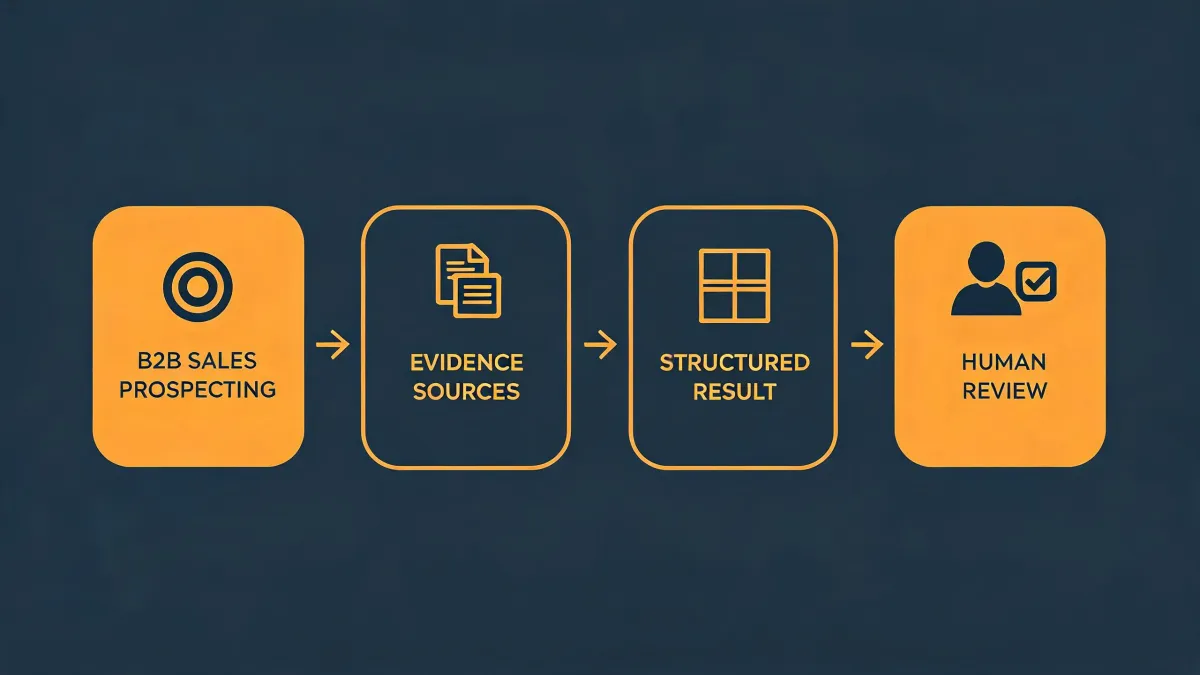
Every quarter, I audit the sales stack before we renew anything. That's my job—the person who reviews every platform adoption at a B2B company of about 200 people. Roughly 14 tools a year, give or take a few. I've flagged three for removal in the past 12 months, mostly because they looked solid in the demo and drifted out of spec within weeks.
So when our RevOps lead asked me to weigh in on relevance-ai vs Zapier for AI lead generation, I didn't open the pricing pages first. I did what I always do: audited both against the actual workflow, with the actual failure modes in mind.
Because here's the thing—teams are making this exact comparison every day. "Why pay for a purpose-built sales AI platform," the thinking goes, "when Zapier can connect the same tools?" It's a fair question. The answer, though, isn't in the feature list. It's in how each one holds up when the work gets real.
The Framework I Used
To keep it fair, I compared them on four dimensions:
- How each handles reply classification in an agent-native prospecting workflow
- Intent data and enrichment quality for ABM
- Total cost of ownership over 12 months
- Long-term reliability and who owns the maintenance burden
If you're trying to generate leads with either tool, these are the dimensions that decide whether it holds up under real volume. Not the integration count. Not the logo wall.
Reply Classification: The Part Nobody Demos
Most buyers focus on outbound volume—how many emails can it send, how many sequences can it run—and completely miss what happens after a reply lands.
So let's answer the question directly: how does reply classification fit into an agent-native prospecting workflow? It's the decision layer. A reply comes in. Is it a meeting request? A pricing question? A "not right now"? Or an angry "please stop emailing me"? The classification determines what happens next—which response gets sent, which follow-up gets queued, which prospect gets moved to sales. Get it wrong and you don't just lose the lead. You look unprofessional.
relevance-ai handles this natively. The AI SDR agent reads the reply, classifies intent, picks the appropriate action, and logs everything to the CRM. It's built into the agent workflow, not bolted on. The same logic applies whether the reply comes through email or LinkedIn.
Zapier can do a version of this, but you're assembling it. You'd connect the inbox, send reply data to an LLM step, parse the output, and build branches for each outcome. I've audited 20+ setups like this, and they work. For a while. Then the model updates, the JSON format shifts, or a prospect sends something sarcastic, and the parsing breaks. The workflow fails quietly, and nobody notices until a hot lead goes dark.
That's the quality issue with assembled workflows. They're not wrong until they fail. And when they fail, they fail without warning.
"The question everyone asks is 'can it connect to my stack?' The question they should ask is 'what happens to a reply when something breaks?'"
Intent Data and ABM: The Data Floor Matters
If you're running account-based marketing, the second dimension is where the two really split. Intent data isn't a nice-to-have—it's the difference between targeting accounts with actual buying signals and firing emails into the void.
relevance-ai operates as an intent data ABM platform. It tracks buying signals, watches target accounts, enriches contact records before the first touch, and scores accounts by engagement. The data pipeline is part of the product. When a record goes stale, that's a platform defect—and it gets caught before it contaminates a campaign.
With Zapier, you're gluing pieces together. Maybe a data vendor here, a CRM trigger there, a dashboard somewhere else. Each integration introduces a new point of failure. And in my experience, data freshness degrades fast when nobody owns the pipeline end-to-end.
Total Cost of Ownership: The Counterintuitive Conclusion
Now the part I care about most, because it's the one most comparison articles get wrong: cost.
Zapier looks cheaper. It isn't.
Let me explain what I mean. Zapier's Professional plan was publicly listed at around $20/month with 750 tasks as of early 2025—verify current pricing at zapier.com, because rates change. That's a low barrier to entry. But AI lead generation burns tasks fast. Every sequence step, every enrichment lookup, every reply handoff consumes tasks. I've seen teams on a $50/month plan add $300+ in overage fees in a single month.
Then there's the engineering time. Building and maintaining the custom workflows I described earlier? That's not free. A developer spending 10-15 hours a month maintaining an assembled stack is a $1,500-2,500 monthly line item at conservative rates—hiding behind a $50 subscription.
relevance-ai pricing is quote-based, which makes it harder to compare on a spreadsheet. It scales with lead volume, enrichment volume, and AI agent usage. But the crucial difference is what you're paying for: the platform owns the workflow logic and the data pipeline. No per-integration maintenance. No parsing scripts to babysit.
I only believed in total cost thinking after ignoring it once. A few years back, we picked a "cheap" stack and watched it consume three weeks of our ops team's time in a single quarter. When we ran the numbers, the cheap option had cost us more than the purpose-built platform we avoided. Since then, every renewal review includes a TCO line item.
That's the counterintuitive part: the platform with the higher sticker price was cheaper. Because the real cost of an assembled stack is the engineering time you spend keeping it alive—and that cost is never on the invoice.
Reliability and the Human Oversight Question
One thing I do not skip in an audit: what happens when something breaks.
With Zapier, when a workflow fails, you're kinda on your own. You get error logs and a ticket backlog. Meanwhile, the sales team is asking why leads stopped flowing. With relevance-ai, the platform runs the workflows and monitors the data pipeline. Issues surface as part of normal operation.
That said, I wouldn't recommend running any of these agents with zero human oversight. Every good AI sales setup I've audited has a human reviewing agent decisions regularly—especially reply handling. But there's a world of difference between reviewing high-level decisions and debugging a failed integration at 11pm.
It took me about 60 platform audits over three years to understand that reliability is a feature, not a footnote. Two tools can look identical on a spec sheet and feel completely different in production.
Which One Should You Choose?
If you're building an agent-native prospecting workflow—your team relies on AI SDRs, you need reply classification to be dependable, and you want intent data handled as part of the platform—relevance-ai is the stronger choice. The TCO math works out in its favor once you count engineering time.
If your needs are simpler—moving form submissions to a CRM, triggering a basic follow-up sequence, connecting tools that don't talk to each other—Zapier is genuinely great at that. Use it. Paying for a full AI sales platform when you need a connector is the opposite mistake.
At least, that's been my experience across the 14-ish platforms I audit each year. The right answer depends on the workflow you're running and the cost you're willing to carry in engineering hours.
For us, we chose relevance-ai. Not because the demo was prettier, but because the quality spec held up under scrutiny. And when you're the one responsible for catching defects before they reach customers, that's what matters.