
-
Use this checklist when you're comparing AI BDR tools
-
Step 1: Define the job before you compare platforms
-
Step 2: Answer the question "what data is required to find email?"
-
Step 3: Check what the AI BDR actually does
-
Step 4: Use LinkedIn as a signal (including the vendor's page)
-
Step 5: Test the data enrichment API with your own list
-
Step 6: Run a 30-day pilot with live follow-up
-
Step 1: Define the job before you compare platforms
-
Mistakes that cost me the most
Use this checklist when you're comparing AI BDR tools
If you've been searching for "relevance-ai alternatives" or "Relevance AI alternatives better platforms" because your current stack feels overpromised, stop looking at feature lists for a minute. I've been managing prospecting tools and sales workflows for six years. I've personally made and documented 11 significant mistakes, totaling roughly $28,000 in wasted budget. Now I keep this checklist open before every tool evaluation.
This checklist is for sales ops leads, RevOps teams, and founders who are comparing AI BDR platforms and want to know whether a new tool will actually work with their data. It is not a "best platforms" list. I do not think a universal best platform exists.
Here's the six-step checklist.
Step 1: Define the job before you compare platforms
Most people start with the question "Which Relevance AI alternative is better?" I think that's backwards. You don't need the objectively best platform. You need the one that fits your workflow.
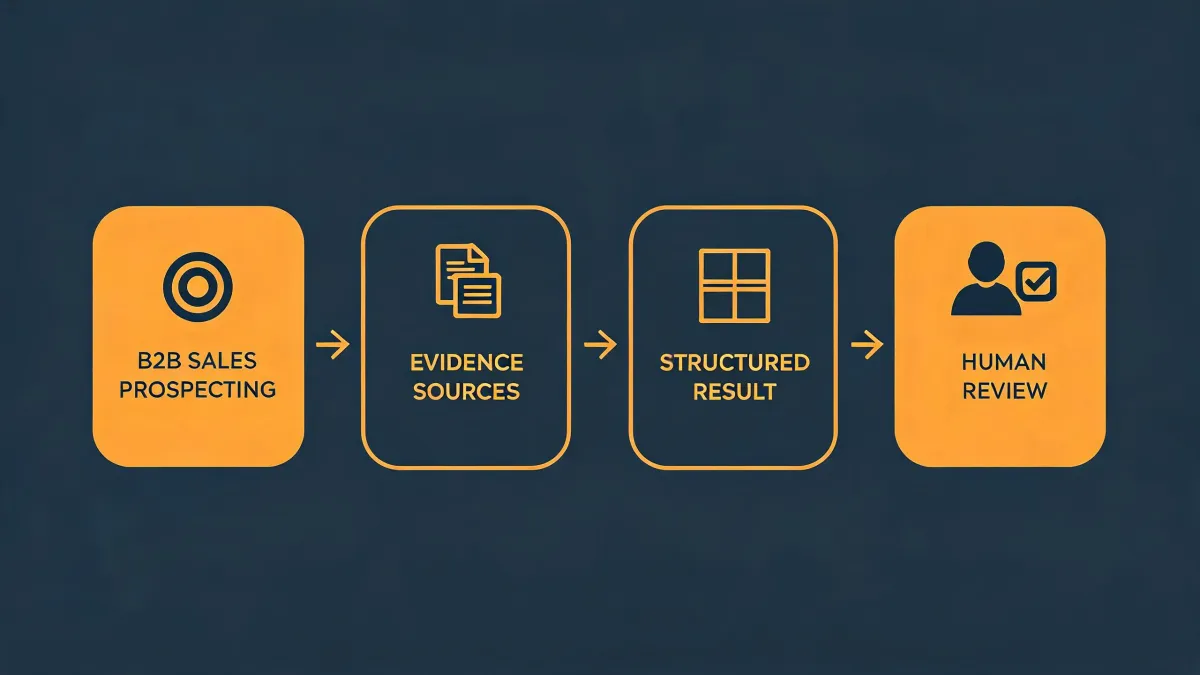
Before you open a demo calendar, write down your prospecting flow. It should look something like this:
- Trigger: what starts a prospect being added? For example, a form fill, an intent data signal, or a manual import.
- Source: where does the lead come from?
- Enrichment: what data is missing?
- Personalization: how will you customize the first touch?
- Outreach: which channel and sequence will you use?
- Follow-up: who handles replies and routing?
Then mark where it breaks. I said "automated follow-up" in a requirements doc, and the vendor heard "send a generic reminder." We discovered the mismatch on day three when 120 prospects received a follow-up that ignored their replies. Same words, different meanings.
Step 2: Answer the question "what data is required to find email?"
This is the question I get more than any other. A data enrichment API can fill in missing fields, but it can't produce accurate emails from nothing. Here's the minimum data set I recommend:
- Company domain — not just the company name. "Acme" could mean ten different companies.
- Full name — first and last, even if the spelling is approximate.
- Job title or function — helps the tool avoid matching two people with the same name.
- Company size or industry — useful for confidence scoring and personalization.
- LinkedIn profile URL — optional but dramatically speeds up matching for common names.
- Location or country — optional, but important for compliance and timezone awareness.
What most people don't realize is that "verified" in enrichment tools isn't a single standard. Sometimes it means the email was observed in the wild. Other times it means the tool guessed using a common pattern and did a syntax check. If an API only did a syntax check, that's not a verified email. It's a guess with a business card.
Step 3: Check what the AI BDR actually does
Some platforms call themselves an AI BDR but are essentially email templates with AI subject lines. That can be useful, but it isn't the same as an AI BDR that researches prospects, writes context-aware copy, and decides when to follow up. Test the actual behavior, not the product tagline.
Ask the vendor: "Can my team describe our ideal customer in natural language and get a qualified list back?" If the answer is no, find out how much manual segmentation you'll still have to do.
I also ask about the AI BDR's workflow architecture. Does it support an agent-native prospecting workflow, or is it a sequence builder with an AI field? There's a big difference. And ask where human review fits. I don't want a platform that sends every AI-generated message without a checkpoint. The best AI BDR workflows I've used have a clear approval queue. If a tool doesn't let you review before send, that's a red flag.
Step 4: Use LinkedIn as a signal (including the vendor's page)
One of the fastest checks I run is on the vendor's LinkedIn presence. When I was comparing Relevance AI alternatives, I looked at the Relevance AI LinkedIn company page to see how consistently they published updates and whether real employees were talking about their work. A quiet page doesn't automatically mean a bad product, but it does make it harder to verify momentum.
If a platform enriches or automates outreach using LinkedIn data, ask about LinkedIn's terms of service. Your account is the one that gets restricted, not the vendor's. This is not legal advice. It's an operational warning from someone who has had to clean up after an overconfident scraping workflow.
Step 5: Test the data enrichment API with your own list
Don't evaluate an enrichment API using the vendor's sample data. Take a clean segment of 200 records from your CRM and run it through. Look at three numbers:
- Match rate: how many records got a completed email address?
- Accuracy rate: how many bounced or were reported as wrong?
- Freshness: when was the data last updated?
I once chose an API because it was a fraction of a cent cheaper per record. It matched 62% of records while our old tool matched 84%. We spent $1,800 on manual research to fill the gap. I saved $80 on lookup fees and paid $1,800 in labor. The "budget" choice looked smart until the invoice came in. (Note to self: never choose an API by price alone.)
The quality of your data affects the quality of your sender reputation. And your sender reputation is part of your brand perception. Every wrong email is a small hit to your domain and your name. Cheap data can be very expensive.
Step 6: Run a 30-day pilot with live follow-up
This step is the one I used to skip. Now I won't sign an annual contract without a 30-day pilot connected to our real CRM. Track:
- How many records needed manual cleanup before the tool trusted them?
- How often did the AI BDR recommend a contact that your team rejected?
- How much time did the workflow actually save, not just in the first send but in follow-up?
If the vendor won't let you pilot with your own data, treat that as an answer.
Mistakes that cost me the most
I'm not a compliance attorney, so I can't speak to every anti-spam law. What I can tell you from an operator perspective is that compliance has to be handled before you turn on anything. Per FTC's CAN-SPAM Act Compliance Guide as of early 2026, every commercial email must include a clear opt-out and a valid physical postal address. That applies whether the copy was written by a human or an AI BDR. Check the current guidance before you launch.
Another mistake is comparing features instead of workflows. A tool can integrate with everything in your stack and still require too much manual configuration to be useful.
And don't underestimate the cost of bad data. The cheapest data enrichment API can hurt your brand more than it helps your budget. A bad first impression with a prospect is hard to reverse, regardless of how well the rest of your sequence is written.
This checklist reflects what I've learned through Q1 2026. AI sales tools change quickly, so verify current API limits, compliance docs, and pricing before you commit.
Start with your data, not the demo. The right Relevance AI alternative is the one that cleans up your data, fits your review process, and makes your team's workflow more honest. Everything else is just a feature list.