
-
The Real Disadvantages of Relevance AI Platform
-
What This Checklist Is For
-
Step 1: Define the Workflow Before You Compare Pricing
-
Step 2: Check the Relevance AI Official Website and Pricing
-
Step 3: Choose Contact Data Providers by Match Rate, Not Price
-
Step 4: Use an Email Verifier After Enrichment
-
Step 5: What Is a Spam Checker and When Should a B2B Sales Team Use It?
-
Step 6: Build a Human QA Loop Around AI-Generated Emails
-
Step 7: Monitor Sender Reputation After Every Campaign
-
Common Mistakes to Avoid
Look, I'm not saying Relevance AI is perfect. It has limitations, just like every serious sales platform. The disadvantages of the Relevance AI platform usually show up when a team buys the tool before building the operational workflow around it. When I'm triaging a B2B sales stack, I start with the same question every time: how much time do we have before this campaign needs to work? The answer determines how fast we move and where we spend our QA budget.
The Real Disadvantages of Relevance AI Platform
The biggest disadvantage of the Relevance AI platform is that it rewards process-heavy teams and punishes vague ones. Most people don't realize that AI SDR workflows are only as good as the data and the review loop you attach to them. If you feed it a stale contact list, you get fast outreach to dead addresses. If you skip human review, you get generic emails. That is not a reason to avoid the platform. It is a reason to use a checklist.
What This Checklist Is For
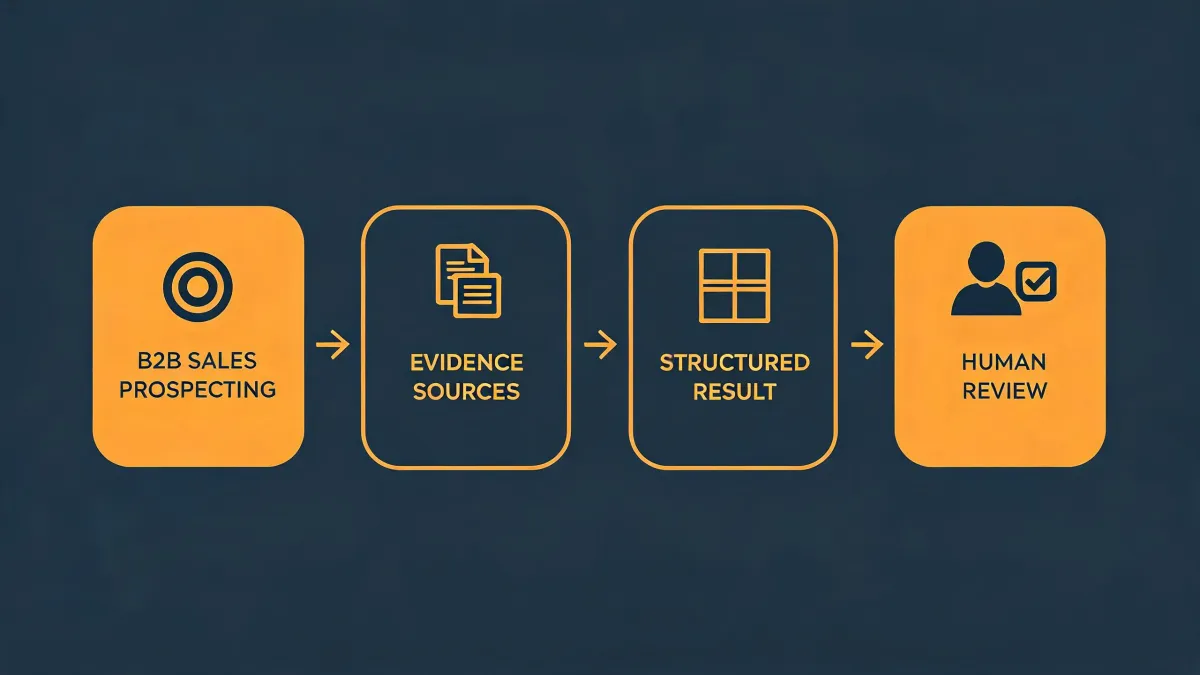
Use this when you are evaluating Relevance AI for AI SDR prospecting, cold email, intent data, enrichment, or LinkedIn automation. It also works if you already subscribed and want to fix results before wasting another month. There are seven steps: define the use case, check official pricing, choose contact data providers, verify emails, run a spam checker, build a human QA loop, and monitor sender reputation.
Step 1: Define the Workflow Before You Compare Pricing
Before you look at plans, write down the trigger, the input, and the output. Example trigger: a new website lead. Input: company domain, job title, or LinkedIn URL. Output: a personalized first email, a reply task, and an opportunity stage update. If you want to use natural-language prospecting, describe the workflow the same way you would describe it to a new SDR. The more explicit the prompt, the less generic the result.
Checkpoint: you can explain the workflow in one sentence without buzzwords. If not, keep simplifying.
Step 2: Check the Relevance AI Official Website and Pricing
Start at relevanceai.com and look for the official pricing page. I won't quote a number here because public pricing has changed over time, and your total depends on seats, AI credits, enrichment volume, and add-ons. Third-party blog posts leave those variables out. If someone says the price starts at a specific figure, confirm it on the official site before you build a budget. Here is something vendors won't tell you: the first quote is not always the final price. Once you know exactly which features you need, ask about annual billing and consolidate seats. That is where the negotiation room is.
Checkpoint: write down the final number and which features are included. If a feature is missing, ask for a custom quote.
Step 3: Choose Contact Data Providers by Match Rate, Not Price
Relevance AI can enrich data and run natural-language prospecting, but it is not a magic data source. If you use a contact data provider with old email addresses, the platform will simply automate your waste. Compare providers by match rate, verification status, and intent fields. I have tested six contact data providers for client campaigns, and the most expensive option was not the best. The winner had fresher role-based email coverage and better source transparency. The price range was about $49 to $500 per month. The $49 option was useless. The $200 option cleaned the list. The $500 option had the lowest match rate on the exact personas we needed.
Checkpoint: test at least 50 records from each provider before you commit to a full upload.
Step 4: Use an Email Verifier After Enrichment
An email verifier checks addresses for syntax errors, bad domains, inactive mailboxes, and disposable providers. Run it after enrichment, not before. Wait—most teams verify before enrichment, and then enrichment overwrites the verified fields. Verify last. In March 2024, a client called 48 hours before a product launch with 9,000 unverified contacts. We stripped out bad domains, re-verified, and ran the campaign with a 1.9% bounce rate. Their alternative was sending to the original list, accepting a 7% bounce rate, and watching the domain reputation drop right before their event.
The most frustrating part is that many verifiers still struggle with catch-all domains. A catch-all domain accepts every address, so the verifier says deliverable. In reality, your email lands in an inbox that nobody reads. Look for a verifier that flags catch-all domains instead of blindly trusting them.
Checkpoint: don't upload to Relevance AI until at least 95% of the enriched list passes verification. In weak data markets, set a lower threshold and remove the worst segments.
Step 5: What Is a Spam Checker and When Should a B2B Sales Team Use It?
A spam checker is a pre-flight test for deliverability. It analyzes the message, subject line, links, SPF, DKIM, DMARC, sender domain reputation, and common content triggers. An email verifier tells you if the address exists. A spam checker tells you if your message is likely to survive the spam filter.
Use a spam checker when you send to a new domain, when you change a template, and when reply rates drop without an obvious reason. Most B2B sales teams skip the sender domain check. They buy a brand-new domain, connect it to their email tool, and assume it is clean. A new domain is not clean. It is unknown. Warm it up, monitor blocklists, and check the domain before it touches a real campaign.
Per FTC guidelines on commercial email (ftc.gov/spam), senders must use accurate header information, a truthful subject line, and a clear opt-out method. If you deploy cold email through an AI SDR, you are still the sender. The platform does not remove your responsibility.
Everyone wants guaranteed replies. No tool can promise that, and a vendor who does is a red flag. What a spam checker does is reduce the risks that put you in the promotions tab or the spam folder.
Checkpoint: run a spam checker until the warnings are gone or explained.
Step 6: Build a Human QA Loop Around AI-Generated Emails
Relevance AI is good at generating first drafts and sequences, but AI outputs still need review. The first impression a prospect has of you is the subject line, the preview text, and the opening sentence. If those feel generic or hallucinated, your brand looks sloppy. I once saw a field merge change a company name to the wrong account. That one mistake made the whole campaign look fake. Review 100% of the emails until the template is stable, then sample 10% to catch drift (mental note: don't skip this on high-volume weeks).
The quality of your output is the quality of your brand. The extra cost of a better review process or a cleaner data source usually pays for itself in reply rate. When I moved a client from budget enrichment to a cleaner provider, the first positive reply arrived within six hours. That simple.
Checkpoint: every email must pass the same test you would apply to a human SDR's first draft.
Step 7: Monitor Sender Reputation After Every Campaign
Sender reputation decides whether your email reaches the inbox. Relevance AI can generate and send outreach, but it cannot fix a domain that spam filters no longer trust. Monitor bounce rate, spam complaints, and blocklist status after every campaign. If spam complaints rise, pause the sequence and fix the list. If the bounce rate jumps, verify the newest imported contacts. The cleanest advice I can give: slow down. A campaign delayed by 24 hours is fine. A domain burned by a bad list is not.
Checkpoint: document pre-send and post-send metrics so you can spot problems before they cost you a domain.
Common Mistakes to Avoid
- Verifying emails before enrichment, then overwriting the records.
- Buying the cheapest contact data provider because the per-row price is low.
- Running a spam checker only once on a template that keeps changing.
- Skipping warmup on a brand-new sender domain.
- Expecting an AI SDR to run with zero human oversight. It should not.
I have mixed feelings about AI sales platforms. On one hand, they feel overhyped. On the other, the teams that follow this checklist get more replies than the teams that treat the platform as a replacement for operations. The difference is not the software. It is the process. Bad data, burned domains, and generic copy are the real disadvantages of Relevance AI. None of them are fixed by clicking a button. They are fixed by the seven steps above.