
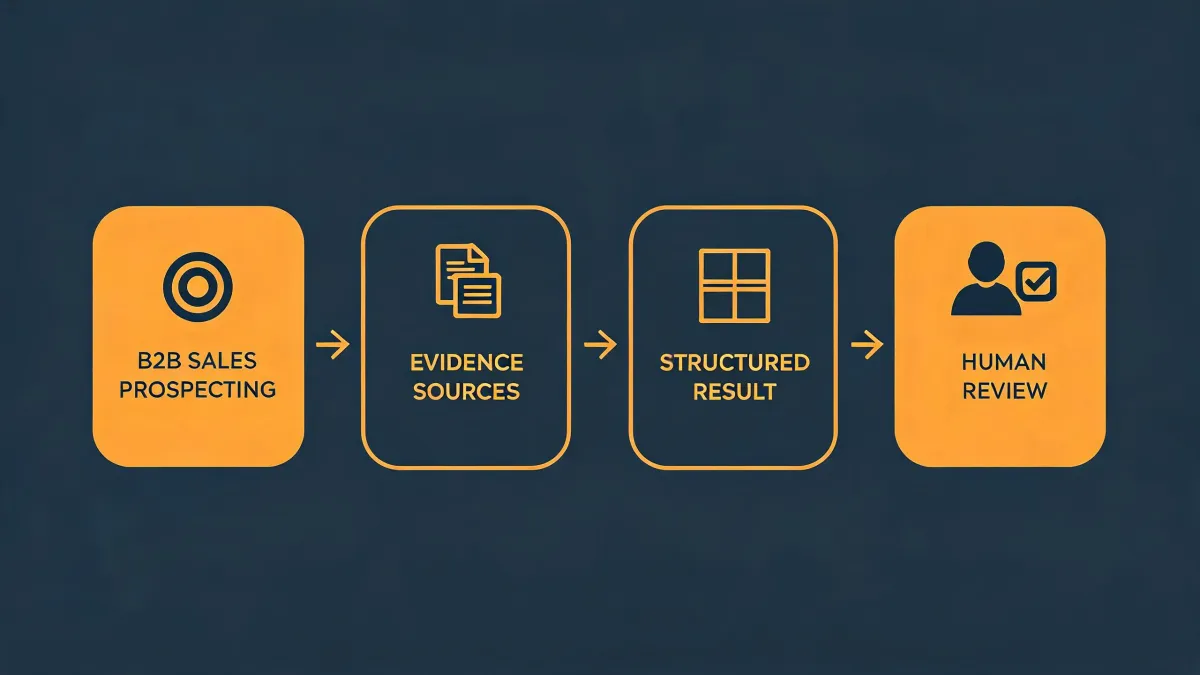
An outbound sales playbook should encode diagnostic choices, not freeze last quarter's scripts into repeatable theater. It should tell a seller what evidence admits an account, how a message hypothesis is formed, when a cadence stops, and how a rejected handoff changes the next cohort.
Prepare a twenty-account learning cohort
You begin by writing one falsifiable market claim and the result that would make you revise it. Drop workshop voice. Keep 15 percent churn and a 50–200 employee band labeled as planning assumptions. The playbook diagnoses the broken transition between hypothesis, research, message, and handoff.
The playbook is a diagnostic, not a kickoff speech. I write one falsifiable claim: 50–200 employee food manufacturers in Ohio will take a 12-minute discovery if the first note cites a dated USDA facility listing. HubSpot’s sales-strategy report and Salesforce’s lead-implementation PDF, both treated as 2026 planning context, do not prove that claim. If 20 researched accounts produce no reconstructable trigger, I stop the cadence and revise the hypothesis. Which transition actually broke last week: research, message, or handoff?
I open the sprint by naming the broken transition, not by cheering the room. On 2026-08-17 I kept The Bridge Group’s 2025 SDR models report as planning context only, and I labeled 15 percent churn plus a 50–200 employee band as assumptions. If the hypothesis does not survive the first 20 researched accounts, the cadence stops.
Our goal isn't just to make calls or send emails; it's to build a repeatable system that scales pipeline, not just noise. This starts with a clear market hypothesis.
Think of it as a testable statement about who we believe will benefit most from our solution, why they need it right now, and what specific problem we can solve for them. This isn't a vague aspiration; it's a specific, actionable idea we're going to put to the test.
Every action we take in this sprint will be designed to validate or invalidate this initial assumption, giving us concrete data to learn from. Your market hypothesis must be specific enough to guide your targeting and messaging.
For instance, instead of 'companies in tech need our product,' a better hypothesis might be: 'Mid-market SaaS companies (50-200 employees) experiencing high customer churn (above 15% annually) will be highly receptive to our customer success platform because it directly addresses their retention challenges by Q3.' This level of detail allows us to define our Ideal Customer Profile (ICP), select accounts, and craft messages that resonate.
It also gives us a benchmark to measure against in our review, helping us understand what worked and what didn't.
Once we have our market hypothesis, the next step is translating it into a tangible Ideal Customer Profile (ICP).
This isn't just a list of industries or company sizes; it's a detailed description of the type of organization that gains the most value from our solution, aligning perfectly with our hypothesis.
We need to consider firmographic data like revenue, employee count, and sector, but also technographic data – what technologies they use – and even intent signals, such as recent funding rounds or hiring trends.
This holistic view ensures we're not just casting a wide net but focusing our efforts where they'll have the greatest impact.
Our ICP informs our account selection process, moving us from a broad market segment to a specific list of target accounts for this sprint.
Use the admission score below: include accounts scoring at least three of four only when no disqualifier is present; the sprint owner records every exception.
This isn't about finding any company that *might* buy; it's about identifying organizations where our solution is a critical need, not just a nice-to-have.
By focusing on a controlled set of 20 accounts for this initial sprint, we can gather focused feedback and refine our approach before scaling. This deliberate selection is key to building a repeatable system and avoiding wasted effort.
Turn research into one message hypothesis
You admit an account only through a scored fit rule and an explicit disqualifier.
- An outbound sales playbook should encode diagnostic choices, not freeze last quarter's scripts into repeatable theater.
- Your market hypothesis must be specific enough to guide your targeting and messaging.
- It also gives us a benchmark to measure against in our review, helping us understand what worked and what didn't.
- Use the admission score below: include accounts scoring at least three of four only when no disqualifier is present; the sprint owner records every exception.
- By focusing on a controlled set of 20 accounts for this initial sprint, we can gather focused feedback and refine our approach before scaling.
With our target accounts in hand, the real work of personalized engagement begins with thorough account research.
This isn't just about finding a contact's name and email; it's about uncovering relevant triggers, challenges, and initiatives that allow us to tailor our message.
We're looking for recent news, earnings reports, leadership changes, project announcements, or even public social media discussions that indicate a pain point our solution addresses.
Salesforce Research surveyed 4,050 sales professionals in 22 countries during August and September 2025; use that self-reported study only as directional context because it does not establish that a particular engagement practice caused performance. A structured research process ensures consistency and efficiency.
We'll document key insights for each account, focusing on what makes them unique and how our solution directly impacts their specific context. This includes identifying potential champions or decision-makers within the organization and understanding their individual priorities.
OKKI Go, for example, offers capabilities like natural-language company search and candidate review, which can assist in efficiently uncovering relevant account insights and contact information, streamlining the initial research phase before you draft your outreach [okki-use-cases]. This preparation allows us to move beyond generic pitches and create truly resonant messages.
Your outbound message isn't a script to be memorized; it's a framework designed to adapt to each account's unique context, informed by your deep research.
The core components remain consistent: articulate the problem you solve, introduce your solution without overselling, and propose a clear next step.
However, the specific language and examples must be tailored to the individual account and the persona you're reaching out to. Remember, the goal is to open a dialogue, not close a deal in the first email. We're aiming for relevance and intrigue, not a hard sell.
When crafting your message, focus on the recipient's world, not just your product's features. What challenges are they likely facing given their role, industry, and the signals you uncovered? How does your solution specifically alleviate that pain?
ICO direct-marketing guidance, checked 17 August 2026, still sits under the first send. A workshop welcome does not.
Run a cadence with an explicit stop rule
Your research record separates a sourced observation from the message hypothesis it inspires.
For this editorial pilot, a cadence is a predeclared sequence of permitted channel actions; whether multiple channels improve connection or familiarity remains an outcome to test rather than an assumed benefit. Our cadence should incorporate a mix of emails, LinkedIn interactions, and phone calls, each with a distinct purpose.
The goal isn't to overwhelm prospects but to provide varied opportunities for engagement, ensuring we're not relying on a single communication method.
Using email, calls, and professional social outreach is a hypothesis to test against channel eligibility and buyer response; the sprint does not assume that adding channels increases connection or interest. When designing your cadence, consider the optimal spacing between touches and the total length of the sequence.
Too frequent, and you risk annoyance; too sparse, and you lose momentum.
In this checkpoint, OKKI Go can support reviewed company discovery, contact research, and draft preparation, but the playbook still needs a human stop rule. The user should inspect the candidate, confirm the recipient and message, and record why the sequence proceeds or ends.
Return weak handoffs before they become pipeline
You vary one message element at a time so the sprint can teach you something attributable.
Qualification is not a 'gut feeling'; it's a rigorous process of determining if a prospect truly fits our ICP and exhibits a clear need for our solution.
BANT or MEDDPICC may supply question categories, but neither is the sprint's acceptance rule; write the required buyer-attributable fields, allowed unknowns, return codes, and AE owner explicitly.
These criteria define what constitutes a 'qualified' lead, ensuring we're only passing truly viable opportunities to the Account Executives. This prevents pipeline bloat and ensures the sales team focuses on high-potential prospects.
The qualification process should be integrated naturally into your outreach conversations, not as an interrogation, but as a discovery dialogue. Your questions should uncover their current situation, their challenges, and their desired outcomes.
If a prospect aligns with our ICP and expresses a clear, urgent need that our solution can address, we then move to confirm their authority and timeline.
This disciplined approach ensures that every lead we pass is genuinely ready for a deeper sales conversation, maximizing the efficiency of the entire sales process. Salesforce documentation on lead status changes illustrates the importance of explicit process stages for tracking and reporting [salesforce-lead-process].
The handoff from Sales Development to an Account Executive (AE) isn't just about scheduling a meeting; it's a critical transfer of context, trust, and momentum.
A successful handoff ensures the AE is fully briefed on the prospect's background, discovered pain points, and why they are a good fit for our solution.
This means providing a concise summary of your conversations, any specific insights you've gathered, and clearly outlining the prospect's stated interest.
HubSpot's 2025 State of Sales report indicates that lead quality is a top priority for sales professionals, underscoring the importance of a thorough handoff process [hubspot-state-sales-2025].
To facilitate a smooth handoff, we will use a standardized template in our CRM that captures all essential information: the prospect's key challenges, how our solution aligns, their expressed interest, and any next steps agreed upon. This ensures consistency and prevents AEs from having to re-qualify or re-discover information.
Defining a Qualified Lead
For this sprint, a record qualifies only when the buyer confirms the problem in their own words, agrees to a dated next step, and the named AE accepts the evidence and ownership.
Timeline, budget, and decision authority may remain unknown only when labeled unknown; missing required evidence returns the record with a problem, next-step, owner, or timing code rather than an invented answer. This definition ensures alignment between SDRs and AEs, minimizing friction and maximizing conversion rates downstream.
Use the review to change account twenty-one
Your cadence is an experiment with a stop rule, not a universal number of touches. The final, and arguably most critical, step in building a repeatable system is the sprint review. This is where we objectively assess our performance against our initial market hypothesis and identify areas for iteration.
We'll analyze key metrics like reply rates, meeting booked rates, and qualification rates for our 20 target accounts. Did our hypothesis prove correct? Were our ICP criteria accurate? Did our message resonate?
The Bridge Group's 2025 SDR report, which surveyed 351 B2B companies, provides benchmarks for pipeline per SDR, indicating the importance of monitoring metrics to understand performance [bridge-2025-sdr]. This review isn't about blame; it's about learning. During the review, we'll collectively identify specific adjustments to our hypothesis, ICP, research process, messaging, or cadence.
This might involve refining our target persona, testing new value propositions, or adjusting the sequence of our outreach.
Salesloft's pipeline survey highlights seller-reported pressure and inefficiency in early pipeline generation, reinforcing the need for efficient, data-driven adjustments [salesloft-pipeline-survey].
The insights gained from this controlled sprint will directly inform our next outbound initiative, ensuring each cycle is more effective and efficient than the last. This iterative loop is how we build a truly repeatable and scalable outbound system.
Key Metrics for Review
For the sprint review, report event time and exclusions beside every denominator: delivered messages divided by attempted messages, unique human replies divided by delivered messages, Meetings booked divided by the twenty admitted accounts, and AE-accepted opportunities divided by held meetings; keep clicks separate from human replies.
An outbound playbook is a diagnostic for the next broken transition. Keep workshop numbers labeled as assumptions and stop when the hypothesis fails.
Frequently asked questions
What should an outbound sales playbook diagnose first?
The broken transition between hypothesis, research, message, and handoff. A sprint calendar is not a diagnosis.
How is a market hypothesis different from an ICP list?
A hypothesis states who should benefit now and what observation would falsify that claim. An ICP list can exist without any testable outcome.
Which numbers in a playbook must stay labeled assumptions?
Planning figures such as a 15 percent churn example or a 50–200 employee band. They are workshop inputs unless a dated cohort is attached.
When should a playbook stop a sequence?
When the account hypothesis is falsified, the contact route is invalid, or an objection or opt-out arrives. Activity remaining in the cadence is not a reason to continue.