
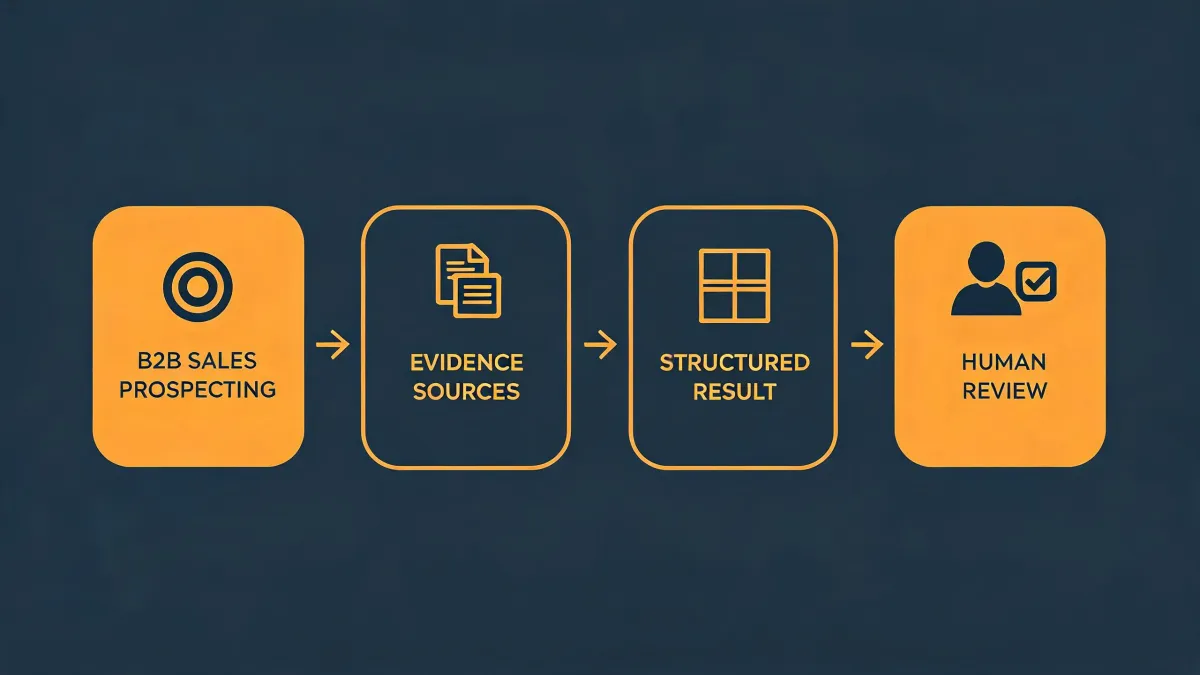
Lead generation management is the discipline of governing lead-state transitions, because channel activity becomes unmanageable when ownership and acceptance rules are implicit. A lead program becomes manageable when every state change has evidence, an owner, an allowed outcome, and a correction route. Channel activity without those controls is only motion.
Manage transitions, not a pile of leads
Lead generation management begins where one state ends and another must be accepted. A record may move from sourced to reviewed, unlocked, contacted, responded, accepted, recycled, or suppressed. Each transition needs an owner, an entry test, an allowed outcome, and a clock. Without those rules, channel activity accumulates while nobody can explain which team owes the next action. Name two operating models—central review versus pod ownership—and the condition that chooses between them: exception volume versus local context.
I choose the operating model by a dated condition, not by taste. Central review wins when exception volume is high and the acceptance rule is stable; pod ownership wins when the buyer context is local and the same reviewer cannot see the plant. NIST AI RMF Core, section 5, checked 17 August 2026, supports documented roles and human oversight; it does not pick the model. Write the condition once. If exception volume and local context both spike, I split: central rule, local owner.
- Define the state vocabulary in operational language.
- Name exactly one accountable owner for each transition.
- Set evidence required to enter and leave the state.
- Create explicit reject, recycle, and suppress outcomes.
- Measure elapsed time from entry, not from an arbitrary report date.
- Keep overrides visible with author and reason.
- Shadow one record across an entire review cycle and count every wait, return, override, and owner change. The resulting timeline reveals whether the published state model matches the work people actually perform.
- Interview both the sending and receiving owner after a failed handoff. Record which evidence each expected, which status they interpreted differently, and which contract clause must change before the next transfer.
A status is a promise
When a manager labels a lead accepted, the receiving team should know what has already been checked and what it has agreed to do. Ambiguous labels transfer hidden work rather than responsibility. The manager should preserve the state, elapsed time, acceptance evidence, exception reason, and named next owner so the operational promise can be audited at the following review.
Build the ownership map
Put acquisition, research, review, contact discovery, drafting, sending, reply handling, qualification, and correction on one page. Assign the role that acts, the role that approves, and the role that receives exceptions. NIST’s voluntary AI framework supports documented roles, oversight, monitoring, and continuing improvement; the map should show where human judgment remains decisive.
- Marketing owns source and audience definitions.
- Research owns provenance and freshness checks.
- Sales accepts or rejects against a published rule.
- Operations maintains routing, suppressions, and audit fields.
- Legal or privacy owners advise on applicable context.
- Managers review exceptions rather than silently rewriting history.
- Shadow one record across an entire review cycle and count every wait, return, override, and owner change. The resulting timeline reveals whether the published state model matches the work people actually perform.
- Interview both the sending and receiving owner after a failed handoff. Record which evidence each expected, which status they interpreted differently, and which contract clause must change before the next transfer.
Escalation is part of the normal design
An ambiguous company match, disputed fact, or unclear reply is not an edge case to hide. It needs a named queue, response time, and decision authority. The manager should preserve the state, elapsed time, acceptance evidence, exception reason, and named next owner so the operational promise can be audited at the following review.
Work one exception from discovery to closure
Suppose a candidate fits the industry rule but the headquarters and operating region conflict. The researcher flags the discrepancy instead of unlocking contacts. The segment owner checks the source, rejects the record, records the reason, and proposes a narrower search condition. The manager reviews whether the acceptance rule or only this record failed.
- Preserve both conflicting sources.
- Do not contact while identity remains uncertain.
- Route correction to the source owner.
- Update the acceptance note if the rule was ambiguous.
- With OKKI Go, review candidate companies and revise search conditions before selective unlock.
- Close the exception only after downstream copies are corrected.
- Shadow one record across an entire review cycle and count every wait, return, override, and owner change. The resulting timeline reveals whether the published state model matches the work people actually perform.
- Interview both the sending and receiving owner after a failed handoff. Record which evidence each expected, which status they interpreted differently, and which contract clause must change before the next transfer.
The management signal is the correction path
The rejected record is valuable if it changes future acquisition. Counting it only as lost volume encourages the same error to recur. The manager should preserve the state, elapsed time, acceptance evidence, exception reason, and named next owner so the operational promise can be audited at the following review.
Review flow and quality together
A weekly management review should pair counts with transition quality: accepted records, rejection reasons, time in state, aging exceptions, opt-outs, and owner workload. Channel totals alone cannot show whether the system is producing sales-ready work or merely passing uncertainty downstream. The manager should preserve the state, elapsed time, acceptance evidence, exception reason, and named next owner so the operational promise can be audited at the following review.
- Show the denominator for every acceptance rate.
- Split rejections by controllable reason.
- Inspect the oldest unresolved exceptions.
- Compare owner capacity with incoming volume.
- Review objections and suppressions separately from qualification.
- Choose one policy change per review cycle.
- Shadow one record across an entire review cycle and count every wait, return, override, and owner change. The resulting timeline reveals whether the published state model matches the work people actually perform.
- Interview both the sending and receiving owner after a failed handoff. Record which evidence each expected, which status they interpreted differently, and which contract clause must change before the next transfer.
Do not turn the meeting into a dashboard tour
The review ends with a decision, owner, due date, and expected observation. If no policy or handoff changes, the team has inspected activity without managing it. The manager should preserve the state, elapsed time, acceptance evidence, exception reason, and named next owner so the operational promise can be audited at the following review.
Publish the operating contract
Document states, owners, acceptance evidence, service times, exception routes, suppression duties, and review cadence. The SBA marketing-plan model connects target, actions, goals, resources, and review; the management contract makes that connection executable. Applicable ICO guidance also requires attention to fairness, transparency, accuracy, objections, and opt-outs. The manager should preserve the state, elapsed time, acceptance evidence, exception reason, and named next owner so the operational promise can be audited at the following review.
- Version the contract and record its effective date.
- Train senders and receivers on the same definitions.
- Use OKKI Go with human confirmation of recipient, subject, and body.
- Audit a small sample of transitions each month.
- Retire unused states instead of leaving zombie records.
- Revisit the contract after a channel, system, or market change.
- Shadow one record across an entire review cycle and count every wait, return, override, and owner change. The resulting timeline reveals whether the published state model matches the work people actually perform.
- Interview both the sending and receiving owner after a failed handoff. Record which evidence each expected, which status they interpreted differently, and which contract clause must change before the next transfer.
What good management looks like
A well-managed program can answer why a record is here, who owes the next decision, when that decision is late, and how a mistake changes the rule. Volume is an input to that discipline, not its substitute. The manager should preserve the state, elapsed time, acceptance evidence, exception reason, and named next owner so the operational promise can be audited at the following review.
A lead program becomes manageable when every state change has evidence, an owner, an allowed outcome, and a correction route. Channel activity without those controls is only motion. Lead generation management is the discipline of governing lead-state transitions, because channel activity becomes unmanageable when ownership and acceptance rules are implicit.
Frequently asked questions
Manage transitions, not a pile of leads?
Lead generation management begins where one state ends and another must be accepted. A record may move from sourced to reviewed, unlocked, contacted, responded, accepted, recycled, or suppressed. Each transition needs an owner, an entry test, an allowed outcome, and a clock. Without those rules, channel activity accumulates while nobody can explain which team owes the next action.
Build the ownership map?
Put acquisition, research, review, contact discovery, drafting, sending, reply handling, qualification, and correction on one page. Assign the role that acts, the role that approves, and the role that receives exceptions. NIST’s voluntary AI framework supports documented roles, oversight, monitoring, and continuing improvement; the map should show where human judgment remains decisive.
Review flow and quality together?
A weekly management review should pair counts with transition quality: accepted records, rejection reasons, time in state, aging exceptions, opt-outs, and owner workload. Channel totals alone cannot show whether the system is producing sales-ready work or merely passing uncertainty downstream. The manager should preserve the state, elapsed time, acceptance evidence, exception reason, and named next owner so the operational promise can be audited at the following review.
Publish the operating contract?
Document states, owners, acceptance evidence, service times, exception routes, suppression duties, and review cadence. The SBA marketing-plan model connects target, actions, goals, resources, and review; the management contract makes that connection executable. Applicable ICO guidance also requires attention to fairness, transparency, accuracy, objections, and opt-outs. The manager should preserve the state, elapsed time, acceptance evidence, exception reason, and named next owner so the operational promise can be audited at the following review.