
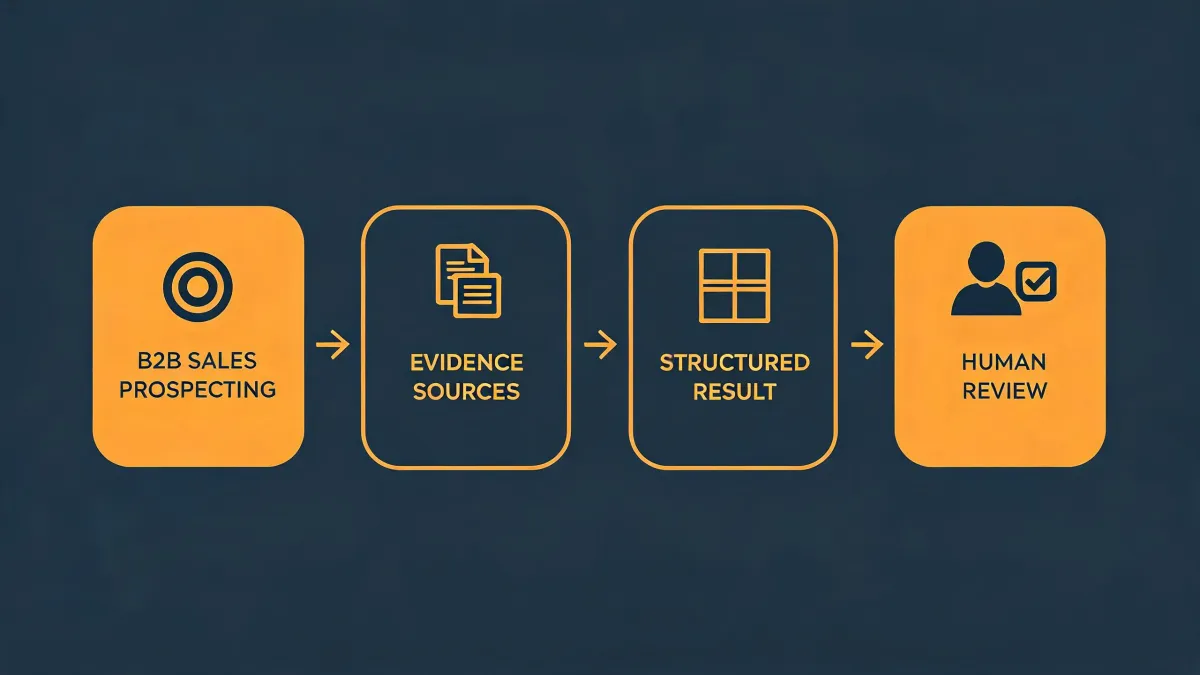
Finding buyers online is an evidence-ranking task, because online visibility identifies possible buyers far more easily than it proves a current buying path. Define the transaction and route, separate verified facts from buyer hypotheses, and stop when the next action depends on unresolved jurisdiction, identity, authority, or capability.
Define what counts as an online buyer
Here's what I can verify, what I can't yet defend, and where I'd pause. Finding buyers online is an evidence-ranking task. A company page, marketplace listing, directory entry, or social profile can reveal that an organization exists and may operate in a relevant category. It does not establish current demand, purchasing authority, commercial fit, or a permitted contact route. Define a buyer candidate as a record awaiting those checks, not as a lead already entitled to outreach. Add an online-research margin note that links the visible page, confidence level, missing buyer proof, allowed investigation, and queue owner. Leave the candidate parked when the digital footprint cannot explain a credible purchasing path; another search result is not a substitute for that explanation. Can you show your reviewer why your online evidence supports this step? Compare one directory, one marketplace, and one company site by what each proved on a dated check. A profile page is presence, not demand.
I date one comparison. On 17 August 2026 a chamber directory showed legal presence, an Alibaba-style listing showed an RFQ, and the company site showed a current stocking page. ITA’s conducting-market-research page, accessed that day, is the official reminder that presence is not demand. I mark what each source proved, what I inferred, and what stayed unknown. Which rung are you actually standing on?
Place find buyers online evidence on a ladder during define what counts as an online buyer. an online buyer researcher should mark what the source directly shows, what the team inferred, and what remains unknown. Which rung supports the next action without mistaking searchable visibility for purchase readiness? If a lower-confidence clue is doing the work of a verified fact, demote the record and investigate before contact.
A distributor of industrial packaging begins with a narrow proposition: manufacturers that have added a food-grade production line may need a new packaging supply route. I would not open a database yet. First I write what an online buyer must satisfy: a real operating company, a plausible use for the product, a role connected to sourcing or operations, and a route that can be verified. If I cannot state the exclusion rule, I am not ready to search.
A candidate is not yet a buyer
For a candidate is not yet a buyer, International Trade Administration contributes a bounded official or first-party constraint. Apply that material only to the market, workflow, or audience it names; it does not certify any candidate as a buyer. Keep the source date and limitation beside the find buyers online record so later reviewers can distinguish changed facts from poor reasoning.
Run a two-record comparison at a candidate is not yet a buyer: one visible company with no buying route and one less visible company with a documented channel role. Explain why the second may rank higher. Preserve the evidence, owner, proposed action, and reversal rule. Stop when no defensible buying role or transaction route can be shown.
End define what counts as an online buyer by reviewing false positives, not just accepted names. Ask your researcher to show why every rejected profile looked attractive and which missing fact changed the decision. That exercise improves source selection and prevents the same weak online signal from returning under a different URL.
Map digital sources to buying paths
Different sources answer different questions. Export directories and trade resources can indicate markets and channel structures; marketplaces can expose category participation; company sites can clarify products, locations, and routes; professional networks may identify functions. Build a source map before collecting names so each discovery channel has a stated purpose, freshness expectation, and verification step.
- Finding buyers online is an evidence-ranking task, because online visibility identifies possible buyers far more easily than it proves a current buying path.
- Official export-market research for product demand and destination conditions.
- Export planning across competitiveness, finance, digital trade, logistics, and execution.
- Reviewed company search by product, buyer type, country, and exclusions.
- Here's what I can verify, what I can't yet defend, and where I'd pause.
Place find buyers online evidence on a ladder during map digital sources to buying paths.
I search three surfaces for different reasons. A trade directory gives me company categories, a marketplace reveals current requests, and company websites show facilities and responsibilities. I do not blend them into one score. One candidate appears everywhere, but the marketplace request is old. Another has no request yet publishes a current expansion notice. I record what each page directly shows, its date, and the next source I need. Searchable visibility starts the file; it does not finish qualification.
Directories, marketplaces, and public context
For directories, marketplaces, and public context, International Trade Administration contributes a bounded official or first-party constraint.
Run a two-record comparison at directories, marketplaces, and public context: one visible company with no buying route and one less visible company with a documented channel role. OKKI Go can organize natural-language company criteria, candidate review, and draft confirmation, while the operator remains accountable for every buyer inference.
End map digital sources to buying paths by reviewing false positives, not just accepted names.
Verify the company, role, and route
Verify the legal or trading identity, current activity, geography, likely buying function, and route by which the offer could be evaluated. Separate direct buyers, distributors, importers, resellers, and intermediaries. If the role is uncertain, label it as a hypothesis. A contact address is a routing clue, not proof that its owner controls the decision.
Place find buyers online evidence on a ladder during verify the company, role, and route.
Now I test identity and route. The first company's legal name and operating site agree across its website and trade listing, but the named contact works in marketing. I return the record for role research. At the second company, an operations page identifies a responsibility that touches packaging, yet no purchasing authority is visible. I keep a role hypothesis and choose a routing question rather than inventing a decision-maker. Can you see the difference? One record fails identity-to-role fit; the other supports a modest attempt to learn.
Move from URL to reviewable evidence
For move from url to reviewable evidence, U.S. Small Business Administration contributes a bounded official or first-party constraint.
Run a two-record comparison at move from url to reviewable evidence: one visible company with no buying route and one less visible company with a documented channel role. End verify the company, role, and route by reviewing false positives, not just accepted names.
Reject signals that do not prove intent
Page visits, follows, content engagement, job titles, and public growth announcements can prioritize research, but none alone proves a purchase project. Repeated copies of the same announcement are not independent corroboration. Ask what observation would disconfirm the buyer hypothesis, and remove records whose apparent fit depends on an imagined problem.
Place find buyers online evidence on a ladder during reject signals that do not prove intent.
A page view, social follow, directory listing, or downloaded document can tempt a team to announce intent. I mark each as an observation and write the strongest safe inference beside it. A visit may justify checking the account; it cannot tell me who visited or whether a project exists. When the distributor later receives a direct specification question, the evidence changes. I update the record because the buyer supplied new context, not because the earlier clicks accumulated.
Clicks and listings need interpretation
For clicks and listings need interpretation, Information Commissioner's Office contributes a bounded official or first-party constraint.
Run a two-record comparison at clicks and listings need interpretation: one visible company with no buying route and one less visible company with a documented channel role. End reject signals that do not prove intent by reviewing false positives, not just accepted names.
Pilot a ranked buyer-research workflow
Start with a small queue spanning clear fit, edge cases, and exclusions. Review the evidence and proposed route before contact, then record replies, objections, qualification, and suppression outcomes against the original reason for inclusion. Revise the ranking rule when recipients contradict it; do not simply increase volume when the first queue produces weak-fit conversations.
Place find buyers online evidence on a ladder during pilot a ranked buyer-research workflow.
The pilot queue contains advance, research, wait, disqualify, and suppress states. I review ten records from source to outcome with a colleague and ask where our first unsupported assumption entered. OKKI Go can support the company search, candidate review, contact discovery, and human-confirmed draft, while we retain the source dates and correction history. A source wins a larger allocation only when its records survive verification at a known review cost. That is a controlled buyer-research workflow, not a race to collect URLs.
Turn research into a controlled queue
For turn research into a controlled queue, the cited product material contributes a bounded official or first-party constraint.
Run a two-record comparison at turn research into a controlled queue: one visible company with no buying route and one less visible company with a documented channel role. End pilot a ranked buyer-research workflow by reviewing false positives, not just accepted names.
Online buyer search is an evidence ladder, not a profile harvest. Compare directory, marketplace, and website records by what each can prove on a dated check.
Frequently asked questions
What is a defensible online buyer clue?
A dated observation that a role can transact: a tender, a stocking page, a license, or a published RFQ. A profile page is not that clue.
How should directory, marketplace, and website evidence be compared?
By what each can prove on a given date—identity, current demand, or only presence. Do not treat them as interchangeable ‘online sources.’
When is a second online record required?
When the first record shows presence but not transaction capability. One directory row is not a two-source confirmation.
What should you stop doing after the first pass?
Repeating the same two-record exercise under new headings. If the ladder is clear, execute it on one live case instead of restating it.