
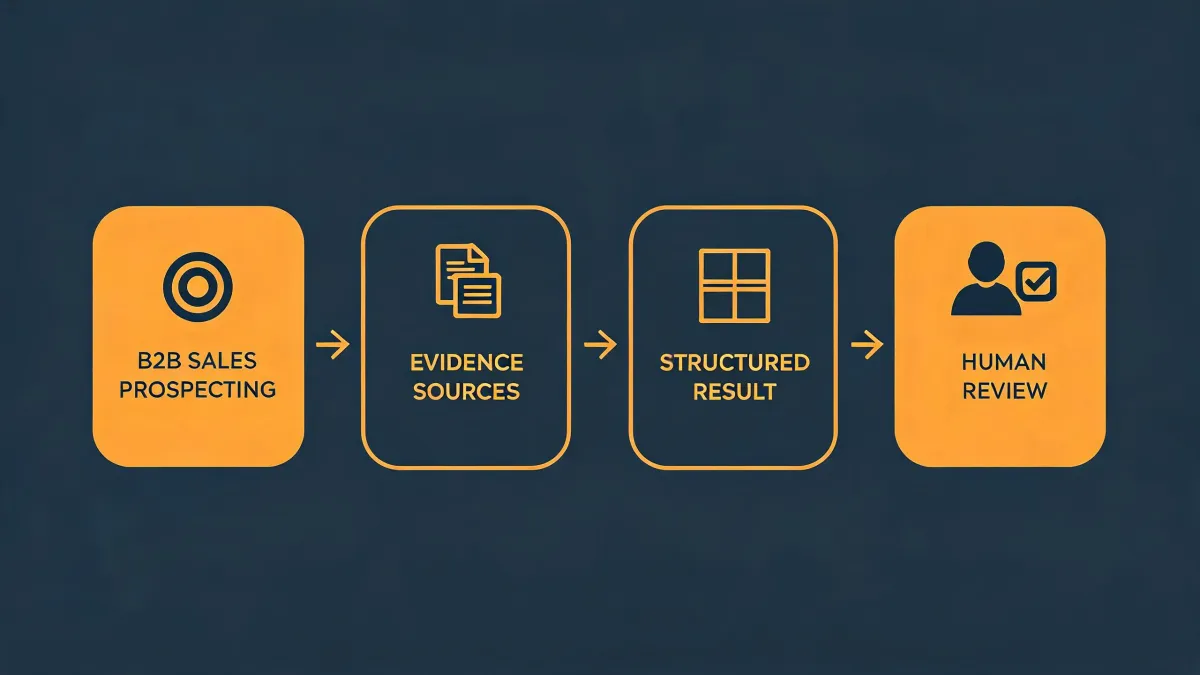
Improve outbound lead generation by measuring the earliest stage that disqualifies a prospect, instead of optimizing the final visible reply metric. Track targeting, contact-data validation, delivery, reply qualification, and sales acceptance separately so you can repair the stage where fit or evidence first breaks.
Outbound Is a Diagnostic System, Not a Message Blast
Outbound lead generation is proactive contact with selected prospects who have not already engaged with your company. But if you stop at that definition, you'll mistake sending for a strategy. The useful definition includes the whole operating sequence: decide whom to target, prepare relevant contact, run a consistent process, correct mistakes, and measure what happens at each stage. ZoomInfo organizes outbound around those linked decisions. That matters because the final reply is produced by every upstream choice, not by copy alone. If the account never fit, a polished message cannot repair the selection decision that came first.
- Targeting asks whether the company belongs in the audience before any message is prepared.
- Contact preparation asks whether the outreach basis is relevant and the data is usable.
- Execution asks whether the process reaches the intended recipient and creates a reply that can be interpreted.
- Handoff asks whether the reply contains enough fit evidence for sales to accept it.
Inbound and Outbound Start from Different Signals
Here's the practical distinction. Inbound begins with some prior engagement that the prospect initiated. Outbound begins with your team's targeting judgment and proactive contact. That does not make one automatically better. It changes what you must prove. In outbound, you need an inspectable reason for selecting the account before the prospect gives you an engagement signal. So ask an uncomfortable question early: if this person never replies, can you still explain why the company was selected, why the contact was relevant, and where the process stopped? If not, the system has hidden its first failure behind silence.
How the Stage Sequence Reveals the Failure
You can diagnose outbound only when the workflow keeps its stages separate. Overloop describes a system that runs from ICP definition and list building through verification, multichannel sequencing, reply qualification, CRM handoff, and weekly KPIs. Notice what this structure prevents. A reply cannot retroactively prove that the account fit the ICP. A delivered message cannot prove that the contact data identified the right role. A handoff cannot prove that the reply was qualified. Each event answers a narrower question, which is exactly why you should resist collapsing them into one response metric.
- Start with target fit. Record why the account matches the ICP before enriching a contact.
- Validate the contact data. Keep uncertainty visible instead of treating a populated field as verified relevance.
- Observe delivery separately from reply. Delivery shows that the sequence reached an address, not that the selection was sound.
- Classify the reply before handoff. A response may be positive, negative, ambiguous, or unrelated to qualification.
- Record sales acceptance and the reason, then send that diagnosis back to the earliest stage that needs correction.
Check the Earliest Stage That Can Still Disqualify
Why start with the earliest disqualifying signal? Because later optimization can make an upstream mistake harder to see. Suppose replies improve after you rewrite the sequence. You still don't know whether the account list was well chosen, whether the contacts were appropriate, or whether the replies represent qualified interest. A clean stage model lets you ask a better question: where did the prospect first stop satisfying the conditions for progress? If target fit failed, change selection. If data validation failed, repair research. If delivery failed, inspect that stage. If qualification failed, revisit the handoff rule. The response follows the diagnosed failure, not the loudest dashboard number. This sequence also keeps your explanation honest. You can say which observation changed the decision and which questions remain open. Without that separation, every improvement becomes a copy success and every decline becomes a copy failure, even when the decisive condition appeared before a message existed. Diagnosis gives each stage a fair burden of proof.
Where the Diagnostic Rule Stops Transferring
The earliest-signal rule works when your tools preserve a meaningful sequence from audience definition to enrichment, outreach, qualification, nurturing, and handoff. Leadfeeder describes outbound in those process terms. But the rule breaks when stage names exist only on a dashboard and no one has defined what qualifies a prospect to move between them. You can't diagnose target fit if the team never recorded its targeting reason. You can't diagnose contact accuracy from a reply metric alone. And you can't diagnose handoff quality if sales acceptance is an informal judgment that never returns to the workflow.
- A sequencing tool can expose activity, but activity fields do not define commercial fit for you.
- A data tool can populate records, but the team still needs a reasoned validation standard for the intended role and account.
- A CRM can store a handoff, but the stage is not diagnostic unless acceptance and rejection reasons are recorded consistently.
- A report can compare stages, but changing definitions or operating periods can make the comparison unsafe to transfer.
The Limit Appears When Definitions Drift
You may be tempted to set one threshold and keep it forever. Don't. The safe threshold is procedural: compare stages only while the target definition, validation rule, sending context, reply classification, and acceptance rule remain comparable. If one changes, label the break and begin a new diagnostic period. Otherwise, a later reply rate may appear better simply because the team admitted different accounts or classified responses differently. The method also stops when the available evidence cannot locate an earlier failure. In that case, say what is unknown and improve instrumentation before drawing a channel conclusion.
Why a Reply Is Not a Qualified Lead
The common mistake is to treat any reply as proof that the system worked. Yet a reply tells you only that a response occurred. Qualification asks whether the response and the account still satisfy the conditions for progress. Start earlier. OKKI Go lets you express company-search criteria such as product, buyer type, target country, and exclusions, then review candidate companies before selective unlocking. That workflow makes the selection decision visible. It does not certify that every candidate fits. You still need to inspect the reason the company appeared and decide whether that reason supports contact and handoff.
- A candidate is a research result, not an accepted opportunity.
- An unlocked contact is a possible route to a person, not proof that the role owns the problem.
- A reply is an interaction that must still be classified against the qualification rule.
- A sales handoff is useful only when the acceptance reason can be traced back to targeting and evidence.
Reject the Shortcut from Activity to Intent
What should you do with a positive-looking activity signal? Place it in the stage where it belongs. A returned candidate belongs to research. A discovered contact belongs to contact preparation. A reply belongs to response observation. Qualification begins only when the available evidence is tested against your agreed fit and handoff conditions. This sounds slower than celebrating the reply immediately, but it shortens the feedback loop. When sales rejects a lead, you can return to the earliest stage that admitted the wrong assumption instead of asking the copywriter to solve every failure with another message variation.
How to Apply the Diagnostic Checkpoints
Imagine you're reviewing an outbound workflow after replies look weaker than expected. The operating constraint is that the team can revise one stage before the next cycle. Treat these as scenario assumptions: the target criteria are documented, the company context and product materials are available, contact discovery occurs only after candidate review, and a person approves every recipient, subject, and body. Those assumptions mirror the bounded drafting workflow described for OKKI Go. Your input is the trace from target rationale through contact preparation, sending, reply classification, and acceptance. No invented customer result is needed.
- Inspect targeting first. If the company lacks a reviewable fit reason, revise the search criteria before touching the message.
- Inspect contact preparation next. If the role or contact evidence is unclear, repair validation before expanding the sequence.
- Inspect sending and response separately. A sent message and a reply are observations, not interchangeable qualification outcomes.
- Inspect the handoff last. Ask whether sales accepted the reply for the same reason the account entered the workflow.
Your Next Decision Follows the First Broken Signal
Now the mechanism changes. Instead of optimizing the last visible reply metric, you use the first disqualifying observation to choose the repair. If target rationale is missing, revise selection. If contact evidence is weak, revise validation. If sending fails, use the exposed status and failure reason to inspect delivery. If interaction occurs, remember that OKKI Go describes opens and clicks as observations, not proof of buying intent. The observable result is a specific operating decision tied to a stage, not a claim that performance improved. Apply this only while the assumptions and stage definitions remain stable. If they change, start a new diagnostic comparison.
When every stage answers one narrow question, outbound stops being a contest for the best-looking reply metric. It becomes a system you can diagnose from the first broken assumption forward.
Frequently asked questions
What is the single most important factor in outbound lead generation?
The most important factor is whether you can identify the earliest stage where a prospect stops qualifying, then repair that stage instead of optimizing a later reply metric.
What do most buyers get wrong about outbound lead generation?
They often treat replies as proof of fit. A reply is an interaction signal that still needs to be tested against targeting, contact, qualification, and handoff conditions.
How should you actually decide on outbound lead generation?
Instrument targeting, data validation, delivery, reply classification, and sales acceptance separately. Let the first broken signal determine the next operating change.
When does outbound lead generation matter most?
It matters most when proactive contact begins before the prospect has engaged, because your team must preserve and test its own reason for selecting the account.