
I sign the budget for our go-to-market tools, so my read on a new sales-AI platform is a little different. “Looks cool” never gets a line item. What I care about is what a workflow costs when it quiet: a stale list, a bad email, a hard bounce rate that drags down a domain before anyone notices.
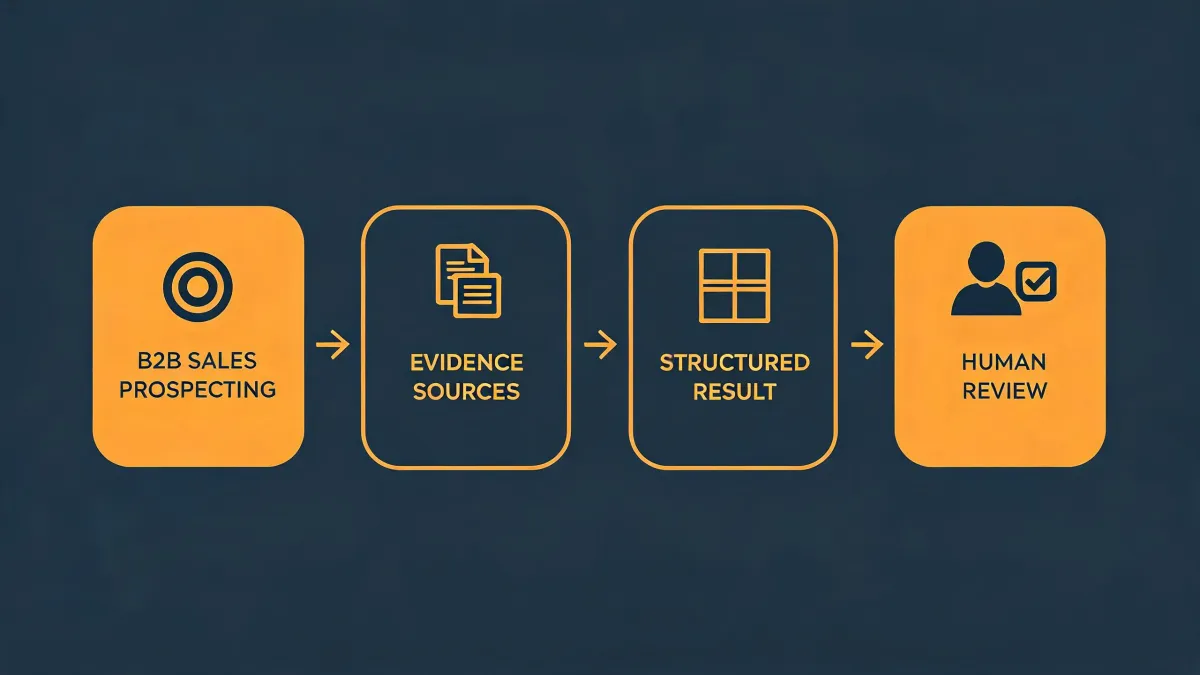
For this comparison, I looked at two ways to run lead generation. On one side is the okki-go workflow for founders and lean RevOps teams: the agent runs research, pulls intent signals, waterfall-enriches the missing fields, validates the email, and then hands a shortlist to a human for approval. On the other side is the DIY stack: a list vendor, an enrichment tool, a separate email validation layer, and an outbound sequence tool that someone has to stitch together.
Here’s the thing: I don’t think “which is cheaper” is the right first question. The first question is what each option really costs when one step fails. Over the past six years of tracking invoices and renewal surprises, I’ve built my evaluation around four dimensions:
- Hard bounce rate and what it actually hides
- Workflow maintenance time
- The pricing model at the lead level, not the subscription level
- Where the human review step lives
Hard Bounce Rate: Stop Comparing the Percentage, Check the Definition
If you’re a revenue operations team evaluating a new prospecting tool, the first question is not “what is your hard bounce rate?” It’s “how do you define it?”
Most dashboards report bounces as a share of emails sent. That sounds reasonable until you run a sequence with four touches per contact. Let’s say you send 400 emails to 100 contacts. One email address is invalid. It bounces on the first send and gets suppressed, so it never receives the other three touches. Your dashboard shows one bounce out of 400 sends: 0.25%. But one out of every 100 contacts was bad: 1% unique-contact hard bounce rate.
Neither number is “wrong.” They just measure different things. The problem is that most vendor comparison sheets quote the number that looks better. I’d want to see hard bounce rate calculated by unique email address at the point of list upload, before a sequence adds more sends to the denominator. If the vendor hesitates, you’ve probably found the weakness in their validation logic.
What should revenue operations teams evaluate in hard bounce rate beyond the headline number? Three things:
- How catch-all domains are handled. A cheap validator will mark a catch-all address as valid because the server accepts it. The message goes somewhere, but nobody reads it. There is no hard bounce, no negative signal, and no reply. It just vanishes. I’d rather see an “unknown” bucket than a false “valid” label.
- Whether validation happens before or after enrichment. In a DIY stack, you enrich first, validate later, and often the two datasets don’t talk to each other. In the okki-go agent workflow, validation is part of the same pass. The agent doesn’t move a lead to outreach unless the email has passed the verification stage.
- What happens after a bounce. Does the tool suppress the address in future sequences? Does it log the reason? A hard bounce should be treated as a data-quality signal, not just a delivery failure.
Don’t hold me to this as hard industry data, but in the last four vendor evaluations I sat through, only one team ever asked about unique-contact versus message-level bounce. It changed how we compared the quotes. I wish I had tracked that earlier.
To be fair, a DIY setup can absolutely produce good email validation. If you’re willing to test your own catch-all rates, maintain suppression lists, and re-validate before every campaign, it works. But that maintenance is real work, and that’s the next cost dimension.
Workflow Maintenance Time Is Part of the Purchase Price
Founders often compare the monthly subscription price and forget to price their own hours. Let me give you a rough example from our own cost tracking:
One of our teams ran a DIY prospecting flow for a while. The weekly routine was: pull fresh accounts from a data source, export them to an enrichment tool, wait for the lookup, re-upload to a verification tool, filter out bad emails, then push the final list into the outreach platform. Every step had its own login, its own credit balance, and its own way of handling duplicates. When one provider changed its API or export format, the whole chain broke silently.
That’s not a “minor annoyance.” It’s a standing cost. I’ve seen us spend four hours a week moving CSVs around and checking whether last week’s enrichment actually worked. At a conservative internal rate, that’s close to $20,000 a year in hidden operational time for a flow that was supposed to save us money.
The okki-go agent workflow is built differently. You define the target profile and the agent runs the steps: research, intent detection, enrichment, verification. If a data source doesn’t have a field, the workflow tries the next source instead of returning a blank row. The output lands in a review queue for a human. There is no “please export the file and re-upload it” stage.
Look, I’m not saying DIY can’t work. If you have a RevOps person who genuinely enjoys building automated pipelines, a custom stack can be flexible and powerful. But for a founder who is also the head of sales, the okki-go workflow wins on total time cost almost every time.
The Pricing Model Question: Subscription Cost vs. Per-Lead Cost
Subscription pricing is easy to compare. The harder part is the per-credit economy hiding underneath it. Many lead generation tools look affordable at the plan level and then charge separate credits for enrichment, verification, and exports. When you add up the per-row costs across a 5,000-lead campaign, the “cheap” tool is often more expensive than the platform that includes the workflow.
I had this exact argument during a Q2 2024 review. A colleague wanted to switch to a lower-priced list tool because the subscription was $150 a month less. I hesitated because I knew we would still need to verify the emails separately. The tool’s own verification was, to be kind, optimistic. We ran a sample of 500 records through it, then through our stricter validator. Roughly 8% of the emails that the first tool called valid failed the second check. That wasn’t an industry stat—it was just our small sample. But it was enough to kill the “savings.”
When I compare okki-go to a DIY stack, I focus on what happens after the CSV is ready. In a traditional setup, bad emails cost you at every stage: you enriched them, you paid for them, and then you sent messages to addresses that were never going to land. In the okki-go agent workflow, the verification step sits before the outreach handoff, so you don’t spend sequence time or sender reputation on records that should have been filtered out.
One more thing: a low hard bounce rate is not an excuse to ignore list freshness. A list that was excellent six months ago is not excellent today. I’ve seen teams buy a “high-quality” list, check its bounce rate after the first send, and then keep using the same list for three more months because “the number was fine.” By month three, the data has aged and the cost shows up in quiet replies and longer sales cycles. I don’t have hard data on how quickly B2B data decays across every industry, but based on our own re-verification runs, I wouldn’t assume a list stays clean for more than one quarter.
Human in the Loop: Where Does the Review Actually Happen?
Here is where I might sound less like a procurement person and more like someone who has dealt with angry SDRs: the worst part of a fully automated lead gen flow is not the tool. It’s the moment when bad output gets sent to real prospects with no human looking at it.
I remember skipping the final review on an email campaign because we were rushing and I thought, “it’s basically the same as last time.” It wasn’t. The merge fields pulled the wrong company name into a few hundred emails. That cost us more in awkward follow-up calls than any subscription fee ever did.
That’s why I like the okki-go workflow’s human-in-the-loop design. The agent handles the repetitive work: researching accounts, finding the right contact, checking the email. But a person approves before the message goes out. That small checkpoint prevents the kind of embarrassing mistake that automation tools tend to repeat at scale. It also keeps your outbound from becoming another source of AI spam, which is worth something even if it’s hard to put in a spreadsheet.
Which One Should You Choose?
My comparison framework would be incomplete without a direct recommendation, so here it is:
Choose the okki-go agent workflow if:
- You are a founder or a small RevOps team and don’t have a dedicated automation builder on staff.
- You need intent data, enrichment, and verification to run in one flow instead of five disconnected tools.
- You want a built-in human review stage so the AI doesn’t auto-send something you’ll regret.
- You’d rather pay a predictable subscription than manage separate credits for every data step.
Choose the DIY stack if:
- You already have a RevOps person who enjoys maintaining pipelines and custom integrations.
- Your outbound program is mature enough that you know your unique-contact hard bounce rate and suppression logic cold.
- You need highly customized data sources or offline account research that an out-of-the-box agent workflow can’t reach yet.
My experience is based on comparing stacks for outbound-focused B2B teams, mostly between five and two hundred people. If you’re running a purely inbound motion or an event-led strategy where cold email barely matters, your priorities will look different.
Bottom line: don’t buy a lead generation tool on the strength of its monthly price. Ask how it defines hard bounce rate, what happens when the data is stale, and whether a human sees the output before it reaches a prospect. If those answers are clear, the right choice usually follows.