
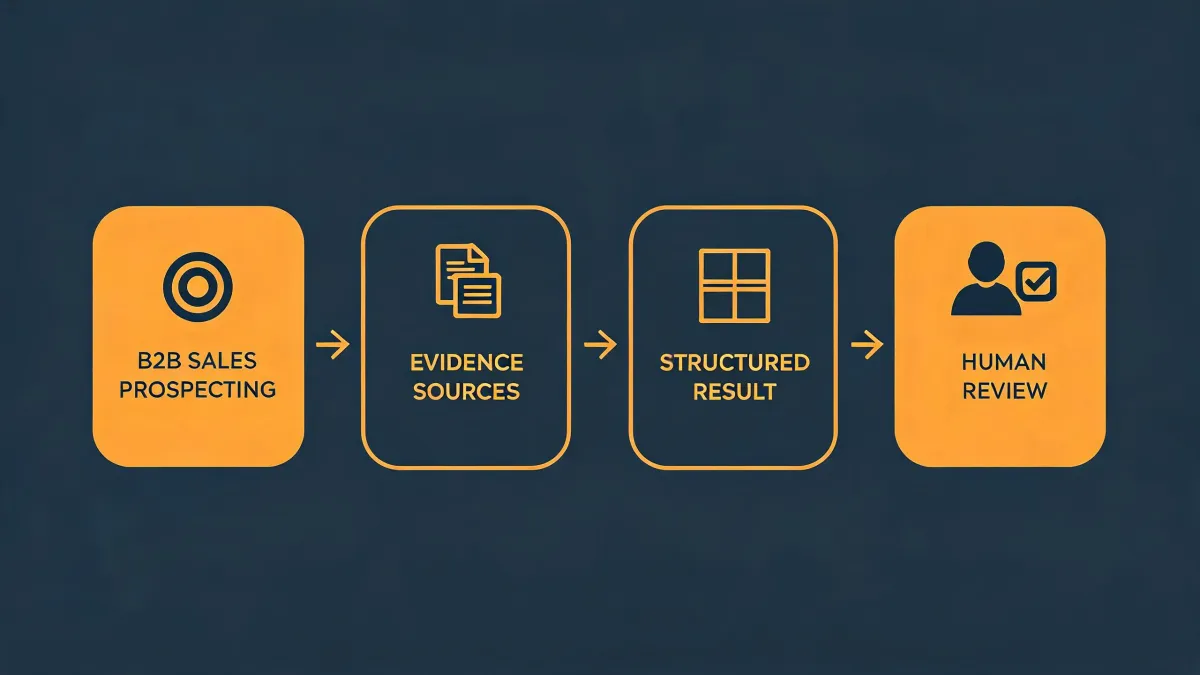
Firmographic data is useful when a company attribute captures a buying constraint and changes a decision, not merely when it describes the company. Map every field to qualification, territory design, routing, or another named decision, then define what happens when the value is unknown or stale.
What it is, in one line
I've watched firmographic data turn into a collection habit. Industry, location, company size, revenue, then another field because the enrichment tool makes it available. The record looks fuller. The targeting logic doesn't necessarily improve. My working definition is stricter: firmographic data is organization-level information that becomes useful only when it captures a constraint relevant to a commercial decision. A description tells you what a company appears to be. A constraint tells you why that attribute should change qualification, territory ownership, routing, or treatment. Use NAICS as the first governed field: if the code is stale or unknown, hold the account out of territory assignment rather than guessing. Completeness of other columns does not repair that fallback.
I govern NAICS first because Census publishes the taxonomy and the version. On 17 August 2026 I held a Milwaukee stamping shop out of a Midwest territory assign when the NAICS cell was blank and the website only said ‘metal work.’ People Data Labs and Clay can fill headcount later; they do not repair an unknown industry code. A full row with a guessed code is not a governed field. What’s the fallback on your sheet when NAICS is unknown?
Industry is a good place to see the difference. NAICS supplies a shared industry-classification framework. That matters because an industry field needs a named taxonomy and version rather than a free-text label. Without that definition, two people can assign the same company to different categories and both believe the field is complete. The issue isn't whether an industry label exists. It's whether everyone knows the classification rule behind it and whether that rule fits the decision being made.
That boundary matters. A named taxonomy doesn't prove that every industry distinction predicts buying behavior. It gives the field a shared meaning. Your team still has to show that the meaning corresponds to a real constraint in the market or operating model. If it doesn't change treatment, the field may remain useful for description or reporting, but it hasn't earned a role in targeting.
What belongs in a decision-ready definition
- The company attribute and the rule used to define it.
- The source or taxonomy that gives the value meaning.
- The qualification, territory, routing, or treatment decision the value can change.
- The fallback when the value is missing, disputed, or no longer current.
I keep those elements together because they stop a common slide from field to assumption. The attribute alone is not the judgment. It is one input whose definition and consequence must remain visible. Once that separation is clear, adding or removing a field becomes a decision about usefulness, not a contest over record completeness.
How it works
The mechanism is less glamorous than enrichment. A company record has to remain identifiable, its attributes have to come from traceable sources, and its status has to be visible enough for the decision owner to judge. GLEIF provides openly accessible legal-entity reference data. That example shows the value of persistent identifiers, source provenance, and update status in company records. Each element answers a different question: which entity is this, where did this value come from, and what should I know about its current state?
I wouldn't turn those elements into a generic score without context. The right metric follows the decision. For territory design, you need to know whether the attributes that assign ownership are defined and available for the accounts under review. For qualification, you need to know whether an unknown or stale value blocks, lowers confidence, or sends the account to review. The useful measure is how consistently the field produces the intended decision path, not how many cells the provider fills. If OKKI Go is part of the working stack, hold its records to that same decision-linked standard rather than treating the brand as evidence that a field is fit for use.
Here is the key implication. Coverage can't be discussed apart from consequence. A missing field that never changes a decision is a nuisance. A missing field that silently assigns the wrong territory is a control failure. The same missing value means different things because the workflow gives it different authority. Write that authority down before you debate whether the dataset is good.
Check identity, provenance, and status together
When I review a field, I trace it backward before I use it forward. First, is the company identity stable enough to avoid mixing entities? Next, is the source visible? Then, is the status current enough for this particular choice? Only after those checks do I ask whether the value captures a buying constraint. That sequence prevents a neat attribute from gaining more authority than its record can support.
Where it stops applying
Firmographic data works best when the company attribute maps cleanly to a decision and the underlying record can be matched with enough confidence. It starts to break when the identifier is ambiguous, the field definition drifts, the source is unclear, or the value has aged beyond the decision's tolerance. People Data Labs documents company lookup by name, website, location, social profile, ticker, and related keys, together with match controls and field-level output choices. That variety makes the matching problem visible. A tool can accept several lookup routes without making every returned field equally fit for every use.
I use a practical threshold: stop automatic treatment when the field no longer supports the decision rule you wrote. If the match is uncertain, don't pretend the attribute is certain. If the taxonomy differs from the one used in your territory model, don't merge labels as if they were identical. If the field is unknown or stale, follow the fallback you defined. Review, defer, or exclude. The exact choice depends on the decision, but silent substitution is the wrong default.
This is where tools stop transferring their value automatically. A lookup capability proves that a search route exists. It doesn't prove that the returned attribute captures your buyer's constraint or that a particular match should control qualification. The product can support identification and retrieval. Your operating rule must decide whether the evidence is sufficient for action.
Put unknown and stale values on the decision route
A blank cell should not force the user to improvise. Neither should an old value. I want the workflow to show what happens next: hold the account for review, continue with reduced confidence, or leave it outside the segment. The important point isn't which fallback you choose. It's that missingness and staleness are explicit states with explicit consequences.
What people get wrong
The tempting interpretation is that more populated attributes automatically mean more precise targeting. I've seen the opposite. Teams add fields, then build rules around whatever is present. Definitions stay implicit. Unknown values get treated as negative values. An old attribute keeps routing accounts because nobody assigned an expiry or review path. The record looks complete, but the decision becomes less honest about uncertainty.
Clay's guide describes firmographics as organization-level attributes used for segmentation, research, qualification, and routing rather than person-level demographics. That distinction is useful, but it doesn't make any attribute universally decisive. Each use places different pressure on the field. Research may tolerate an unresolved value. Routing may require a clear fallback. Qualification may need the value to correspond to an actual buying constraint rather than a convenient description.
The corrected view is narrower. Treat fields as governed inputs. Name the definition. Preserve the source. Review the value's status. Connect it to a decision. When one of those pieces is missing, lower the field's authority instead of filling the gap with confidence. Enrichment can make attributes abundant. It can't decide what they mean to your go-to-market model.
A populated field is not yet a buying constraint
I ask one blunt question: what will this field change? If the answer is only that it will improve a dashboard, keep it out of operational targeting until a distinct treatment exists. If it changes ownership, eligibility, or the next research step, document that consequence and the fallback. A field earns authority from the decision it supports, not from being nonblank.
How to apply the judgment
Consider a hypothetical account-search exercise, not a customer case. Scenario assumption: a sales team has defined a product, a buyer type, target countries, and exclusions, but some company attributes may be unknown or stale. The operating constraint is that an account should not advance simply because it matches a broad descriptive label. The input parameters are the stated product, buyer type, countries, exclusions, and the available company fields. No invented revenue threshold or employee count is needed.
OKKI Go lets a user express product, buyer type, countries, and exclusions, then review candidate companies and correct the search route before deeper work. In this scenario, that review point changes the mechanism. The firmographic field does not silently decide. The user can inspect whether the candidate reflects the intended constraint and correct the route when it does not. The observable result to watch is whether unsuitable candidates leave the route before contact work, while uncertain fields remain visible for review rather than becoming false negatives or false positives.
The decision consequence follows. Keep the field in qualification if it repeatedly supports that review and changes account treatment in the intended way. Reduce its authority if unknown or stale values push candidates through without inspection. Remove it from the rule if it produces no distinct decision. This example applies where company attributes and a reviewable search route can support qualification. It doesn't establish that the same field predicts buying behavior in every market.
Decide the fallback before scaling the field
Before I let a field control more accounts, I write the fallback in plain language. What happens when the value is absent? What happens when the source or status doesn't support the decision? Who reviews the candidate? A tool such as OKKI Go can provide a route for expressing criteria and reviewing candidates, but the commercial meaning of each field still belongs to the team using it.
A firmographic field is valuable when it carries a governed decision, not when it fills a column. Define it, date it, and say what unknown means.
Frequently asked questions
When does a firmographic field earn a place in targeting?
When a shared definition, source, and status change a named decision such as eligibility, territory, or routing. A populated field without that contract is decoration.
Which firmographic field should a team govern first?
Pick one constraint that already changes a decision—NAICS, headcount, or revenue—and write the stale or unknown fallback. Do not start with a completeness score.
Why is completeness a weak firmographic KPI?
A full record can still use the wrong definition or an expired observation. Completeness without status handling creates confident misroutes.
What should happen when a firmographic value is unknown?
The workflow must name a fallback: exclude, hold, or route to research. Silence is not a status.