
-
Is It Email or LinkedIn First? Depends on Your Outbound Motion
- Scenario A: Pipeline Builders Need Both an Email Lookup Tool and Research That Keeps Up
- Scenario B: Account Strategists Should Lead With LinkedIn and Treat Email as the Follow-Up
-
Scenario C: Trigger Responders Should Let Intent Pick the Channel
-
How to Tell Which Scenario You're In
Is It Email or LinkedIn First? Depends on Your Outbound Motion
Back in January our VP of sales asked me to evaluate okki-go for the SDR team. That's my job—I buy the tools, check the invoices, then hear about it when a sequence underperforms. Before I would approve a trial, I wanted an answer to one question: when should our reps start with an email lookup, and when should they start with a LinkedIn connection request?
If you've ever watched a sales tool demo, you know the standard answer: 'Both. Always. Automate everything.' That's not wrong in the way a lie is wrong. It's wrong the way a map without a scale is wrong. It gives you nothing useful to do on Tuesday morning.
The honest answer is that it depends on the outbound motion your team runs. I've sat with three types of teams while evaluating okki-go, and the pattern was consistent enough to turn into a decision guide. See which scenario sounds familiar:
The Pipeline Builder—needs volume, fresh data, and speed. LinkedIn connections can't feed that machine fast enough.
The Account Strategist—works a short list of named accounts and treats every touchpoint like it matters. For them, a thoughtful LinkedIn connection can beat a cold email.
The Trigger Responder—reacts to job changes, funding announcements, or intent signals. The winning channel changes from one account to the next.
Use the scenario that matches your team. If you're evaluating okki-go the way I was, these scenarios are also a good way to ask smarter demo questions.
Scenario A: Pipeline Builders Need Both an Email Lookup Tool and Research That Keeps Up
You're a Pipeline Builder when the SDR team has a number attached to its week—sixty, eighty, a hundred net-new contacts. The names come from list builds, event attendee lists, and territory expansion research. You can't get there with LinkedIn connection requests alone. The only realistic approach is a reliable email lookup tool.
But here's what surprised me: finding the email was rarely the bottleneck. The bottleneck was research. A rep who spends fifteen minutes reading a company's blog for one decent hook will contact maybe twenty people a day. That's not a data coverage problem, it's a workflow problem.
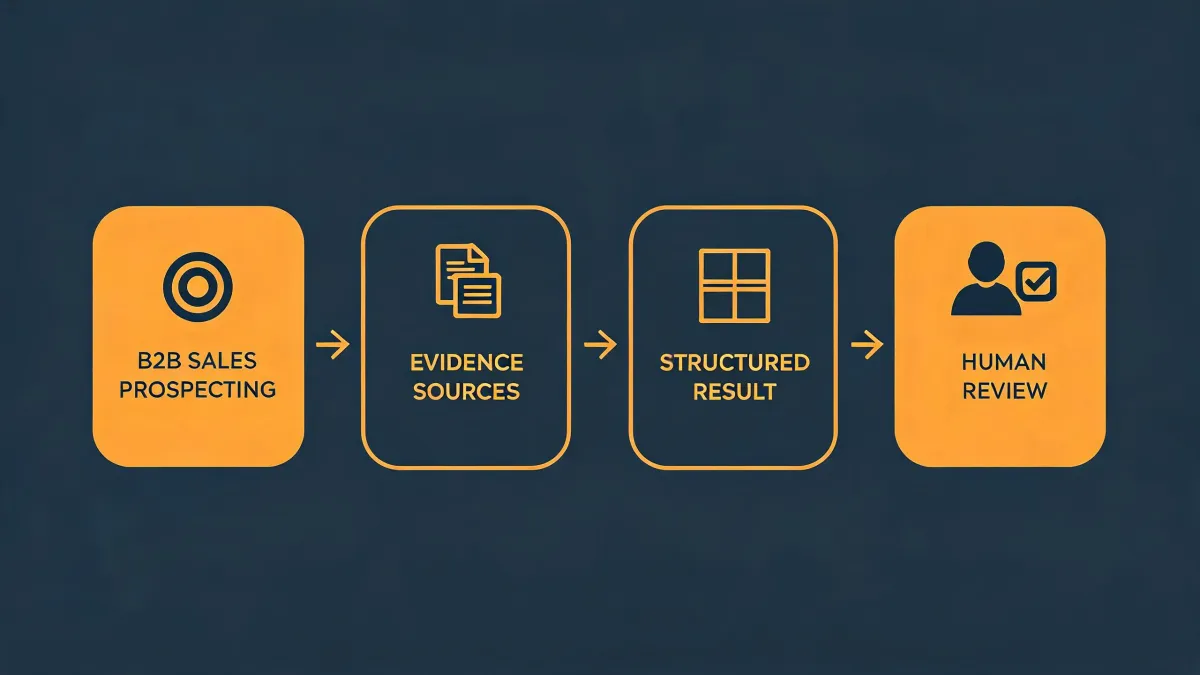
This is where okki-go outbound research shines in practice. The agent runs the parts that usually stall—identifying the right person, checking recent company signals, sorting out a messy org chart—then brings back a recommendation for the rep to approve. Human-in-the-loop is a phrase vendors love. In practice it means the AI does the legwork and the rep stays in control of the message. For a pipeline builder, that's the difference between a tool that adds work and one that removes it.
Okki-Go data coverage: what to check before you sign
Data coverage is where buying evaluations usually go off the rails. Buyers ask 'how many contacts do you have?' and the salesperson quotes a number from a slide. I don't care about the slide. I care about whether the tool can find the person I'm hunting for.
The test I'd recommend to anyone in my seat: take thirty accounts from your actual ICP—include the ugly edge cases, like a company that just hired a VP of Revenue or a startup that pivoted last month—and run okki-go on them. Count how many decision-makers come back with verified emails attached. Repeat the same test with every other tool you're comparing. That result tells you more about okki-go data coverage for your specific market than any database total ever will.
Email verification accuracy: expect honesty, not magic
An email lookup tool is only as good as what happens after it finds an address. Okki-Go verifies emails as part of its waterfall enrichment—syntax checks, domain setup, catch-all flags—and keeps risky addresses out of the campaign. Is the email verification accuracy 100%? No. And anyone who promises 100% hasn't tested their own product against a typo'd corporate domain or an inbox abandoned for a year. What verification actually does for a Pipeline Builder is keep bounces low enough that you don't wreck your sender reputation while scaling. That's the number worth watching, not the 'deliverable count' in a dashboard.
Scenario B: Account Strategists Should Lead With LinkedIn and Treat Email as the Follow-Up
The second type of team runs a completely different rhythm. One rep owns fifteen or twenty accounts, each deal is six figures, and the buying committee has six people. Sending a volume campaign to an account like that is like using a firehose to water one plant. The water might be clean, but the approach is wrong.
For this motion, the best first move is usually a LinkedIn connection request. Not because LinkedIn is magic, but because it's human and low-pressure.
What is a LinkedIn connection, and when should a B2B sales team use it?
Let's define the term properly, because I've seen teams treat it like a lead magnet. A LinkedIn connection is someone who accepted your invitation to connect on the platform. That acceptance means you can message each other directly and see more of each other's activity. It doesn't mean they want a demo, and it isn't a substitute for a real conversation. It's a foot in the door.
A B2B sales team should use a LinkedIn connection when one of these is true:
- There's a natural reason to connect—a shared contact, a comment they left, an event you both attended, or genuine interest in their company. The reason can't be 'I sell software.'
- The account is important enough to move slowly. One thoughtful connection with a warm reply beats five cold emails to an executive who never opens them.
- The right email address isn't findable or verifiable. This happens often with European companies and with executives who recently changed jobs.
- You can keep the connection note to two sentences. A wall of text gets ignored; a short note that references their recent post gets a 'happy to connect.'
Now the flip side: don't make LinkedIn your primary channel in Scenario A. An SDR sending forty connection requests a day spends their best hours waiting in a queue for approvals that may never come.
Okki-Go is still useful for the Account Strategist, but not as a volume engine. You use okki-go outbound research to map each account—who just joined, who might champion the project, which department owns the budget. Once the agent has mapped that, the message 'we have a mutual contact in X and I wanted to share what they found useful' becomes a LinkedIn opening that actually sounds human.
Scenario C: Trigger Responders Should Let Intent Pick the Channel
The third group is the most interesting. They don't chase a weekly contact count, and they don't work from a fixed list. They watch for moments—a target company raises a Series B, hires a new CRO, or visits the pricing page three days in a row. When a trigger fires, they move fast. Speed, relevance, timing. In that order.
Okki-Go's intent data and waterfall enrichment were built for this. The same agent that researches standard lists can watch for signals and prepare an outreach the moment one appears. For a Trigger Responder, the choice between email and LinkedIn depends on the signal and the contact:
Email wins when the signal is strong and the address verifies. If a prospect read your pricing page at nine in the morning, an email at ten with a direct offer makes sense. It's fast, it leaves a trail, and it doesn't ask the prospect to approve anything.
LinkedIn wins when the signal is real but softer. A new executive just landed in the role, but it's too early to pitch? A connection request that says 'saw you joined from X—congrats, I'd like to stay in touch' respects the moment. That's exactly when a B2B sales team should use it.
A good outbound agent should make that judgment call instead of forcing every opportunity down one channel. This is what I tell vendors during evaluation: the tool can recommend, but a human approves. Nothing goes out without eyes on it. That's not a limitation, it's the whole point of human-in-the-loop outreach.
How to Tell Which Scenario You're In
Don't let the vendor pick your scenario. Answer three questions honestly. First, how many net-new people does your team need to contact each week? If the number is over fifty, you're a Pipeline Builder, and okki-go's outbound research plus email lookup should be at the top of your test list. Second, how many accounts does each rep deeply manage? If it's fifteen or fewer, you're an Account Strategist—put LinkedIn connections at the center of the outreach and use the tool for account mapping. Third, when a trigger fires on a target account, who jumps on it and how fast? If that's your world, ask the vendor to show you how their agent decides between email and LinkedIn for each signal.
If you're in the middle of a purchase decision, run the thirty-account test from Scenario A. It will tell you what okki-go data coverage is really like for your market, and the way a salesperson handles the accounts the tool can't find will tell you just as much about the company. A vendor who hides coverage gaps in the demo will hide them on the invoice, too.