
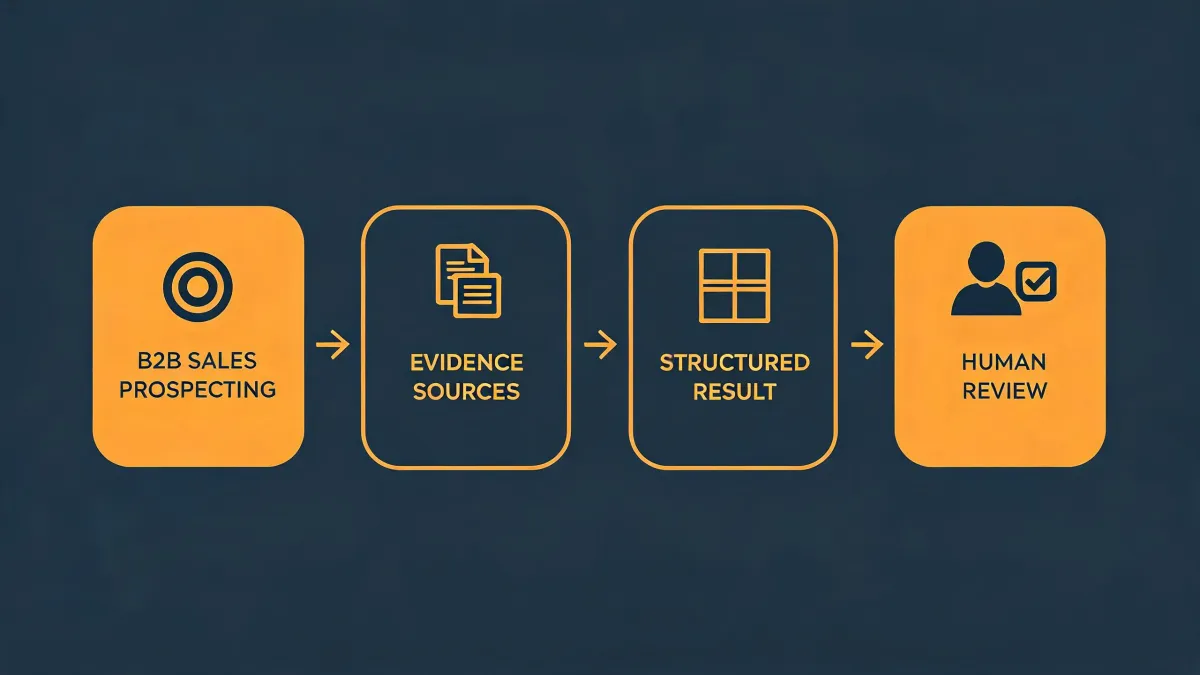
Cold email follow up earns another touch only when it contributes new evidence or a changed decision context. A useful cold email follow-up is not the first email with a new subject line. First verify delivery, recipient fit, prior context, and any objection or stop signal. Then decide what the recipient still needs to know, add one piece of relevant information, and make one low-effort request that can resolve the state. Let that observed state determine the next action: hand an interested reply to a person, answer or review an objection, record a referral, pause uncertainty, and stop on an explicit no or opt-out. Choose spacing from context and review capacity rather than a universal schedule, and reopen a closed path only when new verified evidence changes the case.
What it is, in one line
You're reviewing a fourth follow-up that says, in effect, “checking in again,” so pause the queue and ask the uncomfortable question: what would this email let the recipient understand or decide that the first three messages did not? If you can't name a new job, the problem isn't your wording yet; it's that the planned activity has outrun the evidence for another contact, and sending on schedule would merely repeat pressure without improving the recipient's decision. Before editing the next email, confirm that the previous attempt was addressed and sent as intended, while treating delivery or engagement observations as operational signals rather than buying intent. Recheck the person's role, the account reason, prior conversation, suppression state, and any request not to be contacted. Then name the single uncertainty another message could resolve, the new information it would contribute, and an interval that respects the request's urgency, the recipient's likely decision time, and your team's ability to review replies. A useful second touch changes the evidence. Add a relevant specification, a short answer to a likely implementation concern, or a market observation that narrows the question. Do not send 'just checking in' as if the recipient owes attention. The follow-up has to stand on its own for someone who did not read the first message, while remaining recognizable to someone who did. A bounded cold email follow up review can use this evidence: The FTC explains that commercial email must avoid deceptive headers and subject lines, identify the message as an advertisement where required, include a valid postal address and clear opt-out method, and honor opt-out requests promptly. The team must still define what the observation permits, who owns the next decision, and what would stop or reverse the action. That separation keeps documented capability from becoming an unsupported promise about delivery, relevance, qualification, or commercial outcome. Before you schedule the next touch, ask: what new reason are you giving the recipient to respond? If your answer is only persistence, revise the message or stop.
Read the original email as the recipient would: does the subject honestly describe the purpose, does the opener explain why this person is relevant, does the body offer a specific reason to care, and does the final line ask for only one manageable decision? A weak first email doesn't become stronger through repetition, so repair the proposition before increasing frequency, and keep subject lines truthful rather than disguising a commercial follow-up as a reply, invoice, personal introduction, or urgent internal note. If research is the bottleneck, you can give OKKI Go your product, buyer, country, and exclusion conditions; it returns reviewable company candidates, you choose which records to unlock and revise the search when needed, and the usable result is a human-approved shortlist rather than a prediction of who intends to buy. For the third touch, compress rather than intensify. Restate the reason for contact in one line, introduce one new proof point, and offer a binary path: worth routing to the right owner, or not relevant now. Do not manufacture urgency or imply prior agreement. If there is no new value to add, silence is a better next step than another reminder. A bounded cold email follow up review can use this evidence: the reviewed workflow can prepare a draft from company context and user-supplied product material; the user confirms recipient, subject, and body before sending, and can inspect send state and failure reasons. The team must still define what the observation permits, who owns the next decision, and what would stop or reverse the action. That separation keeps documented capability from becoming an unsupported promise about delivery, relevance, qualification, or commercial outcome.
What belongs inside the definition
You know only that no reply has been recorded, because silence can sit beside an incorrect address, an absent recipient, poor role fit, a message that asked too much, a busy week, a deliberate pass, or a decision still in progress. Don't convert an open, click, or successful send into imagined interest, since those observations can help you inspect the route but cannot tell you whether the person has a relevant problem, authority, budget, or desire to speak. For example, if the address failed, repair or retire the record; if the role is uncertain, ask for direction; if delivery appears normal but the value is vague, clarify one business consequence; and if a stop signal exists, end the path. Set the sequence before the first send. Define the maximum number of touches, the purpose of each touch, the interval that permits a genuine context change, and the conditions that stop the sequence. A reply, an objection, an opt-out, an invalid address, or evidence that the person is not relevant should change state immediately. A calendar alone is not a decision rule.
The mechanism worth checking
Choose spacing only after that review, allowing enough time for the request's complexity and the recipient's work context while protecting your own reply queue, because a borrowed day count can't account for holidays, buying cycles, channels, markets, or team capacity. Build the sequence as a progression of information jobs: establish relevance, supply missing evidence, make the comparison easier, resolve role ambiguity, offer a lower-effort response, and then close the loop when no useful job remains. That progression gives you a better timing question than “what day is next,” because you can ask whether the recipient has had a fair chance to process the previous job and whether your team is ready to interpret the response. Treat an out-of-office reply as context, not consent. Record the return date if appropriate, check whether the message identifies a different owner, and route the case for human review. Do not automatically scrape colleagues and widen the sequence. The original targeting hypothesis should remain accountable even when automation can find more addresses.
Where it stops applying
When the sequence has no useful job left, close it concisely and make the opt-out path easy. Keep the subject connected to the actual topic, open with one line of context, introduce one new fact that matters to this recipient, and remove the history lesson about how many times you've already tried to reach them. A second email might correct the problem statement, a later email might add a compact proof point or clarify the implementation burden, and a final email might explicitly close the path, but none should pretend that persistence itself is value. The final message should make closure easy. Briefly state that you will stop the sequence, preserve a clear opt-out, and avoid guilt or a false breakup performance. Closing a sequence is an operational act: update suppression where required, retain the reason, and prevent another workflow from restarting the same contact without review. A bounded cold email follow up review can use this evidence: the platform supports a reviewable company-discovery and outreach workflow in which users can refine search conditions, review candidates before unlock, and retain human control over outreach content. The team must still define what the observation permits, who owns the next decision, and what would stop or reverse the action. That separation keeps documented capability from becoming an unsupported promise about delivery, relevance, qualification, or commercial outcome.
- Cold email follow up earns another touch only when it contributes new evidence or a changed decision context.
- Before editing the next email, confirm that the previous attempt was addressed and sent as intended, while treating delivery or engagement observations as operational signals rather than buying intent.
- Then name the single uncertainty another message could resolve, the new information it would contribute, and an interval that respects the request's urgency, the recipient's likely decision time, and your team's ability to review replies.
- Do not send 'just checking in' as if the recipient owes attention.
- The team must still define what the observation permits, who owns the next decision, and what would stop or reverse the action.
Match the next message to the unresolved question. If role relevance is unclear, add one role-specific consequence and ask whether you have the right person. If credibility is missing, offer one verifiable example or short explanation. If timing is wrong, provide a respectful pause or future condition. If the request is too large, ask a smaller question that resolves one uncertainty.
Your closing can be direct without manufacturing urgency: name the one question, make “no” easy to say, preserve a clear opt-out route, and let the answer determine whether a person continues, corrects the record, pauses, or closes it. A sequence is incomplete until each response state changes what happens next, so write the route before launch and give live replies, referrals, objections, correction requests, and stop signals priority over every scheduled email. If your system can't suspend the old path while a person reviews a changed state, reduce the active cohort until someone can reliably own exceptions, because a fast follow-up that ignores a reply is worse than a slower process that records it. Draft review should expose the change from the prior email. Put the previous claim, the new evidence, the requested action, and the stop condition side by side. If a reviewer cannot identify what is newly useful, the message has not earned a send. This test is simple enough to apply before automation and strict enough to prevent empty repetition at scale. A bounded cold email follow up review can use this evidence: the platform supports a reviewable company-discovery and outreach workflow in which users can refine search conditions, review candidates before unlock, and retain human control over outreach content. The team must still define what the observation permits, who owns the next decision, and what would stop or reverse the action. That separation keeps documented capability from becoming an unsupported promise about delivery, relevance, qualification, or commercial outcome.
Where the rule stops transferring
For a simple example, replace “just bumping this” with “I noticed your regional team handles supplier qualification separately, so the relevant question may be whether export-market research is owned centrally or locally,” then ask who owns that decision. When you don't know whether the person owns the problem, ask for role direction rather than a meeting; when relevance is uncertain, ask whether the issue exists; and when interest is explicit, move the conversation to human qualification instead of sending another automated reminder. Avoid stacking requests such as “thoughts, a referral, fifteen minutes, or a better date,” because four escape hatches create four decisions and make a short reply harder, even though each option may sound considerate on its own. Review follow-up performance by cohort and touch purpose. A reply after touch four does not prove that four touches caused the reply; timing, prior exposure, and message content may differ. Compare eligible contacts, keep state definitions stable, and inspect objections as carefully as positive replies. The aim is learning which context earns continuation, not defending a preset cadence.
The tempting interpretation to reject
An interested reply exits the cold sequence to a named person, a substantive objection pauses automation for a considered answer, and a referral closes the original recipient path before the new owner's eligibility and context are reviewed. Silence may permit another useful job if your checks pass, while an out-of-office reply should respect the stated return context and an ambiguous response should wait for human interpretation rather than being forced into a positive or negative branch. For controlled preparation, you can provide the platform with selected company context and your product material; it returns a draft, a person confirms the recipient, subject, and body before sending, and the usable record includes send state or a failure reason for human review rather than proof of consent, intent, or performance. The platform can support a reviewed path from company context to a draft that the user confirms before sending. Use that checkpoint to compare the current follow-up with the account evidence and prior message. The platform does not turn an open, click, or generated draft into proof of buying intent; a person still owns the decision to continue.
How to apply the judgment
An opt-out or applicable objection is not a copywriting challenge, so record it promptly, suppress the relevant path, and make sure the stop reaches every system or person that could otherwise continue contact under your market's requirements. The FTC guidance cited here describes a United States commercial-email baseline, while the ICO guidance addresses United Kingdom direct marketing under a different framework. Other markets may apply different rules, so check the local law and your specific recipient and channel before sending; this tutorial is not legal advice. Also set an internal stop for ordinary silence: end the sequence when its distinct information jobs are exhausted, when confidence in fit falls below your review rule, or when continued contact would exceed the team's capacity to handle replies and corrections well. Recycle later only when new verified evidence changes the case—a requested future date, a corrected role, a relevant company event, or a materially different proposition—and retain the old history so the new path doesn't rediscover the same mistake. OKKI Go may preserve company context for a reviewed follow-up draft, but it does not create permission or a reason to continue after an objection.
The next decision checkpoint
Before you schedule your next follow-up, say its new job aloud; if the sentence collapses into “remind them again,” close the draft, preserve the record, and wait for evidence that earns a different conversation. For cold email follow up, this the next decision checkpoint note must preserve the evidence, responsible owner, next action, and stop condition so another reviewer can reconstruct the decision without relying on memory.
Open the next scheduled follow-up and underline the one new fact, the one uncertainty it resolves, and the one response it requests; if you cannot find all three, stop the send and repair the decision before the prose.
Frequently asked questions
How long should I wait before following up on a cold email?
Use context rather than a universal interval: consider the size and urgency of the request, the recipient's likely decision time, holidays or stated availability, the previous message's informational job, and your team's capacity to review replies before another email can be released.
What should the first follow-up say?
Briefly restore context, add one relevant fact or clarification that was absent from the first message, and ask one low-effort question that resolves the most important uncertainty; do not merely announce that you are following up.
Should I use the same subject line?
Keep the subject truthful and easy to connect to the real topic, whether you preserve the thread or write a new subject; never disguise a commercial message as an invoice, urgent internal note, or personal reply.
How many cold email follow-ups are enough?
There is no universal count, so stop when you have exhausted the sequence's distinct information jobs, confidence in fit has weakened, review capacity is strained, or an explicit no, opt-out, or other applicable stop signal occurs.