
-
Is okki go an AI SDR?
-
What does the okki go human review workflow actually do?
-
What should RevOps teams evaluate in a business email finder?
-
How do I evaluate email verification without getting sold a story?
-
Does LinkedIn Sales Navigator integration actually matter?
-
What hidden costs should I watch for in AI sales tools?
-
How do I calculate TCO for a lead-gen stack?
I've spent the last six years managing the software procurement side of a B2B revenue team. I've negotiated with a bit over 20 vendors, rebuilt our TCO spreadsheet twice, and logged every renewal in a system my finance lead calls "obsessive." Below are the questions I get asked most often about okki go, AI SDRs, and the lead-gen data stack — answered the way I'd answer them to a colleague, not the way a vendor would answer them in a pitch.
- Is okki go actually an AI SDR?
- What does the okki go human review workflow really do?
- What should RevOps teams evaluate in a business email finder?
- How do I evaluate email verification without getting sold a story?
- Does LinkedIn Sales Navigator integration actually matter?
- What hidden costs should I watch for in AI sales tools?
- How do I calculate TCO for a lead-gen stack?
Is okki go an AI SDR?
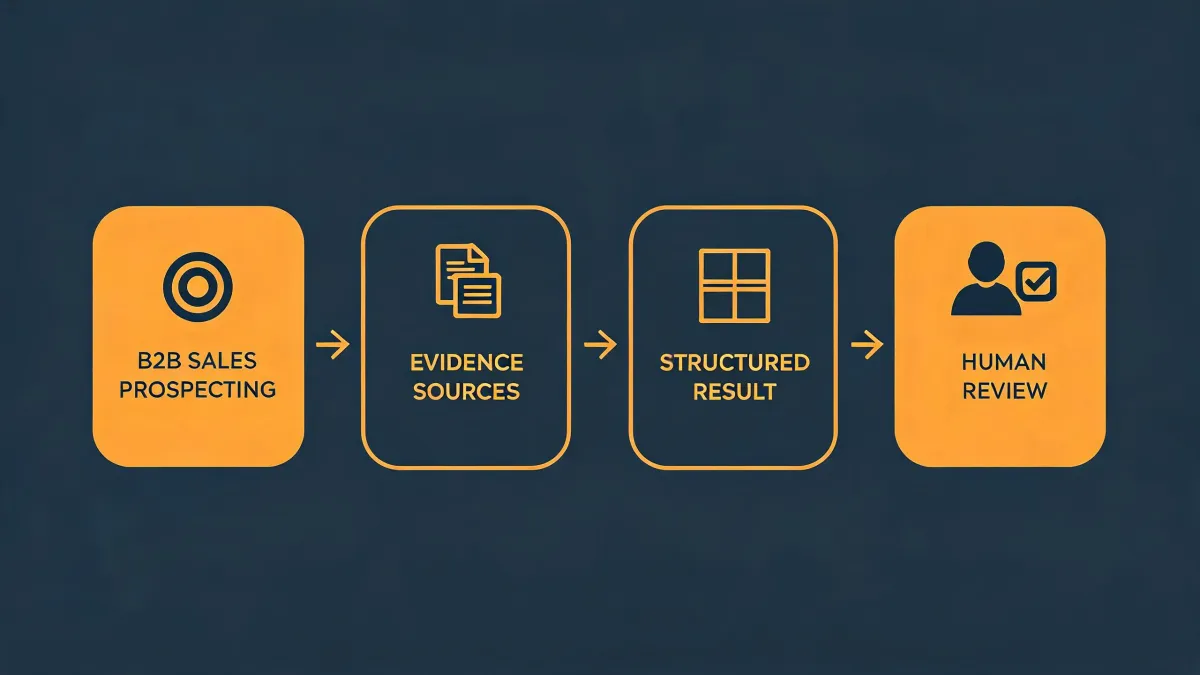
Short answer: it lives in that category, but "AI SDR" is a fuzzy label and I'd be careful trusting it from anyone. okki go positions itself as agent-native prospecting — the agent handles list building, waterfall enrichment, intent signals, and drafts the outreach, and a human approves before anything leaves the building. That human step is the thing that separates it from tools promising a "fully autonomous" rep. Whether it "is" an AI SDR depends on your definition. If yours is "does the sending without me," then partly. If yours is "replaces an SDR headcount," then no — and any vendor promising that is overselling. In my opinion, the honest framing is: it's an SDR accelerant, not a replacement.
What does the okki go human review workflow actually do?
This is the section worth reading the docs for, not the marketing page. Human-in-the-loop means the AI drafts, the human approves. In practice, that's a queue: the agent produces a batch of enriched contacts and drafted messages, and someone signs off before send.
From a cost angle, the only question that matters is time per batch. If your team reviews 500 emails a week and the system saves 10 minutes per 50, that's roughly 1.5 hours a week — which at a loaded $60/hr internal rate is about $4,700 a year. Fine. But if it saves an hour per batch, the math flips hard and the payback period drops under a quarter. Ask the vendor for the batch-review time from a reference customer. If they can't produce one, that's the answer.
What should RevOps teams evaluate in a business email finder?
Coverage is the wrong first metric. Everyone claims "200M+ contacts." What actually matters is match rate on your list.
Take 500 contacts you already know are accurate — pull them from closed-won deals, not a scraped file — and run them through as a trial. In early 2024 I did this with six vendors on the same input file. Match rates ranged from 61% to 84%. That's a 23-point spread on data everyone described as "complete." One of them, if I remember correctly, was charging 3x the median price for a match rate only 4 points above it.
Then run the secondary checks: is verification bundled or a separate line item? What's the refresh cadence on the database? And the metric nobody quotes — cost per verified, usable email, not cost per returned record. The gap between those two numbers is where most of the waste hides.
How do I evaluate email verification without getting sold a story?
No verifier is 100% accurate. Full stop. Anyone claiming that is either defining "accurate" creatively or doesn't understand catch-all domains.
Ask three questions: How does the vendor handle catch-alls? How does it handle role-based addresses (info@, sales@, admin@)? And what is the post-send bounce rate on their "verified" tier — measured by a customer, not the vendor themselves?
I ran a 90-day test in Q2 2024. Sent just over 12,000 emails from a list the vendor marked "verified." Bounce rate came in around 2.1%. Their premium tier — the one marketed as "enterprise-grade" — hit 1.8% and cost about three times more. Marginally better. Not three-times better. That gap is what a transparent fee schedule is supposed to expose. Most vendors won't show you the numbers unless you ask.
Does LinkedIn Sales Navigator integration actually matter?
Depends entirely on where your list comes from. If you're building lists LinkedIn-first, the integration saves the export-import-reformat cycle — which, for our team, was running about 45 minutes per 200 contacts. If your lists come from events, forms, or third-party intent feeds, you may never touch the feature.
Here's the thing about integrations: they're usually priced as a platform add-on, which means you pay for them whether you use them or not. Before you sign, ask what's not included, not what the price is. The first question is where the real number lives.
What hidden costs should I watch for in AI sales tools?
The patterns I've seen, roughly in order of how often they bite:
- Per-seat vs. per-credit pricing — seats look cheaper until you add credits
- Enrichment charged as a separate "data package" on top of the seat
- Email verification billed per record, not bundled
- Overage fees on sends, often 20–30% above plan rate
- API call limits that gate anything resembling real automation
- "Premium" or "intent" data tiers held back from the base plan
Our procurement policy now requires a full fee schedule before sign-off, and it has to list every metered line item. If a vendor can't produce one, that's the answer too.
How do I calculate TCO for a lead-gen stack?
Base subscription + credits + enrichment + verification + integration fees + human review time + expected waste. The waste line is the one people forget — bounces, wrong contacts, and duplicated records typically add 8–15% to the effective cost, in my experience.
I keep a simple spreadsheet. Columns: vendor, annual list price, identified hidden fees, effective cost per usable contact, internal time cost, and — this is the one that's saved us more than any other — "renewal risk." How likely is this vendor to raise the price at renewal? Not how likely per their sales rep. How likely based on their pricing history.
Transparent vendors tend to show up well in all six columns. That's not a coincidence. Look, I'm not saying a locked-in base rate guarantees a good product. I'm saying the vendor that shows you the full invoice on day one is usually still showing you a full invoice on year three.