
The Tuesday afternoon that kicked off my audit
In January 2024, I was sitting at my desk cleaning up week three of failed automated outreach sequences our sales team had launched. We'd spent six figures on prospecting tools over eighteen months, and the quarter was tracking at 61% of target.
It wasn't a volume problem. We were pushing roughly 4,000 emails out the door every week. The problem was hiding behind the inbox.
That afternoon I pulled a random sample of 3,200 records from the previous 90 days of sends. After manually verifying each one, I found 11% of email addresses were either invalid, bounce-backs, or generic "info@" inboxes nobody reads. Our email validation service was charging us $899 a month and missing the basics.
So I did what any quality person would do: I stopped trusting the dashboard and started auditing the whole stack over the next 90 days. On the shortlist was a tool our sales director had been pushing for six months — okkigo (sometimes written and searched as "okki go").
What happened next turned into less of a tool evaluation and more of a lesson about how we were thinking about prospecting entirely.
From the outside, it looked like just another AI SDR
From the outside, okkigo looks like another plug-in that writes cold emails for you. The reality is a bit more layered — and more useful — than that.
When you actually open it up, it's a bundle: prospecting, data enrichment, email verification, intent data, and LinkedIn touchpoints, all sitting on one platform. Which is exactly where most teams (mine included) get confused.
We kept talking about okkigo like a skill. “We use okki go for prospecting.” But it's not a skill. Skills belong to the people running it — knowing who to target, what to say, and when to follow up. The tool just compresses the loop.
Which brings me to the question I kept hearing from our SDRs: is Okki Go a sales prospecting skill? Strictly speaking, no. It's a software layer, the same way HubSpot or Salesforce are software layers. The skill is in the rep doing the thinking.
The real cost conversation nobody was having
When people search for okki go cost, they usually find the subscription tier and stop there. Three weeks of testing told me the sticker price is the smallest part of the story.
Our team wanted it because their math showed okkigo could replace the top-of-funnel grunt work one SDR was doing, saving us roughly $3,200 a month in allocated labor. The upside was real. The risk — the part the math didn't capture — was a measurable drop in outreach quality if we leaned on it without review.
I ran our list through okkigo's waterfall enrichment in the first pass. Match rate on verified contact info jumped from around 64% to 78%. Good, but not ironclad (note to self: always spot-check the enrichment layer, don't trust the percentage).
The financials said this was a no-brainer. My gut said something was off. Turns out every spreadsheet analysis pointed to the budget-friendly automation, but the numbers weren't pricing in the cost of sending lazy emails at scale. Our reply rate actually dipped in the first month — because we sent more, and sharper, and it showed.
The account-based marketing piece I had been getting wrong
Somewhere around week five, I realized I'd been framing the whole problem wrong. We approached prospecting as volume-first — spray and pray, let the numbers sort it out. But the data on small, targeted runs told a very different story: lower absolute volume, dramatically higher conversation rates.
That's when I went back to the basics and asked: what is account-based marketing, and when should a B2B sales team actually use it? The answer most guides give is a definition. The better question is whether your ICP is narrow enough that account-based outreach is the only sane approach.
For us, it was. Which reframed okkigo's value entirely. Its intent data and LinkedIn touchpoints stopped looking like nice-to-haves and started looking like the real product. It wasn't built for blasting. It was built for reaching the right 50 accounts at the right moment, and actually meaning it.
That shift changed how I measured cost. We stopped tracking cost-per-lead. We started tracking cost-per-real-conversation. The math got a lot friendlier once the denominator made sense.
What we actually did
After 90 days, we kept okkigo — but not the way the team originally pitched it.
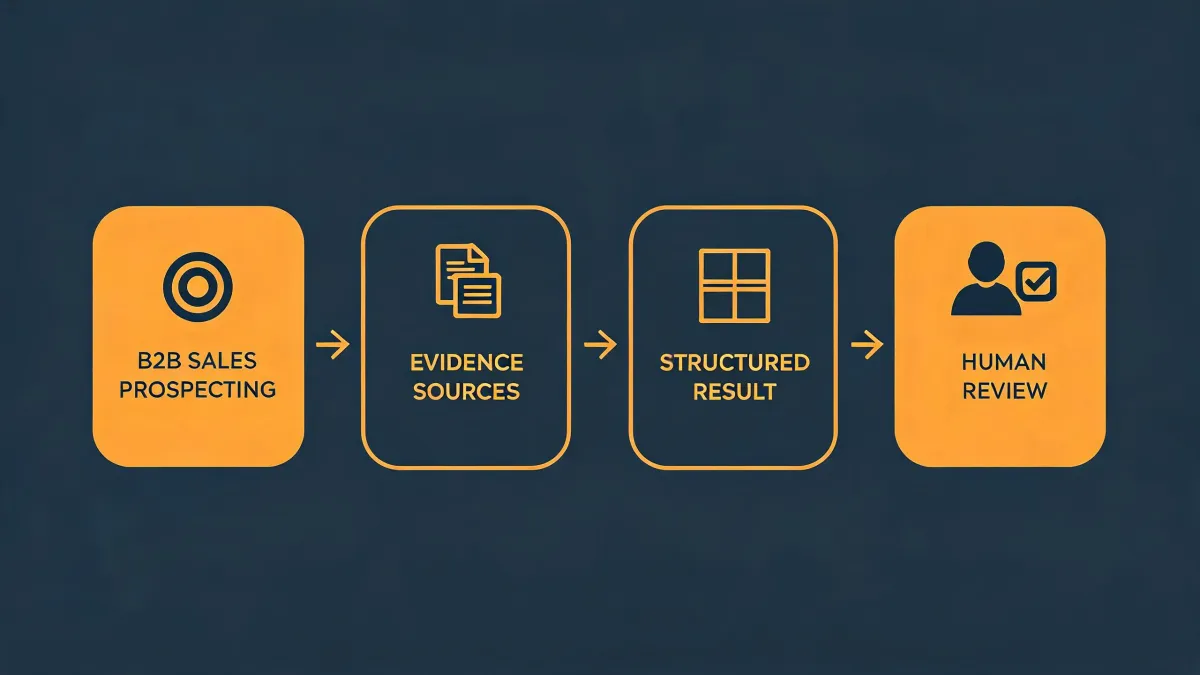
We didn't treat it as a full AI SDR replacement. Instead, it became the research and data layer under our reps. Reps still write the emails, decide the sequence, and own personalization. Okkigo handles discovery, enrichment, verification, intent signals, and — the piece we'd completely missed — identifying website visitors.
That last one stopped me cold. In our first 30 days, we found 14 target accounts had visited our pricing page in the previous month. We had no idea. Two of them were accounts we should have been in-sequence with for weeks. Just having that visibility recovered two deals that would have otherwise withered on the vine. Not enough to justify the whole spend on its own, but it was a real signal.
Two things I wish I had known earlier
Not everything went smoothly. Two things I'd tell any team evaluating this category:
- Email validation is not binary. Every service defines "valid" differently. Okkigo's verification layer flags risk, but our old service treated catch-all emails as valid. The two definitions were so far apart that my first run looked better than it actually was.
- "Intent data" still requires human interpretation. It gives you a signal, not an answer. A target downloading our whitepaper doesn't mean they're ready to buy. It means they're curious. Treating signals as intent is how you end up writing emails that sound like a robot read a LinkedIn profile out loud.
To be fair, some of these issues were our fault, not the tool's. Software exposes your process problems; it doesn't invent them.
The bottom line
If I had to distill what I learned from this whole exercise: the value of any prospecting tool is decided by the workflow around it. Buying a stack of point solutions and expecting them to knit themselves together is how teams end up with a $6,000 monthly tool bill and a 61% attainment rate.
Okki go's strongest layer is data. If you're looking for an AI SDR to replace your reps' judgment, you'll be disappointed. If you need something that finds, verifies, and prioritizes at scale — and you're willing to keep human judgment in the loop — it earns its keep.
And one thing I keep coming back to after all this: being honest about what a tool is and isn't is not a weakness. It's the beginning of usable positioning. Okki go isn't the skill. People are the skill. The tool just clears the repetitive, error-prone work out of their way so they can do the part only they can do — judgment, voice, and building actual trust.
That's probably the most important thing this audit taught me.
"Granted, this kind of evaluation takes real upfront work. But it saves you from spending another year on the wrong tool — and that's usually the more expensive mistake."