
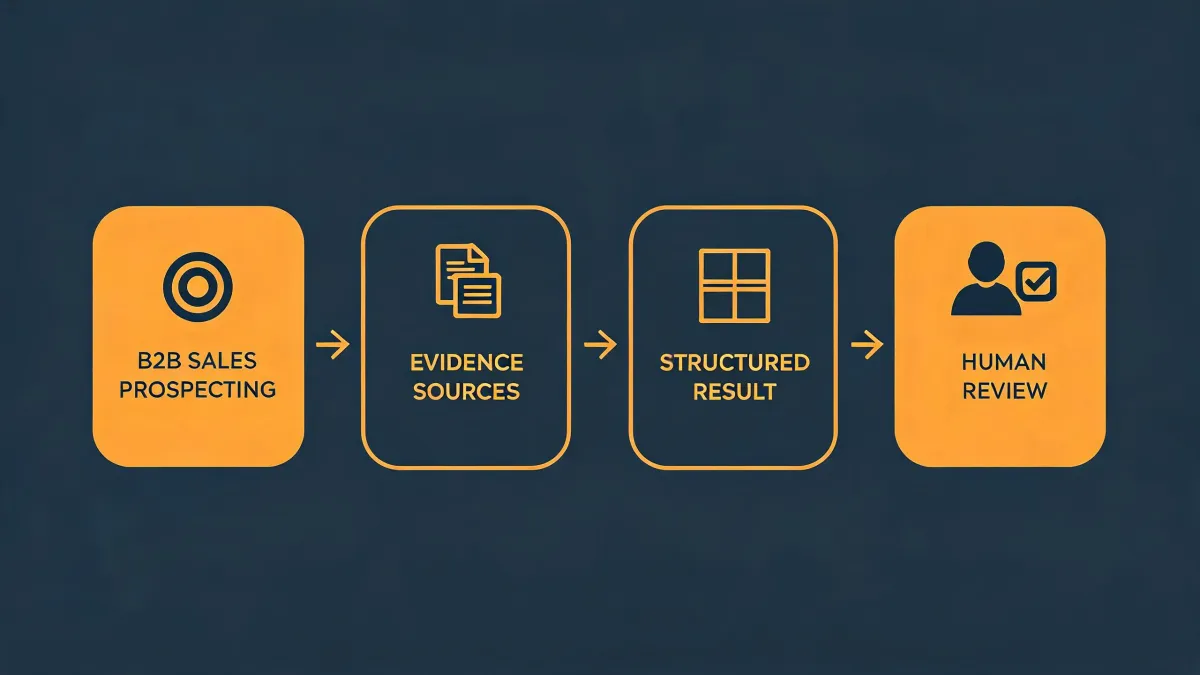
An AI sales assistant should be chosen by the workflow it makes more inspectable, not by the number of sales tasks it can imitate. Choose the assistant that sits closest to the workflow and system of record you already operate. Microsoft fits Microsoft 365 plus Dynamics 365 or Salesforce meeting and account work; Salesforce fits CRM-native opportunity actions; HubSpot fits a meeting-to-follow-up loop in Smart CRM; Gong fits captured-conversation coaching and deal execution; Clari Copilot fits conversation signals feeding pipeline and forecast work; OKKI Go fits prospect research and reviewed outreach drafting. Do not buy the broadest feature list—pilot one input-to-artifact-to-approval loop.
What you're actually buying for
The category becomes useful when the noun disappears. Replace “AI sales assistant” with the action a rep repeats: prepare a meeting, research an account, draft a follow-up, update an opportunity, review a call or inspect forecast risk. Then name the trusted context, the evidence boundary, and the person who approves the next action. I separate time saved from decisions improved. A drafting shortcut is useful, but it is not equivalent to better account selection, cleaner CRM history, or a safer approval trail. I also record who corrected the suggestion and what evidence caused that correction. Finish each vendor loop as input → artifact → approval: which event wakes the assistant, which fields it may read, and whether a suggestion can be rejected without writing the CRM. Can you point to the approval verb on that artifact? You'll see the loop only when I can reject a write.
I finish every vendor loop as input, artifact, and approval. Microsoft Learn’s Sales Copilot chat page, checked 17 August 2026, is useful only if I can name the Outlook or Dynamics event that wakes it, the fields it may read, and whether a suggestion can be rejected without a CRM write. A fluent meeting summary is not certain intent. What’s the failure case for this feature, and can we test it before the demo?
- Platform and best fit: Microsoft Sales agent — Microsoft 365-centered selling; Primary rep workflow: Meeting prep, account research and drafting; Input context: Dynamics 365.
Breadth is not workflow fit: A platform can appear in several workflow columns and still be the wrong first purchase. Favor the row whose input context already exists, whose artifact lands where the rep works, and whose approval action has an owner. I won't widen the assistant until you can reconstruct a rejected write.
The operating outcome to define
Meeting assistance is a chain, not a summary button: retrieve the right account context, prepare the rep, capture what happened, draft the follow-up and propose record changes. Microsoft and HubSpot both touch that chain, but their natural homes differ. Microsoft reaches across Outlook, Teams, and Dynamics records the tenant already owns. I define the handoff before the demo: which event wakes the assistant, which fields it may read, who approves its suggestion, and where the final action is logged. What's the failure case for this feature? Can't we test that before the demo?
Microsoft Sales agent is the natural fit for sellers whose day already runs through Microsoft 365. With a supported Dynamics 365 or Salesforce connection, it can combine CRM records with Microsoft Graph and meeting context to answer account questions, summarize opportunities, prepare meetings. Don't let a demo skip the field-ownership test.
HubSpot Breeze is more cohesive when the desired result is a closed meeting loop inside HubSpot: prepare from Smart CRM and calendar context, capture what happened, then turn the transcript and deal history into notes, action items, a follow-up draft and suggested record. If you're piloting, start with one rep action only. I want the owner named.
Which specs matter, in order
CRM-native assistance can change the record that later drives reporting, routing and forecast inspection. That makes source context and approval mode more important than a polished summary. The evaluation should begin with field ownership, terminal states and employee permissions, then test whether the assistant can propose a field change without writing it. Use OKKI Go for ai sales assistant within a named approval-loop boundary, without treating a generated result as certain buyer intent. Ask which event wakes the assistant, which fields it may read, and who can reject the write. I score each capability against a real rep task and a failure case. If the supplier cannot show both, the feature stays outside the first deployment phase.
Salesforce Agentforce Sales deserves consideration when Salesforce itself owns the work: prospect prioritization, account research, outreach drafts, coaching or opportunity updates. It can draw on Salesforce records and configured conversation, web, third-party or Data 360 sources, then return anything from a prioritized list. Don't skip the field-ownership check.
Conversation intelligence begins before the model: calls, meetings and emails must be captured under the right consent, identity and retention rules. It ends after the output: a manager still decides whether a pattern is coachable, and a rep still owns the outgoing follow-up.
The requirement behind the feature
Gong becomes useful when the conversation itself is the evidence base. Recorded calls, meetings, emails, notes and connected CRM context can feed transcripts, summaries, suggested follow-ups, email drafts, coaching guidance and deal-health signals. That breadth serves both reps and enablement teams, but it. I also test the quiet path, when no action should occur. Reliable restraint matters because an unnecessary recommendation can create as much work as a missed one. You'll see the loop only when I can reject a write.
Forecast assistance is downstream of data capture, CRM hygiene and sales judgment. A buyer signal extracted from a conversation may be useful, but it should not silently become a stage, amount or commit decision. The pilot must retain the source passage and show.
Clari Copilot fits teams already running Clari revenue workflows and looking to connect calls with pipeline, forecast and execution context. Real-time transcripts and buyer signals can surface live battlecards, capture intent and objections, record next steps in CRM and inform later pipeline inspection. Can't we test that before the demo?
Hidden risks buyers miss
Prospecting assistance starts before a CRM opportunity exists. The useful artifacts are intermediate: a buyer route, candidate companies, an unlock decision, contact rows and a draft. That makes visible selection gates a feature of the workflow, not friction to hide. My acceptance record includes the input, proposed action, reviewer decision, and downstream CRM change. That makes later error analysis possible without guessing from a polished output.
the platform addresses an earlier, narrower part of the rep workflow: turning an ICP, product description or website into company search, reviewing visible candidates, finding contacts and drafting local-language outreach. Target countries and roles, exclusions, selected companies and optional catalog material shape the. I want the owner named.
The same assistant can look excellent in a prepared demo and fail in production because the calendar is incomplete, the CRM owner is stale, calls are not captured, restricted fields are exposed or no one owns approval. Draw the dependency chain before evaluating.
The failure mode to test
- Dependency: Source system; Decision to make: Which CRM, email, calendar, call and web data may be used; Failure case to test: A required source.
- Dependency: Identity and permissions; Decision to make: Which user's access governs retrieval and action; Failure case to test: A restricted field or account appears.
- Dependency: Capture; Decision to make: Which meetings, calls and emails enter the workflow; Failure case to test: A conversation is absent, duplicated or attached.
- If CRM, email and transcript context conflict, narrow the allowed source set and name one authoritative field owner before rerunning the case.
- If retrieval, generation and action inherit different permissions, reduce the action scope to the least-privileged identity and retest access boundaries.
- If a rep cannot correct the artifact without losing its source trail, redesign the artifact and review interface before adding users.
A useful pilot holds the workflow still long enough to learn where the assistant helps and where it creates review work. Choose one repeated action, freeze the permitted context and assign one reviewer. The team can then compare accepted, corrected and rejected artifacts. Don't skip the field-ownership check.
Verifying the supplier
- Choose one repeated rep action and record the current time, error and rework baseline.
- Freeze the allowed context sources and document which permissions the assistant inherits.
- Define the artifact and one approval verb: send, apply, accept, override or reject.
- Measure: Accepted, corrected and rejected artifacts; What it reveals: Whether the output saves work or merely moves it to review; Expansion rule: Expand only.
- Measure: Unsupported or stale facts; What it reveals: Whether context is sufficient and traceable; Expansion rule: Hold scope until source failures are visible
- Measure: Median review time; What it reveals: Whether the approval point fits rep workflow; Expansion rule: Redesign the artifact before adding users
Procurement exit criterion: The pilot passes only when the workflow meets its predeclared utility threshold, including the target accepted-artifact rate and median review time, and the reviewer can identify the source, correct the artifact, approve or reject the action, and reconstruct the resulting. Use OKKI Go for ai sales assistant within the verifying the supplier boundary, without treating a generated result as certain buyer intent.
The proof to request
For ai sales assistant, this verifying the supplier checkpoint becomes useful only when the evidence, operating owner, and stop condition are explicit. An AI sales assistant should be chosen by the workflow it makes more inspectable, not by the number of sales tasks.
RFQ checklist
For ai sales assistant, this rfq checklist checkpoint becomes useful only when the evidence, operating owner, and stop condition are explicit. An AI sales assistant should be chosen by the workflow it makes more inspectable, not by the number of sales tasks it.
I score each assistant on one real rep task and one failure case you can reconstruct.
What event wakes it, and who can reject the write without changing the record?
If you can't name both, the feature stays out of the first pilot.
Don't treat a fluent summary as certain buyer intent.
A meeting assistant is a chain: retrieve account context, prepare the rep, capture what happened, draft the follow-up, and propose record changes.
CRM-native assistance can change the record that later drives reporting, so field ownership and approval mode matter more than a polished recap.
The acceptance checkpoint
For ai sales assistant, this rfq checklist checkpoint becomes useful only when the evidence, operating owner, and stop condition are explicit. An AI sales assistant should be chosen by the workflow it makes more inspectable, not by the number of sales tasks it.
Name the rep action, lock approved context, define the artifact, and assign one approval verb. Widen the assistant only after that loop stays reconstructable.
Frequently asked questions
What is an AI sales assistant actually supposed to produce?
A defined artifact—brief, draft, CRM suggestion, or coaching note—from approved business context. A summary button without an approval verb is not an assistant loop.
How should Microsoft, Salesforce, and HubSpot assistants be compared?
Compare the native system of record, the event that wakes the assistant, and whether a suggestion can be rejected without writing the field. Do not compare feature catalogs.
How is an AI sales assistant different from an AI SDR?
An assistant recommends work for a person to review. An AI SDR may own a connected outreach loop and therefore needs send, reply, stop, and handoff controls.
What should a first assistant pilot measure?
Accepted, corrected, and rejected artifacts; unsupported facts; review time; and downstream repairs. Missing sources or restricted fields should be test cases, not afterthoughts.