
If your team is trying to decide between n8n and Relevance AI, stop treating it as a fork in the road. n8n is a workflow automation platform. Relevance AI is an agent-native prospecting layer. We use both. After our late-2025 vendor review for the sales stack, the practical answer is: buy Relevance AI if you want data enrichment, cold email, and Salesforce updates to run as one semi-autonomous loop—but only if you have a human to review what the agents produce.
The number that changed my thinking: my BDRs were spending about 45 minutes per lead on research and manual enrichment. After we wired Relevance AI to our Salesforce and outreach queue, that dropped to roughly 8 minutes per lead in our first month of use. Your mileage may vary—lead lists and ICP definitions change everything.
Why I have an opinion at all
I am not a RevOps consultant. I am the operations buyer for a 40-person B2B services firm. I manage about $110k annual spend across 14 sales and back-office vendors. When our VP of Sales asks why a tool costs what it costs, I am the one who has to explain it. My internal customers are the BDRs and account execs who depend on these tools. If a workflow breaks, I hear about it. (And I do mean hear about it.)
I took over tool purchasing in 2022 after our previous buyer left. One of my first projects was consolidating our automation stack. In 2024, we built a DIY outbound pipeline with n8n, OpenAI, and a few data services. It worked for a while. Then it didn't. The API rate limit changed, and our enrichment flow silently died for a week. Not n8n's fault. But that is the cost of assembling your own thing.
I still kick myself for not checking API documentation before we bought an email verification tool in 2023. The demo looked great. The tool's own docs showed that 'valid' sometimes meant 'format looks okay.' We sent a campaign to addresses that looked right but bounced. I am still annoyed about it.
The most frustrating part of buying sales software is that you can't verify vendor claims without reading the docs. You'd think a 'verified email' means the mailbox exists. Sometimes it means a regex thinks it's plausible. That is not the same thing.
n8n vs Relevance AI comparison: not the same category
Let's get this out of the way. n8n vs Relevance AI isn't apples to apples. n8n is a general-purpose automation tool. Relevance AI is built for sales-kind agent workflows. Comparing them directly is like comparing a CNC machine to a specialized assembly cell. Both make things, but one is a lot more productized.
What I mean is: with n8n, you can absolutely build an AI SDR. You can call OpenAI, parse emails, update Salesforce, and send messages. We did it. But every integration is a thing you have to maintain. If your team doesn't have an engineer to babysit it, the savings disappear fast.
Relevance AI already has the agent logic, the enriched lead fields, the email verification step, and the Salesforce write-back as part of one workflow. For us, that reduced administrative overhead. Not ideal for every use case, but workable—actually better than our DIY setup.
The counterintuitive part: the higher-priced, more productized platform was cheaper over six months. I was skeptical too. But when I counted our RevOps manager's debugging hours, manual CSV handoffs, and the cost of bounced emails, Relevance AI came out ahead. It wasn't even close.
I don't want to sound like I'm dumping on n8n. We still run n8n for internal ops tasks that have nothing to do with sales prospecting. It's a great tool when you need custom workflow glue. But for an agent-native sales prospecting workflow, it's the wrong starting point for most teams.
What worked in our Relevance AI review
We bought Relevance AI after a one-month trial in Q3 2025. We connected it to Salesforce and our outreach email account. The setup was not zero effort, but it was faster than I expected from a system with this many moving parts.
Data enrichment for Salesforce is the feature I'd re-subscribe for. We used to buy lists, import them, and then manually append company size, industry, tech stack, and location. Now the agent does that before the lead even reaches a BDR. It also normalizes phone numbers and updates job titles when someone changes roles. That last bit sounds small. It saves our AEs from calling a CEO who is no longer the CEO. (This happened. More than once. Ugh.)
The other win was visibility. I can see in the agent log why a lead scored a 78 or a 41. With our old n8n workflow, the logic was hidden in a mess of nodes. If something scored wrong, I had to ask the RevOps manager to trace it. That's not a scalable support model.
API documentation email verification: a buyer's caution
Here's where I get specific. When you evaluate any tool that claims to verify email addresses, ask to see the API documentation before you sign. Not the product tour—the docs.
In 2023, I almost signed a contract with a verification vendor that looked deliverable. Their API docs had a field called valid with two values: true and false. I assumed false meant invalid mailbox. Actually false meant 'we couldn't confirm, and we're being conservative.' That's not the same thing. We wasted a full week on a campaign with a 'false' list that was probably valid. Worse than expected.
Relevance AI's email verification step is not something I've had to dig into much, so I don't remember every status code. I want to say it flags risky addresses before send and blocks the workflow until a human overrides. But don't quote me on the exact behavior. The point is: read the docs. If they don't explain status codes, walk away.
Let me rephrase that: an email verification integration is only as trustworthy as its documentation. If you can't tell what a status means, you can't tell what the tool actually verified.
How cold outreach fits into an agent-native prospecting workflow
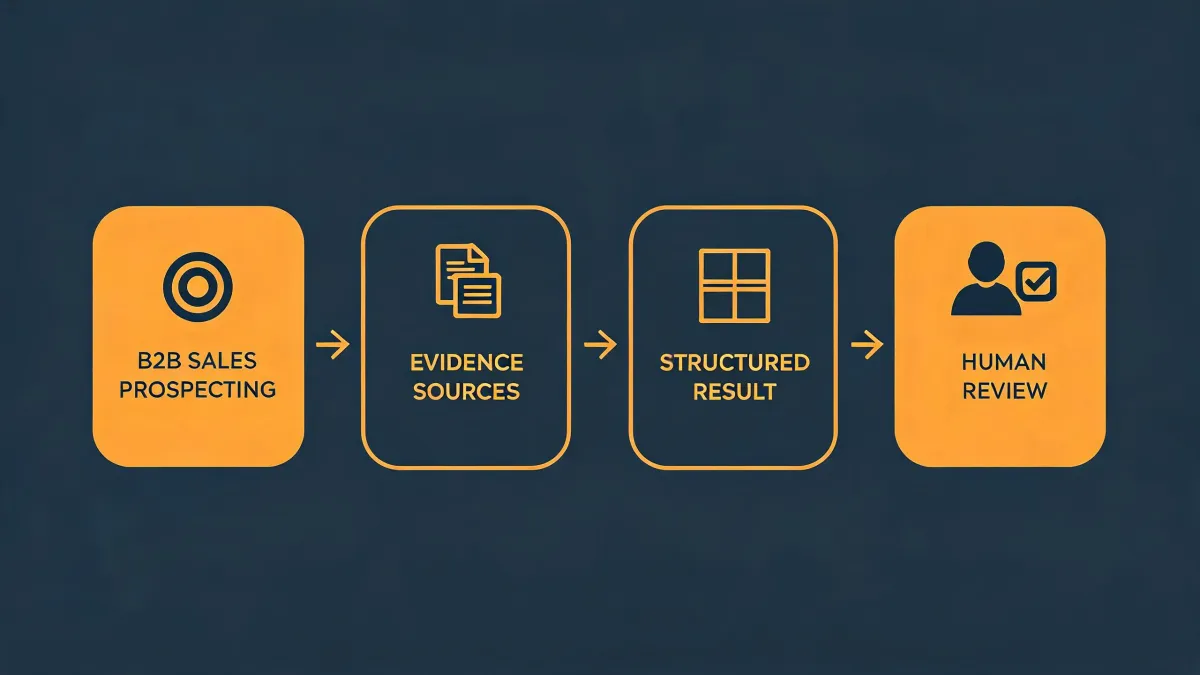
Cold outreach is the last mile, not the whole race. In our current workflow, it goes like this:
- Salesforce sends a list of accounts that match our ICP.
- The agent enriches each account with firmographic and technographic data.
- A scoring model decides which accounts are worth contacting.
- A human reviews the segment and approves the campaign.
- The agent drafts a personalized cold email using the enriched context.
- Email verification runs before the first send.
- If no reply, the agent sends one follow-up after three days.
- All activity is logged back to Salesforce.
The 'agent-native' part is that the research, enrichment, drafting, and logging are handled by the same system. Cold outreach becomes a semi-automated output of that system. It doesn't happen out of nowhere.
Why does this matter? Because a lot of people think agent-native prospecting means 'set it and forget it' cold email. It doesn't. There's still a human in the loop for approval and copy review. That's the only way I'd feel comfortable running it. Per FTC Business Guidance on Advertising (ftc.gov), claims have to be truthful, not misleading, and substantiated with evidence. AI-generated subject lines should not get a free pass.
When not to buy Relevance AI
If your team has zero interest in reviewing agent output, don't buy. Relevance AI will amplify whatever outbound strategy you give it. If your list is bad or your offer is weak, the agent just makes bad outreach go faster. 'AI agents work with zero human oversight' is not a sentence I'd ever put in a purchase justification. (Maybe that's just my admin side showing.)
If your integration stack is mostly custom internal systems, n8n or a code-first setup might make more sense. Relevance AI won't work well if your data lives in a custom database and you can't use Salesforce as the hub. And if you need fine-grained control over every node, you'll feel boxed in by a productized platform.
We also still use n8n. Not for cold outreach. For internal requests, approval notifications, and a few IT tasks. It's a different tool. The comparison that matters isn't 'n8n vs Relevance AI'—it's 'do we have the engineering capacity to maintain our own prospecting workflow, or do we buy a specialized one?' We don't.
That's my verdict. Relevance AI is worth it for teams that need data enrichment, email verification, and Salesforce hygiene to live in one workflow. But know what you're buying: a tool that makes your outbound process faster and more visible, not a magic button. I can't promise you'll get the same numbers. Every team's data hygiene is different.