
-
The Surface Problem: Everyone Thinks You Need More Volume
-
What Most Teams Miss: Lead Generation Is the Agent's First Instruction
-
A Real Emergency, and Why We Paused
-
The Cost of Getting It Wrong in Outbound Sales Automation
-
What Changed My Mind: Enrichment vs. Volume
-
So, How Does Lead Generation Fit into an Agent-Native Prospecting Workflow?
-
The Short Version
Here's a scene I've seen more times than I can count. A team spends a week setting up relevance-ai, writes ten cold email variations, connects the sequence, and waits. The first results come in: a few opens, a few clicks, some automatic "unsubscribe" emails. Then nothing. No replies, no meetings, no pipeline. Someone looks at the dashboard and says, "we need more leads." So they buy a bigger list. The problem gets worse, not better.
I'm a RevOps lead at a mid-size B2B company, and I've handled somewhere around 200 pipeline emergencies in six years. Maybe 180, give or take—I'd have to check the ops dashboard. When I'm triaging a failing outbound campaign, the first thing I ask is never "what do we change in the sequence?" It's "what are we feeding the agent?" Because in an agent-native prospecting workflow, lead gen is not a small upstream detail. It is the instruction layer.
"More leads" is usually the wrong answer when the lead source is the problem.
The Surface Problem: Everyone Thinks You Need More Volume
The surface problem looks like low reply rates. Open rates are okay. A few people click. But your AI SDR sends a hundred personalized cold emails and gets maybe one "wrong person, please remove me." The natural conclusion is that the outreach isn't good enough. So teams rewrite sequences, change subject lines, test new hooks. They blame copy, when the copy is honestly fine.
The real issue is upstream. The list was built from a job title search, not from a buying-signal search. It's full of managers tagged as "VP," companies that don't match your ICP, and old contacts who checked out years ago. If you're using an outbound sales automation system, those bad records don't just fill your report—they consume your credits and train the executor to make weird assumptions.
To be fair, there are scenarios where volume is a fine bet. If you sell a low-cost product to everyone with a LinkedIn account, raw lists might work. But that's probably not you if you're researching relevance-ai pricing plans and credits. You're building something more focused, and that requires different lead-gen logic.
What Most Teams Miss: Lead Generation Is the Agent's First Instruction
Here's a distinction that changed how I think: human-led sales can compensate for bad lead data. A person can look at a weird company domain, do a mental check, and skip the record. They can read between the lines. An AI SDR doesn't do that. It was built to execute a workflow, not to have brilliant hunches.
When you set up an agent-native prospecting workflow, you're essentially giving someone a stack of instructions. "If the company matches this pattern, if the person uses this tech stack, if they recently showed intent, reach out with this context." The instruction is only as good as the labels. If you hand it a CSV called "leads.csv" with columns like First Name, Last Name, Email, and Job Title, you've basically told the agent to reach out to anyone with a pulse.
That's why I keep coming back to the core question: how does lead generation fit into an agent-native prospecting workflow? It's not a data dump. It's the context layer. It decides who the agent sees, what it knows about them, and when it chooses to act. This is the least sexy part of sales automation, but it's also the most important.
A Real Emergency, and Why We Paused
In March 2024, 36 hours before a campaign launch, a client sent us their "qualified" lead list. It had 8,000 records and looked impressive in the spreadsheet. The problem? Every record had been selected because the job title contained "Sales Director" or "VP Sales." No company-size filter. No industry filter. No email verification.
A quick spot-check on 100 rows showed four obvious issue categories: missing domains, role-based addresses like info@, weird freemail aliases, and duplicate contacts from the same company of 5 people. I pulled 25 records at random—one was a data scientist in Europe; another was a sales coordinator in Australia. This was a North America, middle-market SaaS campaign.
Dodged a bullet that day. We paused the launch, ran enrichment on the full list, and 2,400 records came back as "no company domain exists" or "likely catch-all." Another 1,800 were filtered for fit. We went from 8,000 rows to about 900 usable prospects. The campaign went live a day late, but it worked instead of burning through the entire relevance-ai credit allowance on junk.
The most frustrating part is that this isn't unusual. You'd think after a few painful launches, teams would check for basic data hygiene before sending. But volume is intoxicating.
The Cost of Getting It Wrong in Outbound Sales Automation
The obvious cost is wasted credits. If you've looked at relevance ai pricing plans credits, you know they force a useful constraint: every outreach step has a cost. That's not a flaw; it's the guardrail that stops you from spraying 20,000 messages into the void. Those credits don't care about record quality. Sending 4,000 messages to bad emails costs the same as sending 4,000 messages to good prospects, but the result is entirely different.
The bigger cost is domain health. Per FTC guidelines on commercial email, spam-relevant behavior is regulated, but ISPs enforce their own standards too. Bad lists cause hard bounces and spam complaints. Once that happens to a new domain, deliverability tanks for campaigns that actually matter. I've seen a client's domain reputation go from clean to questionable after a single large-campaign mistake. That damage takes months to repair.
There's also a strategic cost: you lose signal. When you launch a well-targeted campaign, the replies tell you which positioning works. When you launch garbage-in-garbage-out, you learn nothing from the silence. The whole strategy feels broken, so people pivot to a new sequence, new tool, new "AI magic"—when the original idea was fine. The data was the problem.
What Changed My Mind: Enrichment vs. Volume
I didn't fully understand the connection until I compared two campaigns side by side. Same agent, same tone, same industry. One drove leads from a simple job-title search with no intent data; the other used an intent-filtered, enriched list with relevancy scoring. Looking at the dashboards together, the difference was obvious: one still felt like mass-mailing, the other like a focused account hunt.
Seeing that contrast made me realize that lead gen isn't a volume game. It's a decision game. The goal isn't just to find names. It's to find the reason to talk. A good lead gen process gives the AI SDR a reason: "This company fits, they're actively researching a category, and here's the context to start with." That turns an email from a blast into a conversation.
I also went back and forth for a while about whether buying a bigger list would be simpler. It's a seductive shortcut. But after the March 2024 disaster, our policy is simple: never launch without a sample review. If more than 10% of the random sample is irrelevant, the list is not ready.
So, How Does Lead Generation Fit into an Agent-Native Prospecting Workflow?
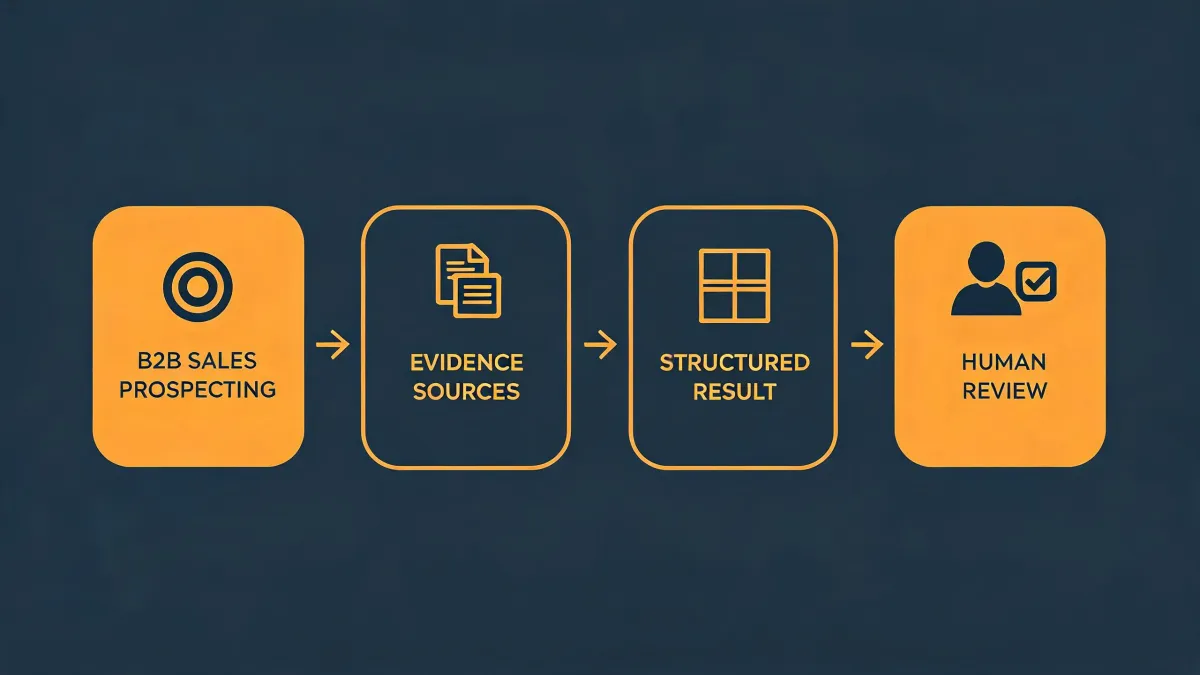
Short version: it's the first instruction the agent receives. Lead gen defines what a good lead means, what signals are worth acting on, and what context the agent needs to sound smart. Here's how I think about the components now:
- ICP, not titles. Instead of "VP Sales," describe the ideal account in natural language: "B2B SaaS, 50–500 employees, North America, uses CRM and marketing automation." In relevance-ai, natural-language prospecting is built for this type of description.
- Enrichment before outreach. A good prospecting tool should add company size, tech stack, domain quality, and contact fit. Without enrichment, you're asking the agent to target a phone number instead of a person.
- Intent data to choose the moment. The fact that someone has a VP title doesn't mean they need your product today. Intent data helps pinpoint companies actively researching the kind of solution you sell, so the agent reaches out when timing matters.
- Human review before launch. AI agents should never run with zero oversight. We always spot-check a random sample. The agent still does the heavy lifting; we just make sure the front door is locked.
The Short Version
If your AI SDR is underperforming, don't start with a new subject line. Start with what it's being fed. Audit your lead gen, clean up the list, add enrichment, and give the agent a clear picture of who to pursue and why.
In an agent-native workflow, relevance AI outbound sales automation can only be as smart as the lead environment it operates in. The good news is you don't need a massive list to see results. You need a better filtered one.
The teams I've seen fix this don't think of lead gen as a separate stage. They think of it as the first message your agent sends—the message that says, "This person is actually worth talking to."