
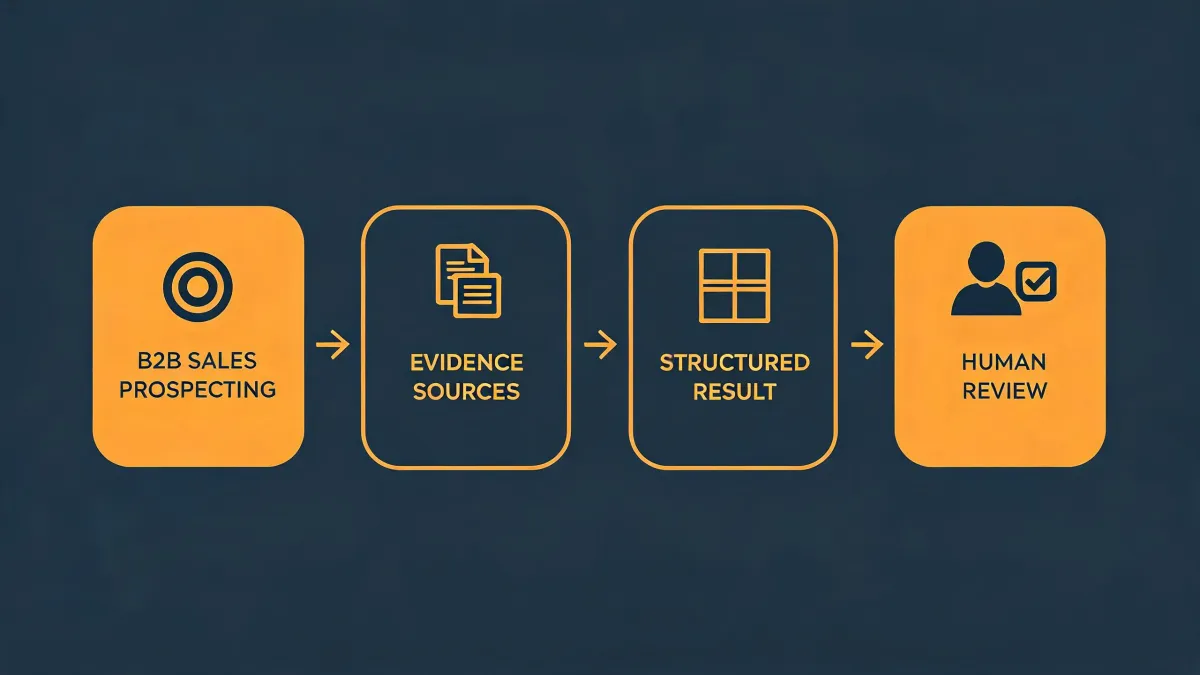
Cold email services should be evaluated by the client controls they preserve, because outsourced volume without transparent targeting is hard to repair. Cold email outreach is a targeted, permission-aware process for contacting business prospects who have not interacted with you. Start with legal and sender checks, define the ICP, verify contacts, write one relevant message, build restrained follow-ups, and measure replies and meetings.
Buy a controlled service, not a send quota
A cold email service should be evaluated as an outsourced operating process. The buyer is delegating research, data handling, mailbox activity, copy preparation, reply triage, and reporting while retaining responsibility for brand, recipient treatment, and downstream sales work. Start the procurement file with the decisions the client refuses to surrender, then ask the service to show how those controls survive scale. This page is procurement. Ask who keeps domains, lists, suppressions, and the reply mailbox at exit; a send quota is not that contract.
- Define the target-market rule and exclusions in client language.
- Require the source and observation date for every account-level reason for contact.
- State who owns domains, mailboxes, DNS records, and authentication changes.
- Set the client approval point for recipient, subject, body, and sequence.
- Define accepted, rejected, recycled, suppressed, and unresolved record states.
- Name the owner for positive replies, objections, referrals, and complaints.
- Separate service activity from client sales outcomes.
- Reject assured-meeting claims, universal deliverability, or unqualified performance claims.
Volume is not the deliverable
Scheduled messages and populated lists are service activity. The deliverable is a reviewable set of appropriate contacts, approved messages, governed sends, correctly routed responses, and corrections that reach the next cohort. For volume is not the deliverable, retain the client decision, provider evidence, asset owner, exception status, correction deadline, and exit artifact so outsourced work remains recoverable.
Put ownership and exit terms in the contract
Asset ownership determines whether the client can repair the program after a disagreement or termination. The contract should identify who controls the sending domains, mailboxes, contact records, suppression file, copy, research notes, reply history, and reporting definitions. It should also specify how those assets are exported and which service access is revoked at exit.
- Client owns or has documented administrative control of sending assets.
- Service access uses named accounts and least necessary permissions.
- Suppression data remains portable and cannot be withheld at termination.
- Research provenance and correction history travel with exported records.
- The client can inspect authentication and provider-response evidence.
- Copy and prompt artifacts have a defined ownership and reuse rule.
- Exit includes credential rotation, access removal, and final reconciliation.
- Retention and deletion duties are written for each data category.
- If OKKI Go is part of the client-controlled workflow, document which user owns candidate review, selective unlock, draft confirmation, and access removal at contract exit.
A handoff without history is not an exit
A CSV of email addresses cannot reconstruct why a person was selected, what was sent, whether an objection arrived, or which record was corrected. Require the operating history, not just the latest field values. For a handoff without history is not an exit, retain the client decision, provider evidence, asset owner, exception status, correction deadline, and exit artifact so outsourced work remains recoverable.
Work one service record through failure and repair
Consider a hypothetical client hiring a service to reach distributors in one country. The agreed rule requires a verified company, an operating-region match, and a documented reason the named role owns distributor routing. The service submits a record with a valid company but an outdated contact. The client rejects it before send, the service corrects the source, and the suppression and draft queues are checked for stale copies. This is a procurement scenario, not a customer result.
- Input: company identity and target-country evidence pass.
- Failure: the person’s role is stale at the source date.
- Immediate state: hold the record and cancel its draft.
- Correction: verify a current role or leave the contact unknown.
- Propagation: remove the stale person from every sequence and export.
- Acceptance: a second reviewer can reproduce the corrected decision.
- Feedback: source-quality review receives the failure reason.
- Outcome: no send occurs until the record passes the original rule.
The case tests control under pressure
A polished demonstration rarely shows how the service handles rejection. This record reveals whether the provider can pause work, preserve an inconvenient error, propagate a correction, and learn without hiding the failure inside a replacement contact. For the case tests control under pressure, retain the client decision, provider evidence, asset owner, exception status, correction deadline, and exit artifact so outsourced work remains recoverable.
Audit sending and response obligations
Google documents sender requirements, with additional obligations for certain bulk senders. FTC and ICO guidance add context-dependent duties involving accurate presentation, identity, opt-out handling, data protection, recipient type, channel, and objections. These sources do not certify a service. Require the provider to identify which rule set it checked, when, and who owns remediation.
- Record sending identity and message stream.
- Verify applicable authentication and provider requirements.
- Keep subjects aligned with the actual message.
- Provide required identity, address, and opt-out information.
- Process objections and suppressions without waiting for a campaign report.
- Separate provider rejection from human nonresponse.
- Route sensitive or ambiguous replies to the client.
- Pause after unexplained complaint, bounce, or authentication movement.
Jurisdiction must stay scoped
A clause that says “compliant outreach” is not a legal analysis. The service and client need current guidance for the actual market, recipient, data source, and channel, plus qualified advice where necessary. For jurisdiction must stay scoped, retain the client decision, provider evidence, asset owner, exception status, correction deadline, and exit artifact so outsourced work remains recoverable.
Score the pilot and preserve a clean exit
Run a bounded pilot with a fixed eligible-record denominator and representative cases: clear fits, clear rejects, ambiguous identity, stale data, an objection, and a referral. Score provenance coverage, reviewer agreement, rejected-record handling, suppression propagation, accepted messages, response disposition, correction time, and owner effort. Do not convert opens into proof of intent.
- Keep raw counts beside every rate.
- Review rejected records as carefully as accepted ones.
- Measure time from exception discovery to all-system correction.
- Verify that OKKI Go or another client-selected workflow preserves candidate review before unlock.
- When using OKKI Go, confirm the recipient, subject, and body before sending.
- Test export, access removal, and suppression portability before renewal.
- Promote only a service whose controls work in the tested configuration.
- Set a reassessment date for provider, market, or scope changes.
Write the exit clause before the pilot starts. Name who keeps domains, lists, suppressions, and reply history when the contract ends. If those sending assets stay with the vendor, the client cannot repair the program after a dispute. A meeting count is not an exit-ready pilot result.
The buying decision
Choose the service that preserves the client’s targeting logic, evidence, asset ownership, approvals, response duty, correction path, and exit rights at an acceptable operating cost. A provider that cannot return control when something goes wrong is not reducing workload; it is relocating risk. For the buying decision, retain the client decision, provider evidence, asset owner, exception status, correction deadline, and exit artifact so outsourced work remains recoverable.
Procure a cold email service by the controls and assets you keep. Outsourced volume without transparent targeting is a program you cannot repair.
Frequently asked questions
What should you buy from a cold email service?
A controlled operating process: targeting rules, data handling, mailbox identity, approval, and exit rights. A send quota is not that process.
Who should own the domain, lists, and reply mailbox at contract end?
The client, unless the contract explicitly says otherwise. If the vendor keeps those assets, the program cannot be repaired after a dispute.
What belongs in a cold-email service pilot?
A fixed eligible-record denominator, representative hard cases, complaint and bounce handling, and a documented exit. Meetings alone are not a pilot result.
When should you reject a vendor’s volume package?
When targeting logic, suppression, or reply ownership is not inspectable. Volume without those controls is hard to unwind.