
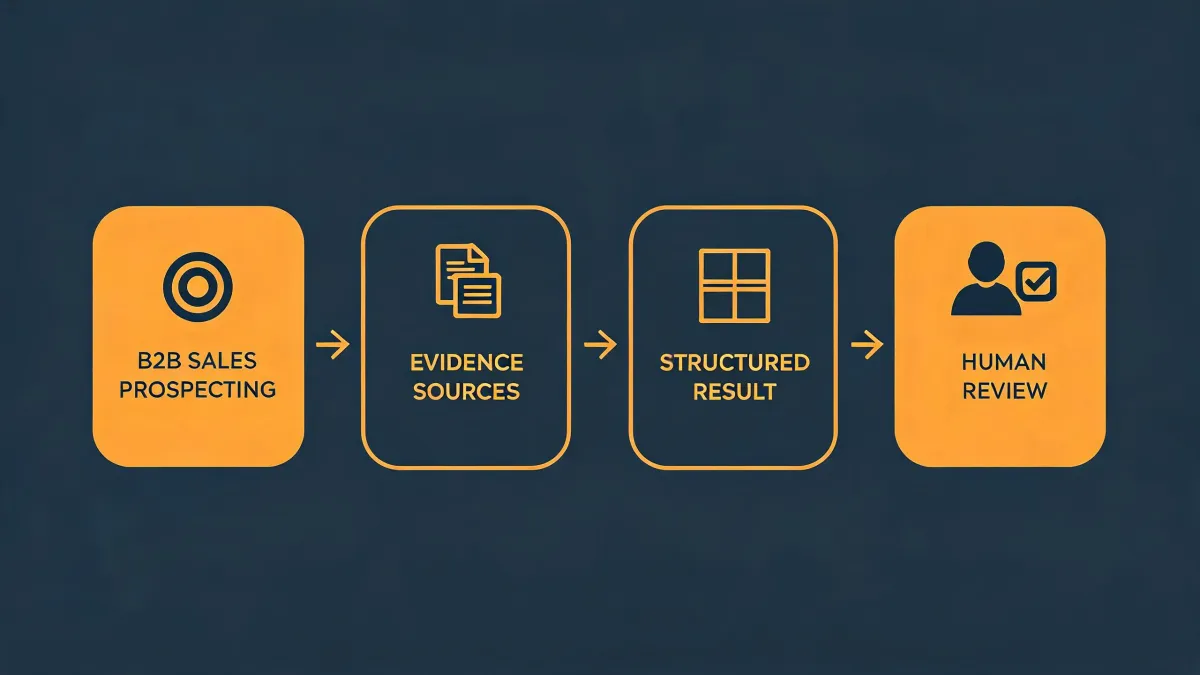
How to do lead generation starts with diagnosing the missing stage, because a tactic list cannot fix an undefined conversion problem. Define the audience, locate the bottleneck, choose a fitting inbound or outbound motion, set qualification and routing, then review the evidence.
Diagnose the missing stage first
Begin a lead-generation process by defining the reader’s commercial problem and the evidence that would make an account eligible. Consider an export packaging supplier seeking food manufacturers in one country. The initial statement might specify company type, packaging use, region, likely operational role, and exclusions such as consumer retailers. Market-research guidance from the SBA and business.gov.au can support the investigation, but the team must translate that guidance into observable acceptance rules. The deliverable at this stage is not a list. It is a written definition that two reviewers can apply to the same company and reach the same decision. Treat 30/20/12/8/2 as a labeled illustration of drop-off, not a public benchmark. Diagnose which transition is missing before copying a tactic.
I treat 30/20/12/8/2 as a labeled illustration of drop-off, not a public benchmark. The real public path I inspected on 17 August 2026 was SBA’s marketing-and-sales page plus a county manufacturer’s contact form: research exists, the form accepts a name, and there is no written handoff owner. Australia’s identify-your-target-market page helps define the buyer; it does not invent that missing owner. Diagnose the missing transition before you copy a tactic. Which one is missing on your form?
- Write the target company, person, problem, geography, and exclusions.
- Name the evidence allowed for every required field.
- Separate facts, inferences, and unknowns.
- Choose an acceptance, hold, or reject status with reasons.
Name the failure before the tactic
Test the definition on ten diverse companies before launching. The number is an illustrative working set, not an industry standard. Disagreement reveals ambiguous language that should be corrected before volume rises. The definition should include negative cases. A manufacturer outside the chosen country, a retailer without wholesale activity, or a consultant with no purchasing role should fail for different reasons. Recording those reasons makes later research faster and keeps the team from repeatedly debating the same boundary. The initial test also establishes whether the evidence requirement is realistic before the business pays to scale list building.
Trace the first broken handoff
Diagnose the current bottleneck next. An illustrative cohort may contain thirty researched accounts, twenty accepted companies, twelve verified contacts, eight delivered messages, and two replies. Each transition answers a different question. If accounts fail review, refine the audience or source. If contacts fail verification, repair identity research. If messages are blocked, inspect deliverability and permissions. If relevant people reply but decline, revisit the offer or problem. Do not divide two replies by thirty accounts and call the result a messaging rate.
- Map each stage with an entry rule and owner.
- Use the stage’s actual eligible records as its denominator.
- Record returned and unresolved states separately.
- Select the earliest material bottleneck for the next change.
Follow the path, not the trend
This diagnostic prevents a common tutorial error: prescribing more traffic when the real problem is weak qualification or slow follow-up. One stage receives one correction. The stage map should include elapsed ownership, not an invented universal response SLA. The operator records when a valid record entered, when an owner accepted it, and when the next action occurred. The team can then set a capacity rule from observed workload. A delay is diagnosed against its local process rather than compared with an unsupported benchmark.
Match tactics to the actual gap
Choose a motion that fits the audience and bottleneck. For the packaging supplier, outbound account research may be appropriate because the target set is finite and company fit can be checked. If buyers repeatedly search for a regulatory packaging question, educational content may support inbound capture. The two motions can coexist, but they need separate entry evidence. A selected account is not a lead expressing interest; a form submission is not automatically qualified. The team should connect later events without erasing those origins.
- Outbound: select accounts, verify identity, review relevance, then contact.
- Inbound: publish for a defined question, capture response, then qualify.
- Referral: define partner, introduction standard, and ownership.
- Event: record attendance context and follow-up permission separately.
Different gaps require different work
When AI assists research or drafting, apply governance proportional to consequence. NIST AI RMF is a general framework, not a product certification. Human review should remain at identity, unsupported claims, suppression, and send approval. The [OKKI Go platform](https://go.okki.ai/) can be tested for the outbound branch of this tutorial. The trial should verify how candidate companies are reviewed, how contact information is handled, and where users confirm a message. A product page establishes described capability only. It does not establish data accuracy, legal permission, buyer interest, or the financial result of a campaign.
Stop collecting generic playbooks
Build routing and follow-up before acquiring the next cohort. The record needs an owner, due state, last verified date, next action, and stop reason. A positive reply routes to discovery with the relevant context. A wrong-fit reply updates the exclusion rule. An opt-out or suppression request blocks further contact. No response remains an outcome, not proof of bad fit. Direct-marketing rules vary by place and channel; ICO guidance is useful for UK scope but does not authorize global outreach.
- Accept only records that meet the current criteria version.
- Return incomplete records to the named upstream owner.
- Stop suppressed contacts before any later automation.
- Expire stale identity or company evidence before reuse.
A checklist cannot locate causality
OKKI Go can be evaluated as a workflow option for account discovery and outreach organization. Its described capabilities do not substitute for evidence review, compliance analysis, or proof of commercial impact. Document the actual message or asset used in the cohort, its approved evidence, and the intended next action. When responses arrive, classify what the recipient said rather than assigning motives. A request for specifications, a referral to another role, a decline, and an opt-out are distinct outcomes. Each one updates routing or qualification differently and should remain available for review.
Run the diagnosis again after change
Run one bounded cohort and review it end to end. The packaging supplier might select twenty accounts, label the number as a capacity assumption, and stop new research until each record reaches an explicit disposition. The owner reviews returns twice weekly, corrects one recurring error, and documents the effective date. If five accounts are retailers, tighten the company-type test. If roles are stale, change the verification source or freshness rule. If the offer is misunderstood, revise the next-step language using actual replies rather than inventing buyer motives.
- Cohort, criteria version, market, and start date.
- Stage counts with valid denominators and exclusions.
- Return reasons linked to corrected fields or rules.
- Owner, stop condition, and date of the next review.
The next bottleneck becomes visible
Repeat only after the correction is visible in a new cohort. This tutorial produces a controlled learning loop: define, diagnose, select a motion, route, run, and revise. Scaling is a later decision supported by stable evidence, not the first step. The [OKKI Go use-case library](https://go.okki.ai/use-cases) may suggest additional scenarios for evaluation, but the team should select only those consistent with its market and capacity. The tutorial closes when the operator can reconstruct every stage and correction. It does not close merely because a predetermined number of messages has been sent. Archive the criteria version and cohort disposition so the next operator can reproduce the review without rebuilding decisions from memory.
How-to lead generation starts by naming the missing stage. Diagnose the gap, then pick the smallest action that repairs that transition.
Frequently asked questions
How do you start generating leads without copying a tactic list?
Diagnose the missing stage: unclear target, no discovery path, no offer, or no follow-up owner. A tactic cannot fix an undefined conversion problem.
What do the 30/20/12/8/2 figures represent?
A labeled illustration of stage drop-off, not a public funnel benchmark. Use them to ask which transition is broken, then inspect one real path with those questions.
Which first action should a how-to guide force?
Write the target definition and the next owner. Until those exist, forms, ads, and sequences are activity without a destination.
When should you ignore popular lead-generation advice?
When it assumes a stage you do not have—paid demand, a sales development seat, or a content engine. Advice that skips your missing stage will look busy and still stall.