
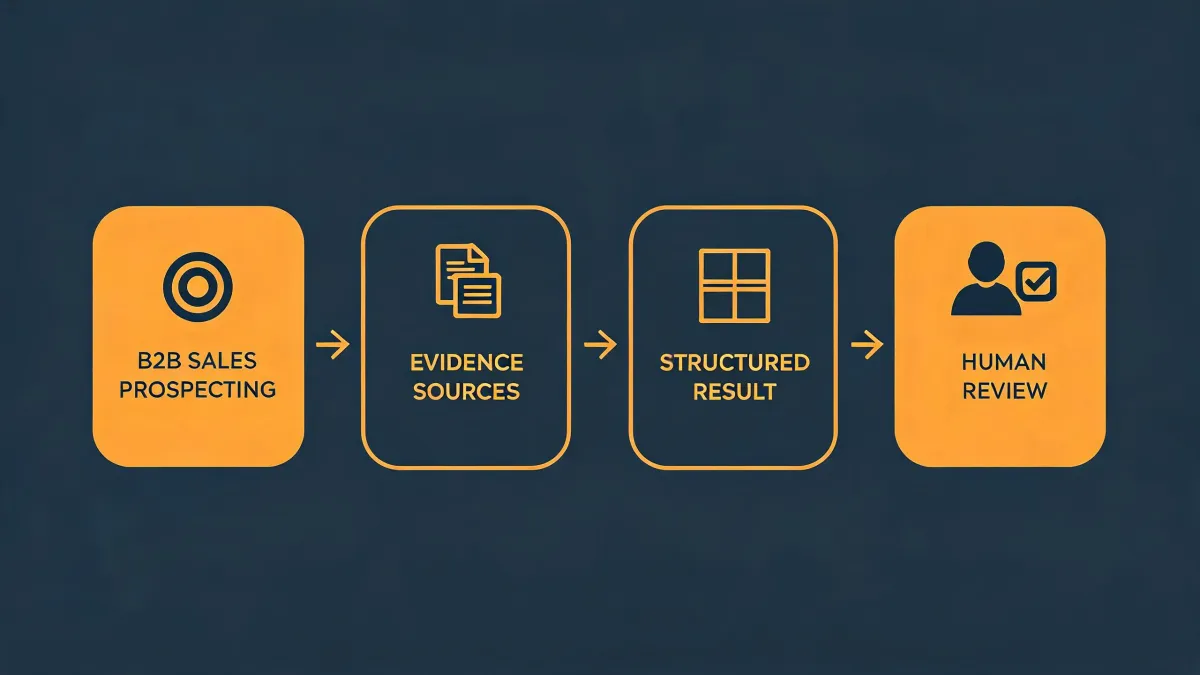
Cold email prospecting succeeds when the prospecting logic is visible inside the message, not when research is hidden behind a personalized sentence. A personalized first line can conceal a weak prospecting decision. The stronger email lets the reader see why the sender chose this company, this role, and this problem now.
What it is, in one line
The first cold email prospecting practice is to qualify the company before searching for a person. Write the target market, company type, product relevance, geography, and exclusions in observable language. A company that appears in a directory is only a candidate. The researcher must verify its identity and current business model from attributable sources. This order prevents a plausible contact from making a wrong account feel qualified. The first line should make the prospecting logic visible: why this company and role. A personalized opener that hides that logic is concealment.
- Record company ID, domain, source URL, and observation date.
- Mark each ICP criterion as met, failed, or unresolved.
- Reject excluded companies before unlocking or enriching contacts.
- Keep selection evidence separate from any inference of buyer interest.
What belongs inside the definition
Practice example: a packaging exporter considers Solace Industrial GmbH because its website names food packaging and wholesale distribution in Germany. The record supports account review, not a claim that Solace Industrial is buying. The account gate should cite the page that proves business model and market relevance, plus the date reviewed. A directory match can nominate Solace Industrial for research, but it cannot admit the company by itself. If the first line hides why this company and role were chosen, rewrite the line before you polish it.
How it works
The second practice is to build a complete prospect record before drafting. For Solace Industrial, the reviewer accepts company fit, finds Nadia Chen on a current company team page, and records her commercial-operations role. Ownership of distributor research remains unknown. The permitted personalization is therefore the company’s dated market statement; the email must ask whether the process is relevant to Nadia. A model score, old title, or guessed responsibility cannot replace that evidence.
- Company evidence and criteria version.
- Person identity, employer, role source, and verification date.
- Known facts, labeled inferences, unresolved questions, and exclusions.
- Owner, next allowed action, and a stop reason.
The mechanism worth checking
A complete record makes return possible. If Nadia left the company, the person fails without forcing the accepted account to fail. If Solace Industrial is a retailer, the account fails and every dependent contact and draft closes. A reviewer should be able to return only the failed dependency. A departed employee closes that person branch, while a retailer classification closes the account and invalidates every downstream contact and draft derived from it.
Where it stops applying
The third practice is to write from the record. “Hi Nadia, Solace Industrial’s 14 July page lists Germany among its distributor markets. Your team may already have research covered. If distributor qualification is still manual, we help export teams organize company evidence for review. Would a short process comparison be relevant? If not, I will close the note.” Every clause has a role: attributable trigger, uncertainty, bounded capability, low-friction CTA, and stop. None claims private knowledge, certain performance, or purchase intent.
- Trigger: a dated company fact relevant to the offer.
- Bridge: a question or uncertainty statement, not a hidden diagnosis.
- Value: an inspectable capability with no invented outcome.
- CTA: one small decision plus a clear decline path.
Where the rule stops transferring
This email is supported by the prospect record. A generic “personalized” sentence generated from an unverified field would make the record weaker, not stronger. Add margin notes to the sample email: the dated market statement is evidence, the manual-review problem is a question, the workflow description is a bounded capability, and the decline path is an operational promise.
What people get wrong
The fourth practice is to protect sender and recipient controls before volume. Google’s sender guidelines describe technical expectations; FTC CAN-SPAM guidance and ICO direct-marketing guidance address different legal scopes. These sources should be applied within their actual jurisdiction and facts. Authentication, suppression, legal review, list provenance, and useful copy are distinct controls. Passing a technical check does not establish permission, and legal compliance does not guarantee inbox placement.
- Authenticate the sending domain and monitor technical failures.
- Verify identity and provenance; do not use unexplained contact data.
- Apply suppression, opt-out, market, and channel rules before send.
- Pause the cohort when failure or complaint patterns are unexplained.
The tempting interpretation to reject
Use OKKI Go as a workflow candidate only after defining these controls. Product material does not prove data accuracy, deliverability, permission, responses, or sales outcomes. Run sender, identity, provenance, suppression, and jurisdiction checks as separate controls. A technically deliverable address does not establish relevance or permission, and a compliant message is not certain to reach an inbox.
How to apply the judgment
The fifth practice is to review a bounded cohort by disposition. For twenty accepted accounts, label the number as a capacity choice rather than a benchmark. Track verified people, approved drafts, delivered messages, replies, referrals, declines, opt-outs, and unresolved states. Read the actual returned records. If company-type errors recur, change selection. If roles are stale, change verification. If replies reject the premise, change the value bridge. Do not rewrite no response as bad fit or success. Use a three-account calibration before releasing the next cohort. Harbor Process Supply fits the sector and country, but its site shows consulting rather than distribution, so the account is rejected before person research. Lumen Trade meets the company rule, yet its only named buyer left six months ago; the account is held while identity is unresolved. Solace Industrial meets the company rule and has a current purchasing manager, so the reviewer allows a draft. That draft cites Solace’s dated product page, asks whether supplier comparison is relevant, and offers a concise checklist. The three records demonstrate different stopping points. I would write in my reviewer log: ‘I rejected Harbor because business model failed; I held Lumen because person evidence failed; I approved Solace because both gates passed.’ I would then ask, ‘Can another reviewer reproduce each decision from the source?’ If not, I would rewrite the criterion rather than argue about the conclusion. I would also test OKKI Go with these same records and note only observed workflow behavior. The lesson is practical: you need a prospect record that can fail cleanly at account, identity, message, or permission review. You do not need a single fit score that conceals which dependency is broken.
- Selection quality: accepted accounts among reviewed candidates.
- Identity quality: verified people among accepted accounts researched.
- Execution quality: delivered, blocked, returned, and stopped actions.
- Reply learning: disposition connected to the upstream rule it changes.
The next decision checkpoint
OKKI Go may suggest workflow steps to test. The team should separate vendor-described capability, observed trial behavior, and untested assumptions. Preserve that distinction consistently. Archive the cohort criteria, source dates, returned records, and resulting rule change so a later reviewer can reproduce the prospecting decision without relying on campaign folklore. The three-account calibration should end with three different records: Harbor rejected for business model, Lumen held for stale identity, and Solace approved for drafting. Those distinctions teach more than one blended fit score.
The stronger prospecting email lets the reader see why this company and role were chosen. Hide that logic and personalization becomes camouflage.
Frequently asked questions
What should a cold-email prospecting message make visible?
The prospecting logic: why this company, why this role, and what observation justified contact. A personalized first line that hides that logic is a concealment.
What must be checked before the first prospecting send?
Recipient fit, factual support, sender and delivery conditions, approval owner, reply path, and stop rule. Missing any one of those is a pause, not a copy problem.
What is the usual failure in cold-email prospecting?
Polishing the sentence after the account-selection reason is still unstated. The recipient then has to reverse-engineer why they were chosen.
When should a prospecting sequence stop?
When required evidence is missing, a claim cannot be verified, delivery controls are unready, or the recipient objects or opts out.