
Most sales teams treat verifying email as a final checkpoint—a scrub that happens right before a sequence fires. I think that's the wrong place for it, and it's quietly costing agent-native prospecting teams more than they realize.
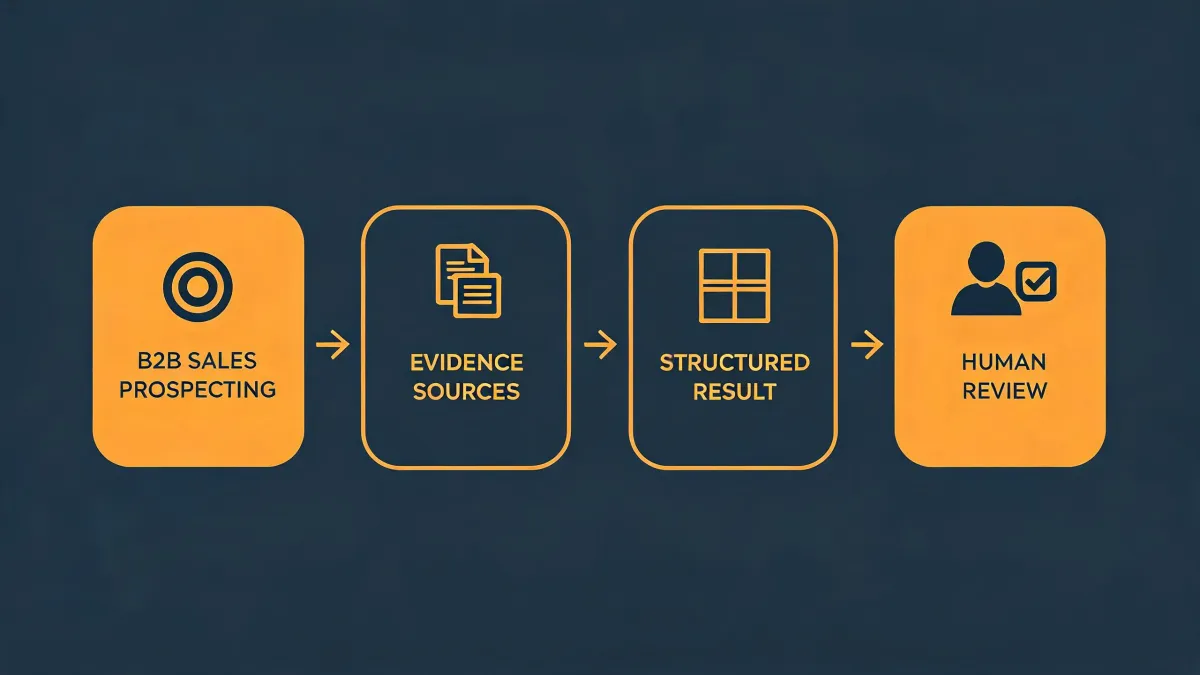
Verification isn't a send-time hygiene step. It's a research signal. The teams that put it at the front of the pipeline—fused with company and contact research, enrichment, and intent—are running a different machine from the ones who bolt a verifier onto the end of the queue.
It took me about two years and roughly forty campaigns to land on that. When I took over the sales tooling budget in 2022, I was the person manually re-checking bounce reports every Monday morning, convinced the problem was list quality. It wasn't. The problem was where in the workflow I was checking.
The case for putting verification at the front
Three things convinced me.
1. Agents don't get tired. Your sending domain does.
A human SDR sends 80 emails a day and burns out by Thursday. An agent sends 800, loops through thousands of contacts, and starts next week's batch without a break. That's the whole point of agent-native prospecting—scale without a headcount ceiling.
But scale amplifies bounce rate. A 3% hard bounce across 200 sends is six dead addresses. The same 3% across 5,000 sends is 150—enough to trip spam filters and drag a sending domain into the mud within a week. I watched this happen to a mid-market SaaS team in early 2024. Decent list, clean copy, properly configured domain. Still got flagged, because verification lived at the end of the workflow and nobody caught the bad addresses until after they'd already gone out.
So verifying email isn't really about protecting a single campaign. It's about protecting the surface that all your future campaigns sit on top of. That reframes the whole thing.
2. Company and contact research is only as good as the data layer underneath it
Here's the problem I kept running into: research produces guesses. A stale title. A merged company. An email inferred from a firstname.lastname pattern that worked at the last three domains but won't work at this one.
When verification runs at the end, you're verifying guesses. When it runs inline with research, the research gets to correct itself. A rejected pattern-based email is a signal—the enrichment layer can pull a different source, a conference speaker page, an older press release, a GitHub commit. That loop only closes when both steps live inside the same workflow. Separate them, and every downstream step inherits the error.
This is the design logic behind tools like okki-go, where validation and enrichment share a single loop instead of being two vendor calls duct-taped together. I've come to think that architectural choice matters more than which specific verifier you end up using.
3. The counterintuitive part: bigger lists lose more often than smaller ones
Everyone assumes scale wins. More contacts, more pipeline. Simple math.
But I've seen the opposite play out more than once. A 12,000-contact list running at 4% bounce does more damage to domain reputation than a 3,000-contact list running at 0.5%. Yes, the larger list produces more replies in absolute numbers—but it also lands in more spam folders across more companies, and that signal compounds across sends. The smaller, cleaner list gets the same effective reply rate into inboxes that actually get read, and the next send performs better rather than worse.
I'd argue the teams winning right now aren't the ones with the largest lists. They're the ones whose lists still work in week three.
But isn't verification basically commoditized?
Fair pushback, and yes—the verification API itself is largely solved. Real-time SMTP handshakes, catch-all detection, role-based flagging. Any serious vendor covers this at a reasonable level. Nobody's reinventing that wheel.
What isn't solved is where the verifier sits. Bolt it onto the end of a sequence tool and it's a filter. Embed it inside the research layer and it's a feedback mechanism. Those two roles produce very different outcomes, even when the underlying algorithm is identical.
The 'verification is just a utility' thinking comes from an era when prospecting was a step-by-step human process and you could afford a manual QA pass before anything went out. In an agent-native workflow, that assumption doesn't hold up—there's no human pass left to do.
I'm not saying every team needs to rebuild their stack around this. If you're sending 200 emails a week from a manually reviewed list, verifying at the end works fine. That's a legitimate workflow, and it scales to where you are.
But if you're running agents, and the whole point is letting the machine make decisions at speed—then verification has to sit where the machine actually decides. Front-load it. Fuse it with company and contact research. Let the enrichment layer correct its own mistakes before they hit a sending queue.
That's the shift that mattered for us. Not a new tool. Just a different place to stand.