
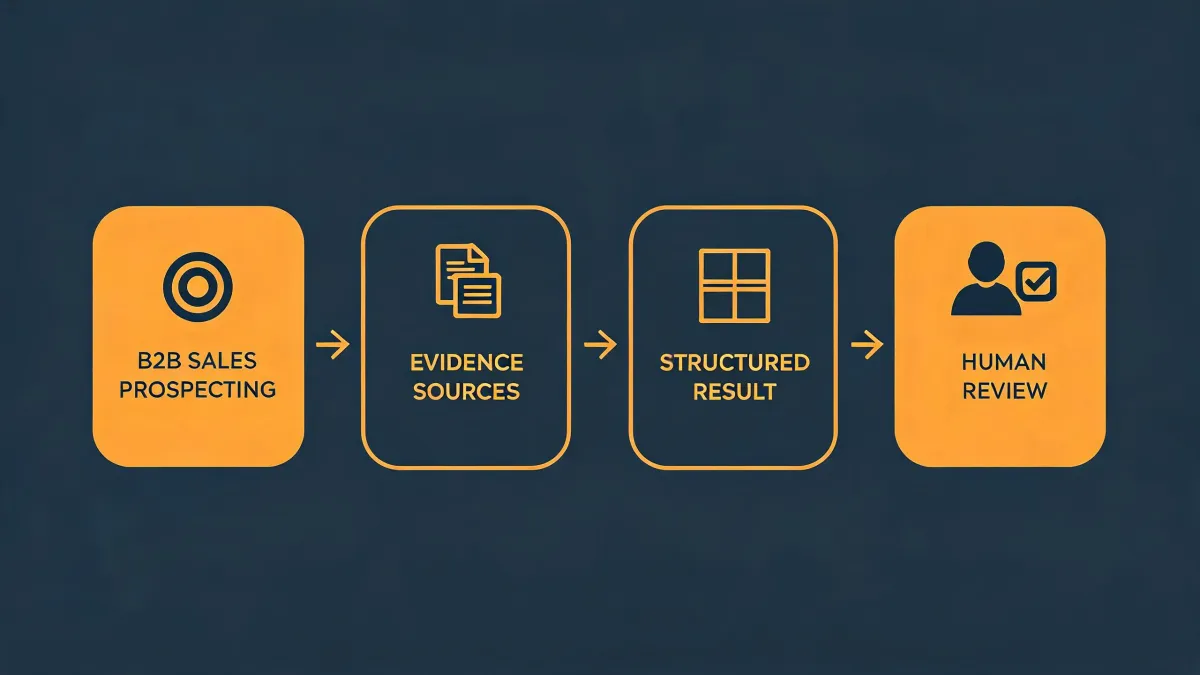
If you're a RevOps lead evaluating sales signals—or an AI SDR platform that supposedly generates them—this is for you. I review deliverables for a living, so I tend to see sales tools the same way I see a vendor's prototype: specifications matter, consistency matters, and hidden costs matter.
This checklist has five steps. Skip one, and you'll likely end up with a platform that produces a lot of activity and very few actual conversations.
Step 1: Define what a "signal" means to your team
Here's the most common mistake I see in vendor evaluations: everyone says "sales-ready lead" but means something different. I said "sales-ready" once during a tool review. The vendor heard "marketing-qualified." Result: 200 leads, 2 meetings. The same thing happens with sales triggers.
Before you evaluate relevance-ai or any other platform, write down your ICP and the specific actions that qualify as triggers. Include negative-fit indicators too. If you can't articulate a signal in one sentence, no AI assistant can fix that.
Step 2: Map the trigger to the workflow
Don't just evaluate the alert—evaluate what happens next. If you're looking at relevance-ai's agents workflows platform, test whether you can customize the workflow without a developer. Ask: can I change the sequence? Does the AI SDR pass the signal with enough context to act on it?
A trigger without a workflow is just noise. What stood out to me about relevance-ai is natural-language prospecting: you can write "find accounts with recent funding and a VP of Sales who was previously at a competitor" and the agent turns that into an outreach sequence. That matters more than having 50 data points per record.
Step 3: Check data coverage and recency
Most of the relevance ai disadvantages reviews and criticisms I've read center on data gaps. That aligns with what we found in our own Q3 2024 audit: firmographic coverage for European mid-market accounts was noticeably weaker than the vendor's demo showed.
So ask these questions before you sign:
- Where does the intent data come from? Can I see the original source?
- How often is enrichment refreshed? Is it monthly, quarterly, or "whenever we feel like it"?
- Can I filter by my target segments, not just globally?
Transparency here isn't nice-to-have. If you can't trace a signal back to its source, you can't trust it.
Step 4: Measure the cost of false positives
In our Q3 2024 audit of 1,200 signals from an AI SDR platform, 63% were false positives based on our own definition. The surprise wasn't that the data was imperfect—it was that our scoring model was the bigger problem.
Every false positive has a real cost: SDR time, email reputation, and team morale. When you evaluate ai sales assistant features, demand to see how the tool handles thresholds. Can you adjust intent scores? Can you suppress accounts that don't match your ICP? To be fair, relevance-ai and other platforms do allow you to adjust thresholds—but that's only useful if you've already done step 1 properly.
Step 5: Review the human oversight loop
Many criticisms of AI SDR platforms revolve around the "black box" problem. You see an alert, but you don't know why. A good platform shows you the reasoning: "this account visited pricing, downloaded a white paper, and has a VP of Revenue who previously bought from a similar vendor."
I'm not 100% sure every platform needs humans in the loop at all times, but in practice, you need at least one person who can override the AI. Ask these questions during the demo:
- Can I see the full reasoning behind each sales trigger?
- Can the AI assistant learn from replies, opens, and unsubscribes?
- Is there a feedback loop where my SDR team can mark alerts as irrelevant?
That's where relevance-ai's design stands out: the AI SDR workflows are meant to be supervised, not left to run blind. But you need to verify that for yourself with your own data.
Common pitfalls to avoid
We didn't have a formal vendor evaluation process a few years ago. That cost us when an "enterprise-ready" AI SDR tool couldn't segment our database by company size. Here are the mistakes I see teams make repeatedly:
- Buying based on a demo that uses perfect clean data.
- Ignoring setup time and ongoing tuning effort.
- Forgetting to check integrations with the CRM and enrichment tools you already use.
- Treating a sales trigger as a single event instead of a pattern of behavior.
There's something satisfying about finally having a clean signal spec. After weeks of noise, the SDR team can tell a real buying signal from a curious click. That's the payoff. And it's exactly why the evaluation checklist needs to be in place before you sit down with a vendor.