
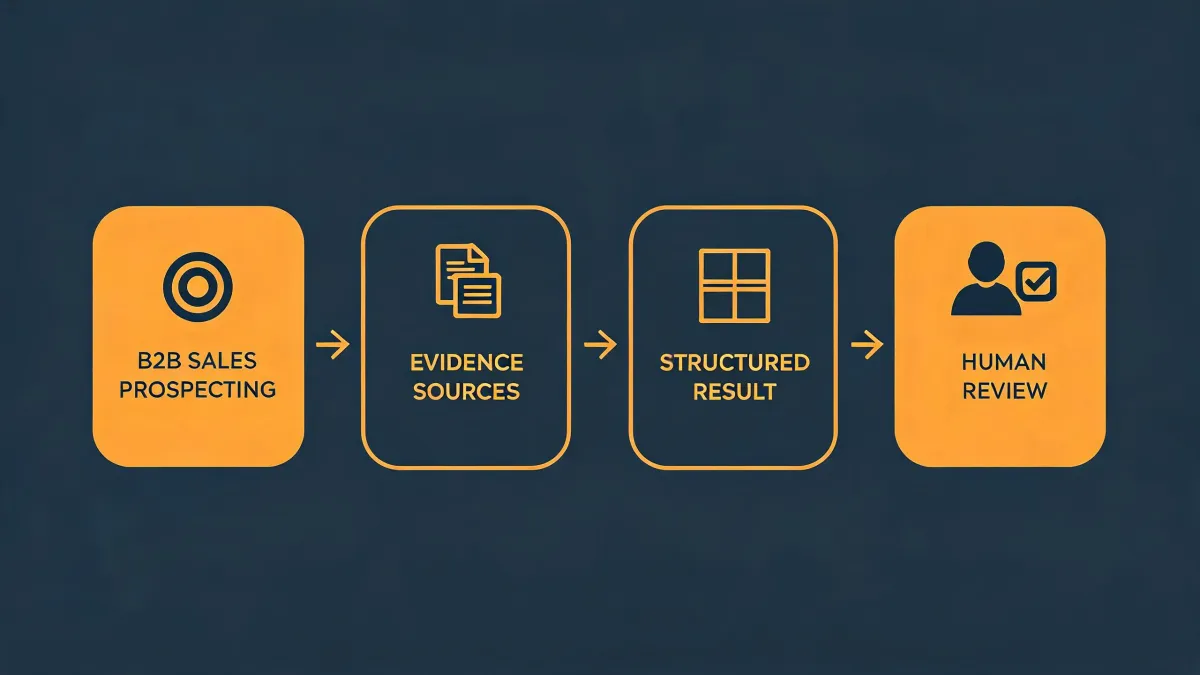
-
Who this checklist is for
- Step 1: Lock your ICP and ABM account list first
- Step 2: Map the Okki Go workflow to your outbound agency pipeline
- Step 3: Configure the LinkedIn email finder with source priority
- Step 4: Set email verification features to match your risk tolerance
- Step 5: Layer intent and enrichment for ABM prioritization
- Step 6: Add human-in-the-loop outreach review
- Step 7: Measure, debug, and document the workflow
-
Common mistakes to avoid
-
Final check before you scale
Who this checklist is for
If you run an outbound agency, lead a RevOps team, or manage SDRs, this checklist is for you. It's the same sequence I use when I review a new prospecting stack before it touches a client campaign. I'm a quality and brand compliance manager at a B2B sales tech company. I review every outbound data vendor and prospecting workflow before it reaches customers—roughly 200 items a year. In our Q1 2024 quality audit, I rejected 28% of first deliveries because contact data couldn't be traced to a source or verification timestamp.
This checklist has seven steps. It's built for evaluating okki-go or any similar AI sales prospecting tool. You'll also see how to connect a linkedin email finder, email verification features, and what revenue operations teams should evaluate in account-based marketing.
Bottom line: don't scale outreach until you can trace every field, verify every email, and explain every intent signal. If you can't, you're not running a workflow. You're running a gamble.
Step 1: Lock your ICP and ABM account list first
Before you open any tool, define the account list. Not the other way around.
What to do
- Write your ICP in one paragraph: industry, employee count, revenue range, tech stack, job titles, and disqualifiers.
- Build three ABM tiers: Tier 1 (20-50 named accounts), Tier 2 (200-500), Tier 3 (1,000+).
- Add required fields: company domain, country, employee count, LinkedIn URL, and a source column.
Checkpoint
Can a new SDR explain why each Tier 1 account is on the list? If not, the list is too broad.
What RevOps should evaluate in ABM
Account fit, data freshness, intent signal source, routing rules, and suppression logic. If your CRM has duplicate domains and no owner field, fix that before enrichment. Otherwise you'll pay to enrich the same company five times under five name variations.
Step 2: Map the Okki Go workflow to your outbound agency pipeline
What is Okki Go? Okki Go is an agent-native prospecting and lead gen workspace. It combines LinkedIn contact discovery, waterfall enrichment, email verification, intent data, and human-in-the-loop outreach. For outbound agencies, that means one place to move from account list to verified contact to sequence-ready lead.
A practical okki-go workflow for outbound agencies usually looks like this:
- Import ABM account list.
- Find contacts from LinkedIn and other sources.
- Enrich missing firmographic and demographic fields.
- Verify emails.
- Score intent and fit.
- Assign to sequence or human review.
- Sync to CRM with source and timestamp.
Checkpoint
Write down one owner per stage. If 'everyone' owns data quality, no one does.
Here's what I've learned the hard way: the tool isn't the workflow. The workflow is the handoffs, the QA gates, and the fallback rules when a field is missing.
Step 3: Configure the LinkedIn email finder with source priority
From the outside, it looks like a LinkedIn email finder is just a lookup box. The reality is source order and verification timing decide whether you get a usable record or a bounce.
What to do
- Set source priority: primary source first, then waterfall fallback. For example, verified work email from a known provider before guessing a pattern.
- Test with 50 known contacts. Measure match rate, accuracy, and time to result.
- Flag catch-all domains separately. Don't treat them the same as verified mailboxes.
Checkpoint
For every email, you should see source, last verified date, and confidence. If you can't see those, you can't audit it later.
If you've ever had a campaign burn because a 'verified' list was two years old, you know that sinking feeling. Trust me on this one: recency beats volume.
Step 4: Set email verification features to match your risk tolerance
Email verification features aren't a single checkbox. They're a stack.
What to check
- Syntax and domain/MX checks.
- SMTP mailbox check where allowed.
- Catch-all and accept-all detection.
- Disposable and role-based address flags.
- Spam trap and abuse list screening.
- Verification timestamps and re-verification rules.
Checkpoint
Run a blind test with 100 emails you know are good, bad, and unknown. Compare results. I want to say we've run this test maybe 200 times. Maybe 180, I'd have to check the log.
No verification tool is 100% accurate. If a vendor promises that, walk away. Per the FTC's CAN-SPAM compliance guide (accessed April 2026), you're responsible for accurate headers, relevant subject lines, and a working opt-out, regardless of what your data vendor says. For EU contacts, GDPR (effective May 25, 2018) adds lawful basis and data minimization requirements.
So don't use verification as a legal shield. Use it as a quality gate.
Step 5: Layer intent and enrichment for ABM prioritization
This is where RevOps teams often overbuy data and underuse it.
What to do
- Choose two or three intent sources max. More isn't better if you can't explain the signal.
- Define three intent tiers: high (demo page, pricing page, multiple visits), medium (content download, webinar), low (single blog visit).
- Add decay rules. A visit from 90 days ago isn't the same as yesterday.
- Enrich only fields you'll actually use in personalization or routing.
Checkpoint
Can sales explain why an account is Tier 1 without reading the raw data dump? If not, the intent model is too complex.
The 'more data is always better' thinking comes from an era when CRM fields were scarce. Today, unmanaged enrichment creates duplicate fields, stale job titles, and false confidence. Put another way: more columns doesn't mean more clarity.
Step 6: Add human-in-the-loop outreach review
This is the step most agencies skip. Then they wonder why reply rates fall.
What to do
- Create a QA sample: first 50 emails from a new sequence, then 10% ongoing.
- Score personalization, claim accuracy, opt-out clarity, and tone.
- Hold the send if bounce risk or brand risk crosses your threshold.
Checkpoint
Who signs off before the first 50 sends? Name one person. Not a committee.
Okki Go's human-in-the-loop approach fits here. The goal isn't to remove SDRs or RevOps. It's to remove the repetitive data work so people can review the tricky accounts. A tool that claims to fully replace your SDR team is selling a fantasy. The vendor who says 'this isn't our strength—here's who does it better' earns my trust for everything else.
Step 7: Measure, debug, and document the workflow
You can't improve a workflow you can't see.
Metrics to track
- Bounce rate by source and verification status.
- Reply rate by sequence, persona, and intent tier.
- Meeting rate by ABM tier.
- Data decay: how many contacts change roles or companies in 90 days.
- QA rejection rate: how many emails fail review before sending.
Checkpoint
Review weekly for the first month, then monthly. Keep a changelog. If you change source priority or verification rules, note the date.
Saved $200 by skipping a re-verification step once. Ended up spending $1,800 on domain warm-up and lost a week of sending. That's the kind of math that makes 'cheap' expensive.
Common mistakes to avoid
- Buying a list before defining an ICP. You'll enrich garbage and call it pipeline.
- Treating catch-all emails as verified. They're unknown, not good.
- Letting the tool own the source of truth. Your CRM should own the record, with source and timestamp.
- Skipping suppression. One angry prospect can undo a month of domain reputation work.
- Over-automating personalization. If the AI writes 'I loved your recent post' and the post was about layoffs, that's a brand problem.
- Assuming compliance is the vendor's job. It isn't. You own the send.
- Expecting one tool to fix offer-market fit. No prospecting tool can save a weak offer.
Final check before you scale
You're ready to scale when you can answer five questions: Where did this contact come from? When was the email last verified? Why is this account in Tier 1? Who reviewed the message? What happens if someone opts out? If any answer is 'I think so,' pause.
Okki Go can be a strong part of an outbound agency stack, especially if you value agent-native prospecting, waterfall enrichment plus intent, and human-in-the-loop outreach. But it's a system. Treat it like one. Document it, audit it, and keep a human near the send button.