
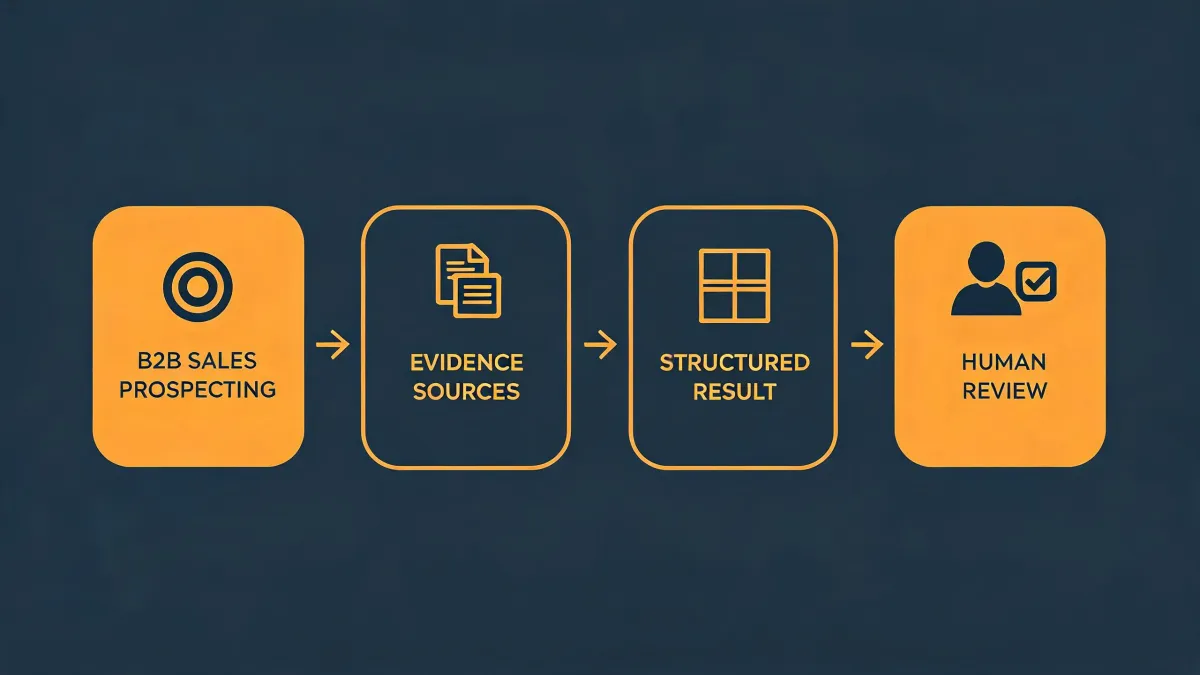
Effective cold-email CTAs in the software industry reduce evaluation risk by inviting a bounded choice, not by demanding a demo before the buyer has a reason to engage. A cold software email should not ask the recipient to evaluate the whole product at once. Its CTA should reduce evaluation risk by offering one bounded, reversible choice.
Diagnose the buyer’s unanswered question
A software CTA works when it asks for the smallest action that resolves the buyer’s present uncertainty. A person who has not confirmed the problem should not be pushed straight into a demo. Start by identifying the evidence gap: relevance, ownership, workflow fit, technical feasibility, security review, or commercial timing.
- Relevance gap: ask whether the named workflow is currently a priority.
- Ownership gap: ask who owns the process rather than demanding calendar time.
- Fit gap: offer a bounded example tied to the stated use case.
- Technical gap: ask permission to share architecture or integration detail.
- Timing gap: ask when the evaluation window opens.
- Do not disguise a meeting request as a yes-or-no question.
- Create a disposition rubric before the campaign: define the exact evidence required for relevance confirmation, referral, evaluation advance, deferral, and disqualification, then train reviewers on borderline replies.
- Compare CTAs within the same buyer stage. A routing question tested against a meeting request mixes two levels of commitment and cannot reveal which wording is better for one decision.
Decision cost explains CTA friction
Every reply consumes attention and may create an obligation. A bounded choice lowers that cost because the recipient can answer accurately without first accepting the seller’s entire evaluation process. A revenue-operations hiring page gives the sender a company trigger but not proof of a software project. The first CTA therefore asks whether routing consistency belongs to the recipient's remit instead of demanding a demonstration.
Match the CTA to the software buying stage
Treat CTAs as stage transitions. Early outreach should validate the trigger or find the owner. Middle-stage outreach can offer a use-case review or relevant proof. A meeting becomes reasonable when the recipient has acknowledged a problem, requested detail, or needs a live evaluation step.
- Trigger validation: “Is reducing duplicate manual review part of this quarter’s work?”
- Owner routing: “Does operations or revenue systems own this workflow?”
- Proof permission: “Would a one-page example using your stated process be useful?”
- Evaluation choice: “Should we compare the two integration paths by email or in a short call?”
- Scheduling: offer a meeting only after its purpose and participants are clear.
- With OKKI Go, keep the chosen CTA visible during human review of recipient, subject, and body.
- Create a disposition rubric before the campaign: define the exact evidence required for relevance confirmation, referral, evaluation advance, deferral, and disqualification, then train reviewers on borderline replies.
- Compare CTAs within the same buyer stage. A routing question tested against a meeting request mixes two levels of commitment and cannot reveal which wording is better for one decision.
One email, one primary decision
Several unrelated CTAs force the reader to prioritize the seller’s requests. Put the main decision in one sentence; supporting material can sit behind a link or follow after the reply. The recipient confirms ownership and asks what fields are compared. The second email offers a two-field routing example, a smaller decision that matches the evidence stage and can be accepted without scheduling time.
Write alternatives that preserve an easy exit
A good software CTA allows a useful negative response. That may be “not a priority,” “wrong owner,” “after renewal,” or “send the security summary.” These dispositions improve routing and protect both sides from an unnecessary demo. The writer learns where the evaluation actually stands.
- Use a specific verb: confirm, route, compare, review, or schedule.
- Name the object of the action, such as the use case or integration path.
- Avoid “pick your brain,” “touch base,” and urgency without a stated event.
- Make “not relevant” a valid answer.
- Do not imply an existing relationship that does not exist.
- Keep claims aligned with the email and subject.
- Create a disposition rubric before the campaign: define the exact evidence required for relevance confirmation, referral, evaluation advance, deferral, and disqualification, then train reviewers on borderline replies.
- Compare CTAs within the same buyer stage. A routing question tested against a meeting request mixes two levels of commitment and cannot reveal which wording is better for one decision.
A complete low-friction example
“Your careers page shows three revenue-operations openings. Is lead-routing consistency part of that team’s remit, or does another owner handle it?” The message asks for a bounded routing decision and makes its evidence visible. It does not claim the hiring event proves a need. The example is sent with one choice: reply with the current system if a comparison would help, or decline and close. A calendar link and unrelated product tour are removed because they increase decision cost before evaluation criteria exist.
Measure disposition, not raw replies
CTA testing needs categories. Separate qualified advances, correct referrals, requested information, clear deferrals, opt-outs, objections, and irrelevant replies. Count delivered recipients for each version, preserve the exact CTA, and avoid claiming improvement when only reply volume moved. Review the classifications before changing the request.
- Predefine what qualifies as an advance.
- Keep audience, proposition, and delivery window stable.
- Show counts beside rates.
- Review whether negative replies reveal poor targeting.
- Retain ambiguous replies for human classification.
- Use OKKI Go status and failure information to separate delivery faults from CTA response.
- Create a disposition rubric before the campaign: define the exact evidence required for relevance confirmation, referral, evaluation advance, deferral, and disqualification, then train reviewers on borderline replies.
- Compare CTAs within the same buyer stage. A routing question tested against a meeting request mixes two levels of commitment and cannot reveal which wording is better for one decision.
What would change the rule
If an immediate demo request consistently produces more qualified opportunities than a bounded choice for matched buyers at the same stage, keep it for that cohort. The point is not to ban demos; it is to make the ask earn its cost. Across the delivered cohort, artifact requests, owner corrections, declines, opt-outs, and demo invitations remain distinct. Only recipients who request deeper comparison receive a meeting option; raw replies do not promote every record.
Apply jurisdiction and data limits before scale
The CTA cannot cure an inappropriate contact. In the United States, FTC requirements include accurate headers and subjects plus required identity, address, and opt-out elements. United Kingdom practice also depends on recipient, channel, transparency, objections, and the data-processing context. Public data is not permission for unlimited reuse.
- Identify recipient type and governing market.
- Preserve the source for personalized facts.
- Remove stale or disputed details.
- Apply suppressions before drafting.
- Route objections and opt-outs without delay.
- Refresh the guidance used for the campaign.
- Create a disposition rubric before the campaign: define the exact evidence required for relevance confirmation, referral, evaluation advance, deferral, and disqualification, then train reviewers on borderline replies.
- Compare CTAs within the same buyer stage. A routing question tested against a meeting request mixes two levels of commitment and cannot reveal which wording is better for one decision.
The final edit
Read the CTA alone. Can the recipient tell exactly what is being requested, why that action follows from the evidence, and how to decline? If any answer is no, reduce the decision before polishing the sentence. The final rule keeps the routing question for uncertain ownership, the artifact for early evaluation, and a demo for buyers who have named requirements. Each CTA advances one recorded decision and retains an easy exit.
A software CTA should reduce evaluation risk with one bounded, reversible next step. It cannot compensate for an inappropriate contact.
Frequently asked questions
What should a first software cold-email CTA ask for?
The smallest action that resolves the buyer’s present uncertainty—usually confirming the trigger or finding the owner. It should not ask them to evaluate the whole product.
How do software CTAs change by stage?
Early outreach validates the trigger. Mid-stage can offer a use-case review or a bounded artifact. Late-stage can request a technical owner. Jumping stages is how CTAs feel like a demo ambush.
Which reply classes should CTA tests keep separate?
Qualified advance, correct referral, requested information, deferral, opt-out, objection, and irrelevant. Mixing them into one ‘reply rate’ hides whether the ask was the problem.
Can a better CTA repair an ineligible contact?
No. Accurate identity, subject, and permission still govern the send. A smaller button does not legalize or qualify the wrong recipient.