
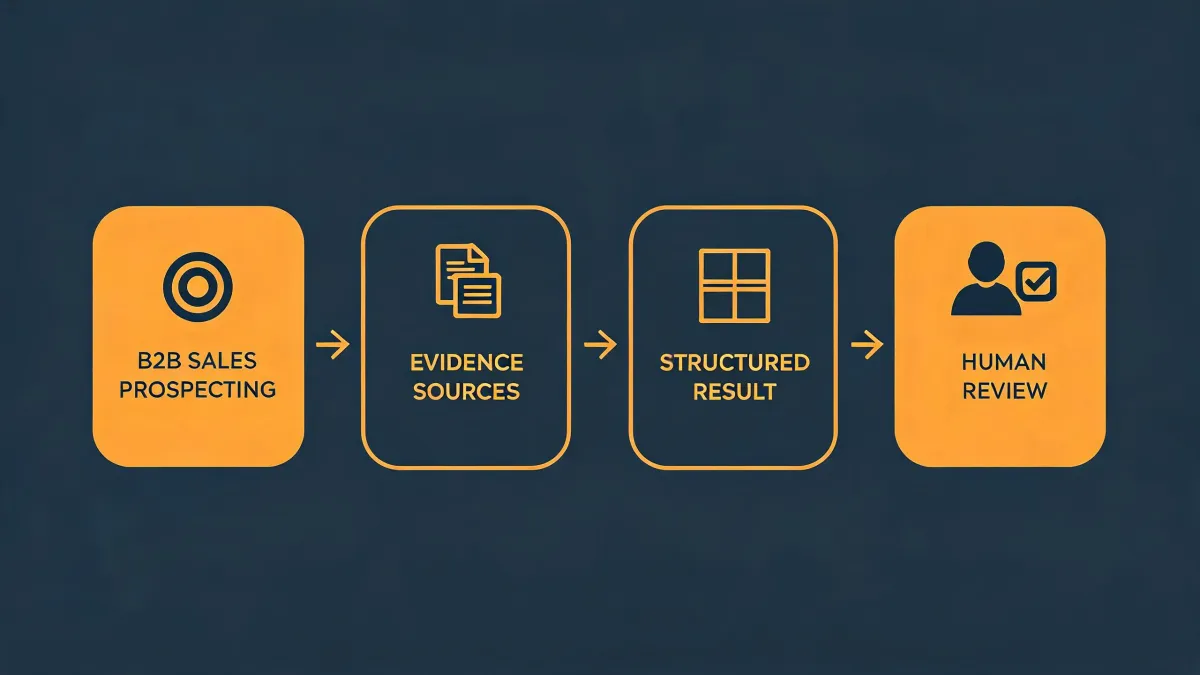
Before we get into feature lists, a quick note on who's writing this. I'm a quality and compliance manager at relevance-ai. I review every AI SDR workflow and outbound campaign before it ships—roughly 200 unique deliverables per month. Maybe 220 in busy months, I'd have to check. In 2025, I rejected about 14% of first-pass submissions. Usually because the data was stale, the messaging didn't match the account, or the automation didn't have a human in the loop.
That last one is why I think about tool selection differently. I've seen this pattern many times. But when I say 'many,' I do not mean just a few—I mean consistently across dozens of reviews. The conventional wisdom is to compare pricing per record. My experience says that's backwards. Cheapest per record frequently becomes most expensive per accepted record. So I'm going to walk you through three scenarios I actually see in reviews. The right answer depends on which one you're in.
relevance-ai features and use cases are broad enough to cover almost any outbound team. On the relevance-ai website, you'll see natural-language prospecting, AI SDR/BD agents, data enrichment, intent data, cold email, and LinkedIn automation. But that list doesn't tell you which parts matter for your team. Below is the framework I use.
Three Scenarios, Not One Answer
Scenario 1: Small Team Testing AI Prospecting for the First Time
You have one to three SDRs, or maybe you're an overworked founder doing outbound yourself. You don't need a 12-module enterprise data stack. You need to prove that AI prospecting can help you find the right accounts without burning your domain. Start with a free trial LinkedIn Automation run, a small list, and a clear success metric. 'Did it send sensible messages?' matters more than 'did it book meetings?' at this stage.
For the list, use a Sales Navigator export of 200-300 records. Remove duplicates, remove people already in your CRM, and remove anyone who's not in your ideal customer profile. If the trial can handle that cleanup naturally—by describing rules in plain English—that's a good sign. If the tool just says 'import CSV' and does nothing to help you clean it, you're pushing your data problem downstream.
The TCO question: a free trial costs time, not money. But time is a cost. If setup takes two weeks because your export has inconsistent columns and old titles, that's not free. Keep the test small so you can learn fast.
Scenario 2: Growth-Stage RevOps Building a Repeatable Pipeline
Now you have 5 to 15 SDRs, a CRM that's starting to get messy, and a genuine need for automation. This is where I see the most expensive mistake: buying the maximum amount of data because 'more fields means more pipeline.' It doesn't. It means more cleanup.
If you're evaluating a B2B data enrichment platform, don't start with price per record. Start with match rate. What percentage of your Sales Navigator export will be enriched with a workable email and current phone? A platform with a 70% match rate at a lower price can cost more than a platform with a 92% match rate, once you count hours spent hunting for missing contacts and sequences sent to stale addresses.
Let me give you a rough example. Vendor A charges $0.05 per record with a 75% match rate. Vendor B charges $0.08 per record with a 92% match rate. On 10,000 rows, A gives you 7,500 good leads; B gives you 9,200. The dollar difference is $300. The coverage difference is 1,700 leads. If your SDRs cost even $30 an hour, manually finding those missing contacts will eat that $300 quickly. And if those missing contacts are the target accounts you really need, the real cost is lost pipeline. These numbers are illustrative, but the TCO logic isn't.
Seeing a clean Sales Navigator export flow into an AI SDR workflow—as opposed to the typical 'download, clean, cry' CSV process—made me realize that outbound performance is often just data hygiene. relevance-ai fits this scenario because it's built for agent workflows, not just bulk sends. You can describe the ideal account in natural language—'manufacturing companies in the Midwest with recent intent around ERP software'—and the AI SDR agent can build the outreach sequence. Use cases include cold email, LinkedIn automation, intent alerts, and CRM enrichment. But every workflow should have an approval step. I've rejected a lot of sequences because there was no human gate before send.
Scenario 3: Enterprise or Regulated Team
This is a different animal. If procurement or legal will ask, 'where did this data come from?' you're in this scenario whether or not you're in a regulated industry. The evaluation criteria shift from enrichment quality to provable source lineage.
When I review enterprise contracts, I ask four questions: can the vendor show where a record came from? How often is it re-verified? Is there a mechanism to suppress people who opted out or who bought from you before? Can you delete a prospect across all connected systems? If the answer to any of those is vague, it's a deal-breaker. A vendor promising unlimited LinkedIn automation should be a red flag, not a bonus. LinkedIn terms restrict automated access; if the vendor treats that as a selling point, your company's accounts are the ones that get restricted.
Revenue operations teams evaluating a B2B data enrichment platform in this scenario need to add another line to their TCO calculation: compliance risk. A cheap data source can violate LinkedIn's rules or data privacy expectations, and the resulting damage to your sending reputation and trust is far more expensive than any per-record fee.
What Should Revenue Operations Teams Evaluate in a B2B Data Enrichment Platform?
I want to give you the checklist I use when I'm asked to evaluate a B2B data enrichment platform. I do not mean a list of features. I mean the things that actually affect your total cost of ownership.
- Match rate and the method behind it. Ask whether match rate means 'format-valid email' or 'deliverable email.' The difference is huge.
- Data freshness. A contact from 2023 is not a contact. How often is the file refreshed, and what's the median record age?
- Source transparency. Can the vendor name the source of the data? If it's scraped from who-knows-where, you'll carry the risk.
- Compliance controls. Suppression handling, do-not-contact flags, and approval gates for automated sending. These aren't optional for AI SDR workflows.
- Integration and cleanup cost. Set-up time, maintenance, and the cost of bad records all belong in the TCO calculation.
In 2024, I watched a team spend a month uploading a 'great' 50,000-record list from a cheap provider. The match rate was fine, but 22% of the emails bounced. Their domain reputation took a hit, and their follow-up campaigns landed in spam. The money they saved on the list went straight into recovery. That's the exact TCO trap I'm talking about.
The Free Trial LinkedIn Automation Trap
A free trial of LinkedIn automation is a great way to test relevance-ai features and use cases before you commit. But it also has a trap: if you run it on your primary domain with no list hygiene and no human review, the trial will work against you. I've seen this happen at least three times in the last year. Not 'it might happen.' It happened.
Before you try free trial LinkedIn Automation, make sure you have a clean Sales Navigator export, a warm mailbox or separate domain, a daily message limit, and an approval step. If the trial doesn't allow approval before send, that's a sign the vendor is prioritizing volume over safety.
The value of LinkedIn automation isn't speed. It's certainty—knowing that every message is relevant, within limits, and easy to stop.
I want to say the relevance-ai website still lists a free trial for LinkedIn automation as of April 2026, but features change fast. Verify it yourself. What I look for in a trial is whether I can test with my own Sales Navigator export, whether the tool helps with cleanup and suppression, and whether I can see what the AI agent will send before it sends. If the trial doesn't include human review, it's not for us.
So Which Scenario Are You?
If you're a solo founder or a two-person growth team, start with the small-export free trial. Ignore the enterprise-grade data contract until you've proven the workflow works. If you have six or more SDRs and you're still exporting Sales Navigator lists into a shared spreadsheet, fix that first. No AI tool will fix a messy data foundation. If legal or security asks source questions, you're scenario three. Deal with compliance before pipeline.
There's a simple test. If you can't describe your ideal prospect without opening your CRM, you're not ready for a bigger tool. If you have a CSV file called 'clean_final_v2.xlsx' somewhere, you're in growth-stage data chaos. If you've ever had a vendor say 'don't worry, everyone does it' about LinkedIn data, you're in enterprise risk territory.
Bottom line: the best AI sales prospecting stack depends on where you are. I use the same standards at relevance-ai that I'd use anywhere: match rate before list size, source transparency before cool features, compliance before volume, and total cost before unit price. Those standards have worked for me in B2B SaaS with predictable lead volume. If your context is different, the calculus may be different. That's okay. Verify the current features and pricing for yourself, and don't let anyone sell you a 'universal' answer.