
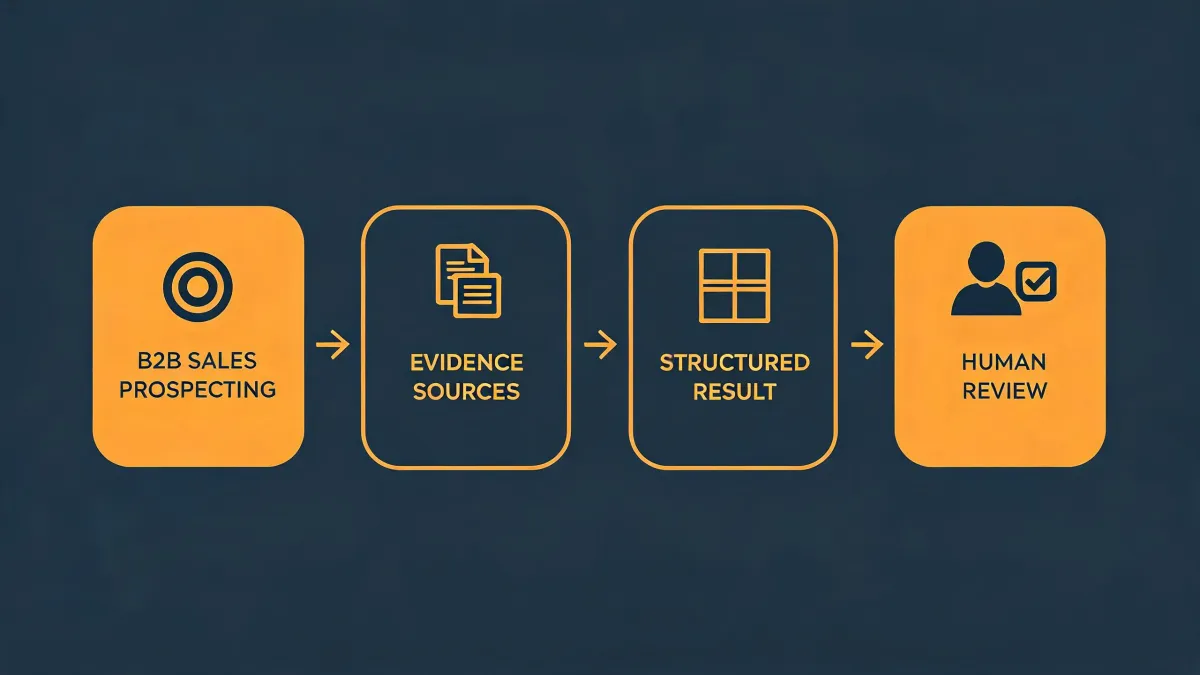
Cold outreach isn't the last step in an agent-native prospecting workflow. It's the verification step. I'm the quality/compliance person at a sales AI company. I review every campaign before it reaches an inbox, and in 2025 I've rejected roughly 14% of first-pass sequences. Most rejects share the same problem: confident AI messaging sitting on top of unverified data. If you're weighing Relevance AI for B2B lead generation, that's the part to study. Not the AI’s chat. The system around it.
What “Agent-Native” Actually Means
When I say agent-native, I don't mean fully autonomous. I mean the workflow is built around an agent that can do the repetitive parts of SDR work: researching accounts, pulling intent data, enriching contacts, drafting emails, and using responses to get better. You describe the ideal buyer in natural language. The agent creates the outreach batch. A human reviews it before send.
At Relevance AI, the sales AI platform connects enrichment, email verification, and sending into one loop. But the loop is only as good as its checkpoints. The first checkpoint is data. The second is message quality. And cold outreach runs through both.
The First Checkpoint: Cold Email Is a Data Quality Signal
Here's what I've learned in quality work: activity is not the same as accuracy. An agent can enrich a record, assign an intent score, and write a personalized line. That doesn't mean the email address is valid, the person is still in the role, or the company is still the right fit. Cold email is the test that exposes those issues.
That's why email verification belongs before send, not after. A syntax check based on RFC 5321 tells you the address looks valid. It doesn't tell you whether the mailbox exists or a real human will see it. I'd rather send 300 verified emails to people who match the ICP than 3,000 to a list that's “maybe okay.” The first campaign will tell you something. The second will just hurt your domain reputation.
I say this from experience. We didn't have a formal verification step in the early days. I knew I should have tested the list, but I thought “the vendor said it's clean. What are the odds?” The odds caught up when a chunk of our first big batch bounced or hit role-based addresses. Maybe 30%—I'd have to pull the logs to give you the exact number. Either way, it was enough to make me put a gate in place.
The numbers said the list was clean enough to launch. My gut said something felt off. I ran a small verification sample and found catch-all domains we hadn't accounted for. Since then, I'd rather spend ten minutes explaining verification than clean up the consequences of a bad send.
The Second Checkpoint: Agent Output Needs a Review Gate
The second reason cold outreach fits into an agent-native workflow: it's the place where judgment gets applied. AI SDRs are great at writing 200 personalized openings. They are too often confident about the wrong detail.
I once caught a draft that referenced a company's “recent funding round” as a reason to connect. The company had announced layoffs two days earlier. Had that gone out, it would have looked like we didn't care enough to check the news. That kind of mistake is worse in an AI workflow because it scales. It won't make one bad impression; it'll make 50.
If you've ever watched a sequence go out with the wrong company name, you know how fast trust disappears. Even after I approve a campaign, I keep second-guessing. What if the subject line is too pushy? What if the personalization reads like a template? I don't relax until the first positive reply shows up.
So every sequence gets reviewed. The review isn't a full rewrite. It's a checklist: Does the trigger match the latest news? Does the first line tie to a real signal? Is there a clear next step? Can the recipient unsubscribe easily? If I have to fix the same error more than twice, I update the quality prompt. That's the “human in the loop” that keeps AI-generated cold outreach from becoming spam.
The Harder Question: LinkedIn Data and “Scraping”
LinkedIn automation and “LinkedIn scraping” show up in almost every AI prospecting conversation. I get why. LinkedIn is where B2B buyers live, and it feels like a shortcut to contacts. But automated scraping can violate LinkedIn's User Agreement (source: linkedin.com/legal/user-agreement, as of 2025), and the quality problem is just as important. A scraped list is a snapshot. People change jobs, titles change, companies pivot. By the time you're sending, the snapshot might be fiction.
In an agent-native workflow, you don't need scraping to get that data. Enrichment sources and official integrations update records over time. The agent can use intent data to decide when a contact is worth a message. That's not just safer. It's more accurate, which means cold outreach gets better.
The Objection: “Nobody Reads Cold Emails Anymore”
I hear this one constantly. If you define cold outreach as a 5,000-row CSV with a generic pitch, then yeah, that's kinda dead. It's not a workflow; it's a bet against the spam filter. But targeted cold email in an agent-native flow is different. It's triggered by a signal. It's addressed to someone specific. It's sent in small batches. It includes a working opt-out and a physical address, which are still baseline requirements under the CAN-SPAM Act (FTC, effective 2003; verify current rules at ftc.gov).
That kind of cold outreach doesn't feel like spam because it isn't. It feels like a relevant note from someone who did their homework. I've seen campaigns of 300-500 contacts book meetings that the same company's 50,000-person blast hadn't. So when someone says “cold email is dead,” I usually answer: “The spray is dead. The verification loop isn't.”
Bottom Line: Cold Outreach Is the Calibration Loop
So how does cold outreach fit into an agent-native prospecting workflow? It's the middle of the loop, not the end. It tests the data. It tests the message. It gives the agent real signals—reply, bounce, unsubscribe, meeting booked—that make the next iteration smarter.
Some people see cold outreach as the part AI replaces. I see it as the part AI makes worth doing again. Use the agent to research and write. Use verification to clean the list. Use a human review to catch the tone-deaf detail. Then send, measure, and feed the results back into the workflow. That's not an old-school funnel. That's a system that gets better every time it touches reality.
I'm not going to promise every campaign will hit quota. What I'll say is this: the teams that treat cold outreach as a quality checkpoint are the ones that don't have to apologize for their data.