
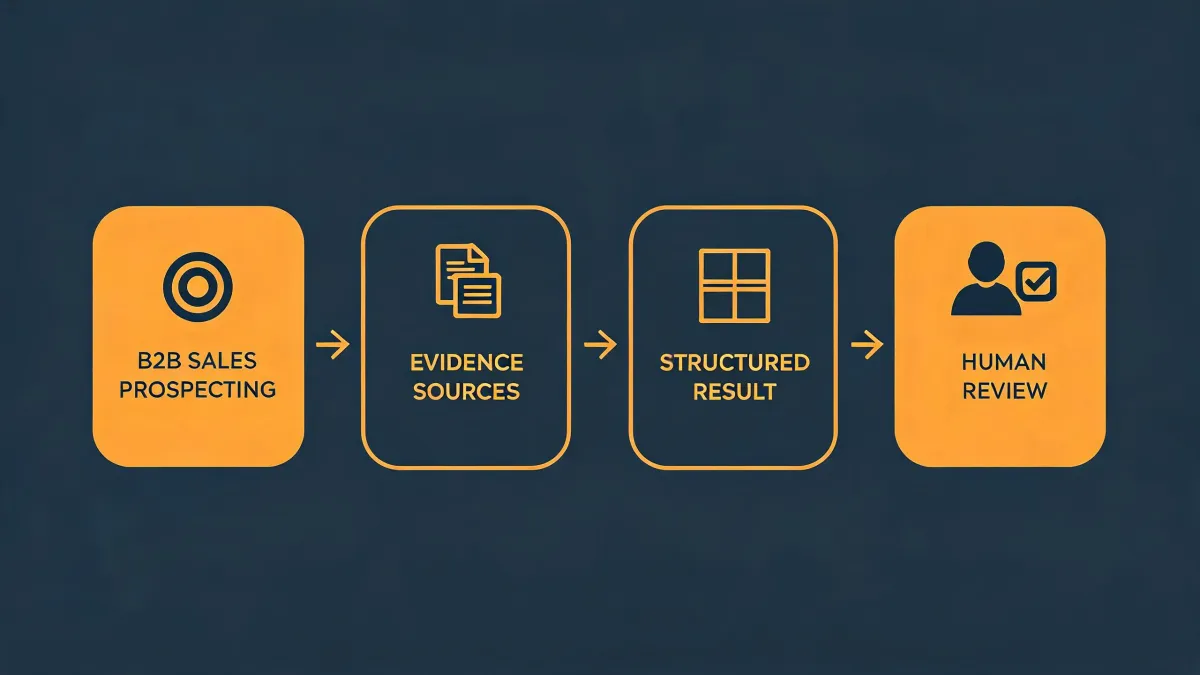
Build a prospect list in seven linked moves: define the audience and release rule, source candidates with provenance, normalize fields, validate freshness, deduplicate identities, qualify and assign ownership, then release only reviewable records and feed corrections back into the rule. A fit rationale governs every move.
First, Define the Inputs and Release Rule
One view says prospect list building is the work of finding companies and contact details. That describes acquisition, but it does not yet describe a usable list. A stronger definition is the controlled creation of prospect records that preserve why each account was included. The difference matters because an address can be present while its business relevance is still impossible to defend.
The objection is obvious: if the target market was defined before sourcing, why repeat the reasoning on every record? Because a market definition is a general rule, while inclusion is a specific decision. The UK Government data quality framework treats quality as an ongoing management practice with defined dimensions, measurement, improvement, and accountable ownership. A finished-looking spreadsheet does not remove those responsibilities.
That leads to a practical definition. A prospect record should carry the account, the fit rationale that admitted it, where the relevant fields came from, and enough freshness context to decide whether those fields still deserve trust. These are not decorative notes. They let another person reproduce the inclusion decision, challenge it, and improve the rule instead of silently deleting a record that feels wrong.
The Definition Includes Accountability
A critic might say this turns list building into governance paperwork. It can, if fields are collected without a decision they support. The boundary is narrower: preserve only what allows a reviewer to explain fit, assess freshness, or correct the inclusion rule. Accountable ownership means someone knows which quality question a field answers and what should happen when that answer is missing.
Next, Source and Normalize Candidate Records
The volume-first argument sounds efficient: collect broadly, enrich later, and let the outreach team sort the useful records. The mechanism fails because later work inherits an unexplained admission decision. Salesforce documentation treats lead status, assignment, conversion, and history as explicit record elements, not as one implied motion. A prospect list should use the same discipline before outreach begins.
Think of the record as a decision path. The fit rationale says why the account entered. Provenance says where the supporting field came from. Freshness says when trust should be reconsidered. Status says what the team has decided so far. History preserves the correction. Tools matter when they keep these distinctions inspectable, not merely when they move more names into the first column.
Now the sequence can develop safely. Segmentation reads a stated rationale instead of guessing from loose fields. Personalization can refer to relevant business context without treating every available detail as useful. Qualification can update the record without erasing why it once looked plausible. When a reviewer finds a mistake, the history points back to the rule or source that needs correction.
Check the Handoff, Not Just the Harvest
- Define the audience, explicit exclusions, required fields, record owner, and the evidence a record must carry before release.
- Source candidate companies while preserving the query or criterion that admitted each one and the origin of fields used later.
- Normalize company names, domains, locations, and field meanings so records can be compared without confusing formatting differences with different entities.
- Validate whether decision-bearing fields are current enough for the intended segmentation, personalization, or contact decision.
- Deduplicate by reviewing company identity and source context, then merge without erasing provenance, history, or conflicting values.
- Qualify the account, assign an owner, and keep uncertain records in a review state instead of treating every populated row as ready.
- Release only records with a defensible fit rationale, provenance, freshness context, status, and correction path, then use rejections to improve the governing rule.
A tool can help answer these questions, but no interface can rescue a missing decision model. If every imported record arrives as equally valid, status fields only organize uncertainty after the fact. The better tool is the one used within a workflow that separates proposal, review, assignment, conversion, and history. That separation is what gives a list a correction path.
Then, Validate, Deduplicate, and Qualify
The rule holds when a candidate list is going to drive segmentation, personalization, or outreach. In that setting, an unexplained inclusion creates downstream risk because later actions treat the record as eligible. OKKI Go accepts natural-language company criteria such as product, buyer type, target country, and exclusions, then returns candidates for review before selective unlocking. That sequence keeps search output provisional.
The counterargument is that every early research set does not need record-level qualification. Correct. A temporary pool used only to discover market language can remain exploratory if no account is treated as eligible and no outreach action follows. The rule becomes decisive at the moment a candidate crosses from research material into a record that can trigger contact, enrichment, or prioritization.
Use that transition as the qualification threshold. Before selective unlocking or another consequential step, ask whether the user can state why the company fits and what would exclude it. If the answer depends on reconstructing a forgotten query, the list is not ready. If the criteria and exclusions remain visible, review can change the decision before more effort attaches to it.
Qualification Begins When the Record Gains Consequence
This boundary also prevents overengineering. Do not demand a complete outreach record from a rough research note. Do demand an explainable inclusion before the candidate enters an outreach-ready list. When OKKI Go or another tool returns candidates, the review point is where criteria, exclusions, and user judgment should meet. Volume remains useful, but it remains a proposal until that meeting occurs.
Before Release, Check Ownership and Contact Context
The tempting claim is that a list is complete when company and contact fields are populated. Yet completeness of columns is not completeness of purpose. A team may know how to reach a person without knowing whether the channel, recipient type, personal-data use, transparency, or objection handling makes that outreach appropriate. The ICO explains that these conditions shape B2B direct-marketing obligations.
Another objection follows: compliance belongs in the sending system, not the prospect list. That division is too neat. If the list does not preserve the context needed to distinguish recipient and data use, the sending workflow must either guess or rebuild it. Provenance is therefore not just a research convenience. It is part of knowing what a field means and how confidently it can support a contact decision.
The correct view is not that a prospect list can settle every legal question. It cannot. The list should preserve the facts and source context that let the appropriate reviewer make the question visible. A populated email field without source or recipient context invites false certainty. A qualified record shows what is known, what remains uncertain, and where an objection must change future handling.
Reject Filled Fields as Proof of Readiness
Ask one uncomfortable FAQ before approving the list: could a reviewer explain why this record may be used without relying on the mere fact that the data was available? If not, more enrichment will not answer the question. It may only add more fields with the same missing context. Readiness comes from a defensible use decision, not from the visual density of the row.
Finally, Release the List and Correct the Rule
Consider a team preparing a new outbound list. This is a scenario, not a customer case. Its operating constraint is that records will move from audience definition through enrichment, outreach, qualification, nurturing, and handoff, the sequence described by Leadfeeder. The available inputs are candidate companies, contact fields, a target-audience rule, and whatever source context the team retained.
Scenario assumption: the list contains records gathered at different times, and some rows have a stated fit reason while others have only company and contact details. The team first planned to enrich every row and begin outreach. It changes the process by separating records with a reviewable rationale and source context from records whose inclusion cannot yet be explained.
What can the team observe after that change? Not a promised conversion result. It can observe which records are ready to enter qualification and which must return to audience definition or source review. It can also see where freshness needs checking before enrichment. The decision consequence is clear: do not spend downstream effort on a record until its inclusion survives review.
- State the fit rationale for the account in terms the next reviewer can understand.
- Preserve the source context for fields that support segmentation or contact.
- Check whether freshness uncertainty should stop enrichment or outreach.
- Record qualification changes so the original inclusion rule can be corrected.
- Keep exploratory records outside the outreach-ready set until these checks are possible.
Make Outreach Readiness a Reviewable State
The example stops applying when the records are only exploratory research and cannot trigger outreach. Once they enter an outbound process, however, the test is firm. Treat OKKI Go or any other sourcing tool as the start of a reviewable decision chain. A candidate becomes outreach-ready only after rationale, provenance, freshness, and qualification context make its inclusion explainable.
A large list can be acquired quickly. An explainable list takes a harder kind of discipline: every record must retain the reason it entered, the context behind important fields, and a path for correction. Once those elements are present, volume becomes useful. Before then, volume only multiplies decisions the team cannot defend.
Frequently asked questions
What is the single most important factor in prospect list building?
The most important factor is whether every account has an explainable fit rationale supported by source and freshness context. That makes inclusion reviewable before outreach begins.
What do most buyers get wrong about prospect list building?
They often treat populated company and contact fields as proof that a list is complete. Those fields do not explain why the account belongs or whether the information is still fit for use.
How should you actually decide on prospect list building?
Trace a record from inclusion through segmentation, qualification, and correction. Require the rationale, provenance, freshness context, status, and history needed to defend each handoff.
When does prospect list building matter most?
It matters most when a candidate record is about to trigger enrichment, personalization, or outreach. That is when an unexplained inclusion begins to create downstream consequences.