
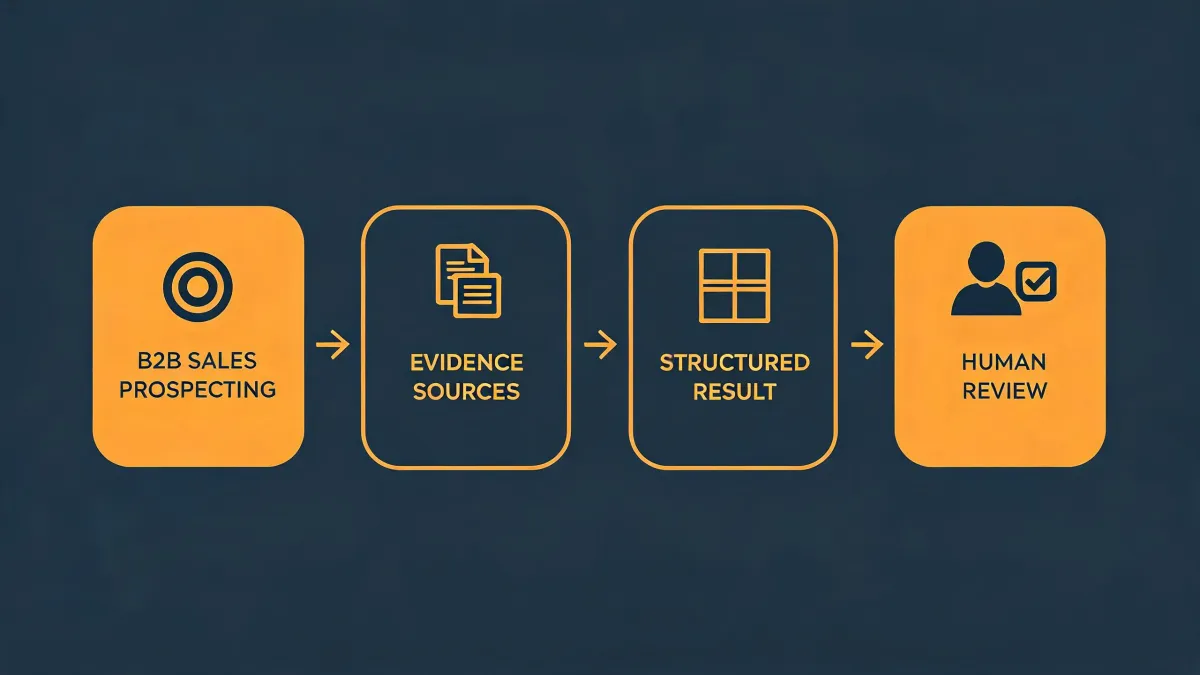
Rank B2B sales prospecting approaches by false-positive control, reviewability, learning value, and activation risk. An ICP-led qualification system ranks first overall. Research-led manual prospecting ranks second for early-stage learning. Multichannel outbound ranks third when fit is already proven. Data-assisted search and activation ranks fourth overall but wins when your team needs reviewable scale and keeps human approval before outreach.
Which B2B prospecting approach ranks first overall?
The first-place approach is an ICP-led qualification system. It ranks highest because it starts with the decision that every later method depends on: does this account belong, and can your team explain why? ZoomInfo distinguishes proactive, sales-owned prospecting from inbound lead generation and frames consistent pipeline as an ICP, qualification, and outreach system. That sequence gives you four ranking criteria. Fit control asks whether poor accounts can be excluded. Reviewability asks whether a person can inspect the reason. Learning value asks whether rejection changes later targeting. Activation risk asks how easily an unsupported record can reach outreach. On those criteria, an ICP-led system wins overall because it places qualification before channel capacity. Its tradeoff is discipline. You must define exclusions and revisit them, rather than treating an attractive list as self-validating. If your team needs one default model, choose this one.
Define the Operating Outcome Before Capacity
You can test the first-place model before buying anything. Write what a new record must demonstrate before sales owns follow-up. Require an account fit, a relevant contact role, and a usable reason for outreach. Then ask what happens when one element is missing. Can you reject the account? Can you return it for research? Can your team see which rule failed? These questions keep metrics honest. More records at the top do not matter if unsupported handoffs also grow. This approach is best for teams with inconsistent qualification, mixed inbound and outbound sources, or costly follow-up debt. It is less attractive when your criteria are still entirely unknown, because you first need the second-place method to learn what a workable criterion looks like. The winner is therefore conditional, but the ordering remains: once you can state the target, qualification must govern every later prospecting method.
Which approach ranks second for early-stage learning?
Research-led manual prospecting ranks second. It is the best option when your market is unfamiliar and your team needs to learn before it scales. HubSpot defines B2B sales prospecting through identifying and qualifying potential business customers with research, outreach, and relationship building. In this model, a person investigates accounts, forms a fit judgment, and carries that reasoning into contact and message choices. Its learning value is high because the reviewer stays close to the evidence. Its activation risk is also relatively easy to control because a person can stop before outreach. Why does it rank below an ICP-led system? Manual judgment can remain private and inconsistent. Two researchers may accept different accounts for different reasons, and the process may not preserve those reasons for the next cycle. Use it to discover patterns, not as an excuse to avoid shared definitions. It wins for a new segment, a complex buying context, or a team that must learn what exclusions matter before formalizing the gate.
Every Feature Should Support a Decision Gate
To decide whether second place is right for you, inspect the handoff from research to qualification. Can the researcher state the account evidence in language another person understands? Can the reviewer disagree and record why? Can your team reuse the rejection when it searches again? If not, the method generates expertise without an operating memory. The practical tradeoff is speed against explicit learning. Manual work may examine fewer accounts, but it can expose why a category, geography, buyer type, or contact assumption fails. Do not rank it by names found per hour. Rank it by how quickly you can turn observations into a stable ICP and qualification rule. When that rule becomes reliable enough for repeated use, move the system toward the first-place model. Research-led work is not the final winner. It is the strongest discovery mode for building the criteria that let your later process reject false positives consistently.
Which approach ranks third for channel coverage?
Multichannel outbound ranks third. It wins on coverage only after your fit gate works. Leadfeeder organizes B2B prospecting around ICP definition, list building, a strategy mix, multichannel execution, data hygiene, and weekly refinement. Notice the dependency. The channel mix does not replace ICP or list quality. It carries accepted candidates through more than one route while refinement returns learning to the next cycle. This approach is useful when your team already understands the target but needs a consistent way to engage across channels and review results. Its tradeoff is propagation risk. A weak account can consume attention in several places instead of one. That is why multichannel execution ranks below qualification and research. You should choose it when your exclusions are stable, your list can be cleaned, and your review cadence can change targeting. You should not choose it merely because a broader sequence looks more complete than a single channel.
Test the Failure Before Expanding Channels
You can verify the third-place approach with a reset test. Start with one accepted account and one rejected account. Ask how the process treats both across the strategy mix. The accepted account may proceed to outreach, but the rejected account should not gain new legitimacy simply because another channel is available. Then ask how weekly refinement changes the list. Does a repeated rejection alter the ICP or data rule, or does the team only adjust timing and copy? The method wins for teams with proven targets and a need for coordinated execution. It loses when inbound interest or outbound reach is mistaken for qualification. Inbound and outbound differ in who initiates attention, but neither settles account relevance. Your ranking should therefore place channel breadth after the shared acceptance gate. If a vendor leads with sequences before it can show disqualification and data hygiene, you are looking at capacity without enough false-positive control.
Which approach ranks fourth for reviewable scale?
Data-assisted company search and activation ranks fourth overall, but it wins the scale use case when review remains explicit. OKKI Go provides a bounded example: a user can state products, buyer types, target countries, and exclusions in natural language, review returned candidate companies, and selectively unlock them. That workflow can make your criteria easier to apply across more records. It still does not prove that every returned company fits. The reviewer must decide. The approach ranks fourth because a weak input can propagate quickly through search, contact discovery, and outreach preparation. Its advantage is reviewable capacity, not automatic qualification. Choose it when your ICP and exclusion rules are already usable, your reviewers can inspect candidates, and your process stops before activation. Avoid ranking it first just because it combines several tasks. A connected stack creates value only when it also keeps the rejection point visible and prevents a doubtful record from becoming active work by default.
Request Proof That a Poor Fit Can Leave
Run an exclusion test before you accept the fourth-place option. Enter a product, buyer type, target country, and exclusion. Review the candidates before you unlock any of them. Can you explain why each company appeared? Can you stop a weak candidate immediately? Can you correct the search route and see a different review set? These questions turn the demo into a ranking test. Next, follow one accepted candidate into contact discovery and draft preparation, but stop before sending. The evidence supports a reviewable flow, not a performance promise. If the supplier shows only a large result set, score it poorly on fit control. If it shows selective unlocking, contact review, and a clear approval point, it can win for scale. The tradeoff is governance effort. Your team must maintain criteria and review decisions, because no data-assisted system can infer a usable buying reason from an unexplained name alone.
Which B2B prospecting approach wins for your use case?
Your winner depends on the operating problem, but the ranking criteria stay fixed. Choose the ICP-led qualification system when false positives already burden sales. Choose research-led manual prospecting when you are entering an unfamiliar segment and need to learn. Choose multichannel outbound when the target is stable and you need coordinated coverage. Choose data-assisted search and activation when the criteria are mature and you need reviewable scale. For unlocked companies, OKKI Go supports contact discovery and drafting from company context and product materials, while the user confirms the recipient, subject, and body before sending. That example makes the final checkpoint concrete. Your winning workflow should preserve the account reason through contact selection and message approval. If the account reason disappears before sending, the approach has traded qualification for throughput. Ask the same question at every stage: what proof permits this record to advance, and who can stop it when that proof is missing? Record the answer beside your ranking, because the same option may win today and lose after your target, team, or activation risk changes. A ranking without a stated operating condition is only a preference list.
- Best overall, ICP-led qualification: show the inclusion, exclusion, stage, and disposition rules that keep poor accounts from activation. Ask who owns each rule, how your team records a rejection, and whether that rejection changes the next list rather than disappearing as private judgment.
- Best for learning, research-led manual prospecting: show how a reviewer records account evidence and turns rejection into revised targeting. Ask whether another person can understand the reasoning, challenge it, and reuse it when your team enters the next account or segment.
- Best for coverage, multichannel outbound: show that only accepted accounts enter the channel mix and that weekly refinement changes the list. Ask how the workflow prevents a rejected account from reappearing through another route and how channel observations return to qualification.
- Best for scale, data-assisted search: show company review, selective unlocking, contact confirmation, contextual drafting, and human confirmation before sending. Ask whether your reviewers can inspect criteria, stop a poor fit early, and correct the route before automated capacity multiplies the error.
- For every option, show how sending status or failure remains an execution observation, while opens or clicks are not treated as proof of buying intent. Ask what each metric permits your team to decide and reject any ranking that promotes activity signals into unsupported qualification claims.
Accept Proof Before Throughput
The winner-by-use-case conclusion should not blur into an everyone-wins list. The ICP-led qualification system remains first because every other approach needs an acceptance rule. Research-led manual work ranks second because it can discover that rule, but it struggles to scale private judgment. Multichannel outbound ranks third because it expands coverage, but it can multiply a bad target. Data-assisted search ranks fourth overall because weak criteria can propagate fastest, yet it wins the scale case when candidate review and activation controls are real. As you compare suppliers, score the evidence, not the label. Ask whether a weak account can leave, whether a contact can be challenged, whether a buying reason survives into the draft, and whether the user confirms the final action. Then run one cross-option comparison with the same doubtful account. Show how each approach researches it, rejects or accepts it, and prevents an unsupported next step. This common test keeps your ranking from rewarding whichever demo uses the most polished query or message. Capacity matters only after those gates hold. If an approach can show more output but cannot show disciplined removal, it does not deserve to move up the ranking. Your final choice should solve the current operating problem while preserving the first-place qualification rule.
The ranking has one durable winner and three conditional winners. Put ICP-led qualification first, then choose research, multichannel execution, or data-assisted scale for the specific problem your team actually needs to solve. Re-run the same false-positive test whenever your target, channel mix, or activation workflow changes, because an old winner should not keep first place after the operating question moves.
Frequently asked questions
What is the single most important factor in B2B sales prospecting?
The first-ranked factor is false-positive control: the workflow must prove account relevance, contact role, and a usable buying reason before outreach becomes active work.
What do most buyers get wrong about B2B sales prospecting?
They often rank list size, automation, or channel count above qualification. Those capabilities can increase follow-up debt when weak records are not removed first.
How should you actually decide on B2B sales prospecting?
Use four criteria: false-positive control, reviewability, learning value, and activation risk. Then choose the winner for your use case without moving capacity above qualification.
When does B2B sales prospecting matter most?
It matters most when data, sequencing, and sales execution are connected, because a weak entry criterion can then create repeated downstream work.