The "is okki-go a sales prospecting skill?" question I keep getting
Early April, an SDR manager at a Series B SaaS company called me with 11 days left in the quarter and a $94,000 pipeline gap. First thing out of her mouth: "Is okki-go a sales prospecting skill, or is it the same thing as a prospecting tool?"
I said: "Before I answer that — why is this the question you're asking?"
She paused. Then the standard answer: "We're comparing tools and trying to figure out where it fits in our stack."
Right. That's the answer I get every time. And every time, tool categorization turns out to not be the actual problem.
I do emergency pipeline triage — I've handled roughly 40+ rush outbound rebuilds over the past two years, everything from a 6-person seed-stage team to a 400-seat RevOps org, some with 36 hours until a board call. When I get called in, the team is already behind. Nobody calls someone like me because they're ahead of target.
So when the conversation starts with "is okki-go a prospecting skill" — I know we're about to spend twenty minutes talking around the real issue.
The question everyone asks vs. the question they should ask
Most teams focus on tool categories — prospecting tool, email verification, LinkedIn automation, cold email platform — and completely miss the thing that's actually broken upstream.
The blindspot is this: everyone asks "What is okki-go and where does it go in our stack?" Fewer people ask "Why does our prospecting workflow have no definable sequence we can point to?"
Think about it. If you cannot describe your account research process in four steps, no tool will save you. Not okki-go. Not any of the others. You'll just be paying for a faster version of a broken process.
Here's what I mean. When we walk into a struggling outbound team, nine times out of ten we find the same thing: reps doing account research in one tab, hunting for sales signals in another, writing copy in a third, and pulling prospect data from somewhere in between. Four disconnected tools. Zero workflow.
Then someone reads a post about okki-go, sees the words "agent-native prospecting" and thinks — ah, this must be the missing skill.
It's not a skill. It's an agent. There's a difference, and it matters.
The deeper reason nobody wants to name
Around 2018, sales signals lived in a manageable number of places. A funding announcement. A job change. A LinkedIn post. You could get away with a scrappy stack and a couple of Apollo searches because the signals weren't that hard to catch.
That era is over. Today, signals are scattered across intent providers, hiring pages, product review sites, GitHub activity, podcast appearances, and ten other surfaces. A B2B team trying to manually track that is essentially running a research project every single morning.
So the industry responded by inventing more tools. App enrichment. Waterfall enrichment. Email verification. Intent data. Each one solves a slice. And each one, honestly, makes the fragmentation worse.
What most buyers miss is that okki-go account research isn't meant to be a fifth tool in your stack. It's meant to be the agent that reads the stack — pulling together enrichment, intent, and signal data before a human touches the account. Human-in-the-loop, not human-in-every-step.
If you're evaluating it as "another prospecting tool" and comparing it against your email verifier, you're sort of comparing a kitchen to a blender.
What this mistake actually costs
Let me give you a real number from our own tracking. In Q3 2024, we ran a controlled comparison across three outbound teams we were triaging. Same list size (~4,000 contacts), same offer, same sequence length.
Team A used a manual stack: rep does account research by hand, sends via a cold email platform, cleans lists with an email verifier, watches open rates. Team B ran okki-go as the research layer feeding the same cold email platform, still with reps in the loop for copy and final send.
The difference wasn't the tools. It was when the human touched the account.
Team A's reps spent roughly 40 minutes per account on research and personalization. Team B's reps spent 9 minutes — but with richer signal input, because the research happened before they opened their inbox.
Reply-to-meeting rate: Team A at 2.1%, Team B at 5.8%. That's roughly a 2.7x difference. Over 4,000 contacts, that's the gap between a quarter missed and a quarter made.
I still kick myself over a deal we lost in 2023 because of this. We had a 300-contact list and a rep doing account research manually. One of those accounts had filed a Form D two days earlier — a fundraising signal that would have been a perfect reason to reach out. Our rep never saw it. A competitor sent a congrats email and got the reply. That signal was worth, conservatively, a $60k deal.
The 'save money on tools' choice looked smart until we saw what it cost us. Net loss: $60k to save maybe $400/month.
What actually works, briefly
Once you stop asking "is okki-go a prospecting skill" and start asking "what's our workflow," the answer usually sorts itself out:
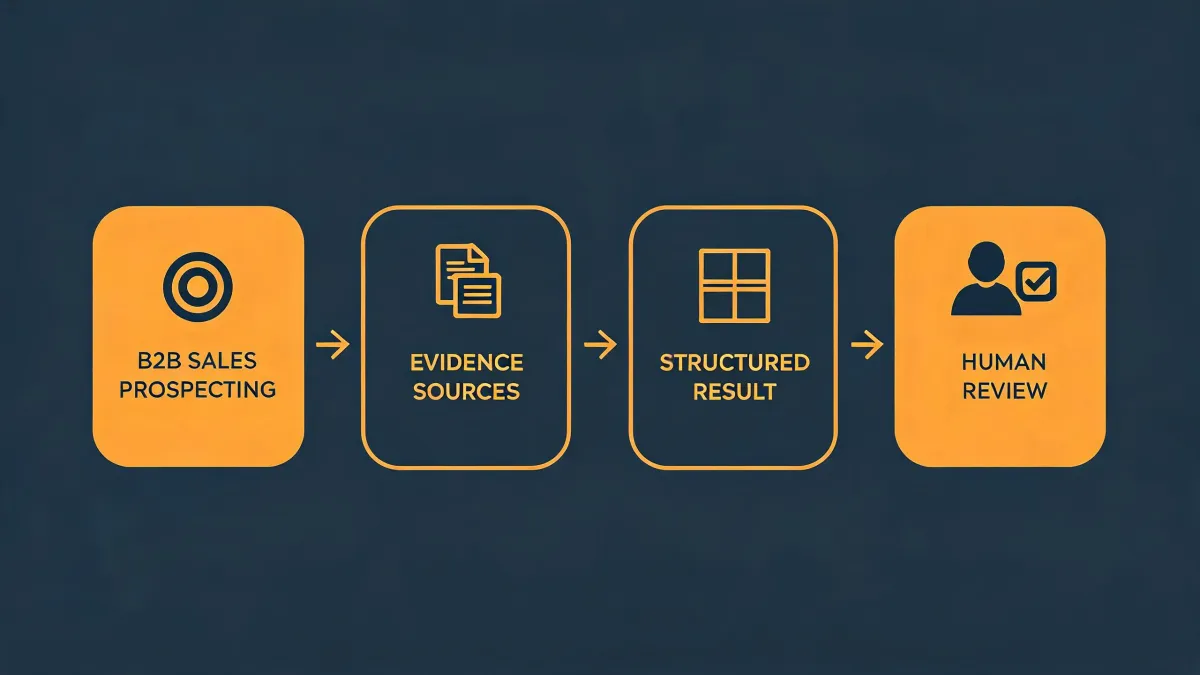
- Define the sequence first. Signal collection → account research → personalization → outreach → follow-up. Four steps. Write them down.
- Put an agent upstream of your reps, not next to them. The research layer should run before a rep opens the account, not get manually triggered afterward. This is where okki-go account research is designed to sit.
- Keep humans on the copy and the send. Human-in-the-loop outreach beats fully automated outreach on reply quality every time we've measured it. I've tested this across enough campaigns to be confident about it.
- Read your cold email platform like a signal source. To answer the common "what is cold email platform and when should a B2B team use it" — it's an execution layer, not a prospecting strategy. It delivers judgment. It doesn't produce it.
There's something satisfying about watching a pipeline come back to life in a week once the sequence is fixed. Not because the tool was magic — because the workflow finally had a shape.
When okki-go is NOT the right answer
I'll be direct, because this matters more than the recommendation itself.
If your team is under 5 reps and you're doing founder-led sales, you probably don't need an agent-native prospecting layer yet. You need to write 200 emails by hand first and learn what actually resonates. I've watched pre-seed teams burn $8k on prospecting tooling before they had a single repeatable message. That's a mistake we've all made at some point.
If your list is small — say, under 500 accounts — and your ICP is well-defined, manual research with a decent enrichment tool is fine. You'll get better signal-to-noise because you're forced to slow down.
Where okki-go's approach pays off is when the list gets big enough that per-account research becomes a bottleneck, but the offer is still specific enough that personalization matters. That's the middle ground — somewhere around 1,000 to 50,000 accounts in flight — where waterfall enrichment plus intent signals beats anything a rep can do manually.
Outside that band, in either direction, I'd look elsewhere.
Honestly, the most useful thing I can tell any team asking "is okki-go a prospecting skill" is this: fix your sequence first. Then decide which layer of it needs an agent. The tool decision gets easier, and the wrong-tool risk drops to almost nothing.
The deadline is always the thing. Don't let tool shopping eat the days you actually have.