
I review roughly 200 outbound campaigns a year before they reach customers. In 2025, I rejected about 18% of first deliveries. Not for spelling mistakes or weak subject lines, but because the workflow behind the campaign was broken.
If you've ever spent weeks configuring a cold email platform, connected your lead generation tools, and still watched reply rates flatline, you know the feeling. And if you're like most teams I've worked with, your instinct is to blame the tool. You search for "relevance ai review pros cons," compare feature lists, and sign up for another demo. Six months later, you're having the same conversation.
That's the surface problem. I want to show you the one underneath it—because the feature list was never the issue.
The surface problem: we blame the tool instead of the process
When cold outreach underperforms, the ritual is always the same. The lead generation tool gets blamed for stale contacts. The email validation API gets blamed for bounces. The cold email platform gets blamed for poor deliverability. And a new evaluation cycle begins with a new vendor.
I lived this at my previous company. Our stack looked excellent on paper. The lead generation tool pulled hundreds of thousands of contacts with intent data. The API email validation service scored 98% accuracy in our test batch. The cold email platform had open tracking, bounce handling, and sender rotation—all the features we thought we needed.
Our first campaign went out on a Tuesday at 11:47 AM. By Thursday, 24% of messages had bounced. Our sender reputation cratered so fast we looked like spammers on a brand-new domain. That campaign cost us about $6,800 in licenses, labor, and recovery. It took roughly three months of throttled sending volume to rebuild the domain's reputation.
I still kick myself for not catching it before it shipped. But the problem wasn't any single tool. It was the workflow connecting them—or, honestly, the lack of one.
The deep cause: point solutions don't equal a workflow
Here's what most tool evaluations miss, and it's not something you'll typically find in a "relevance ai review pros cons" post:
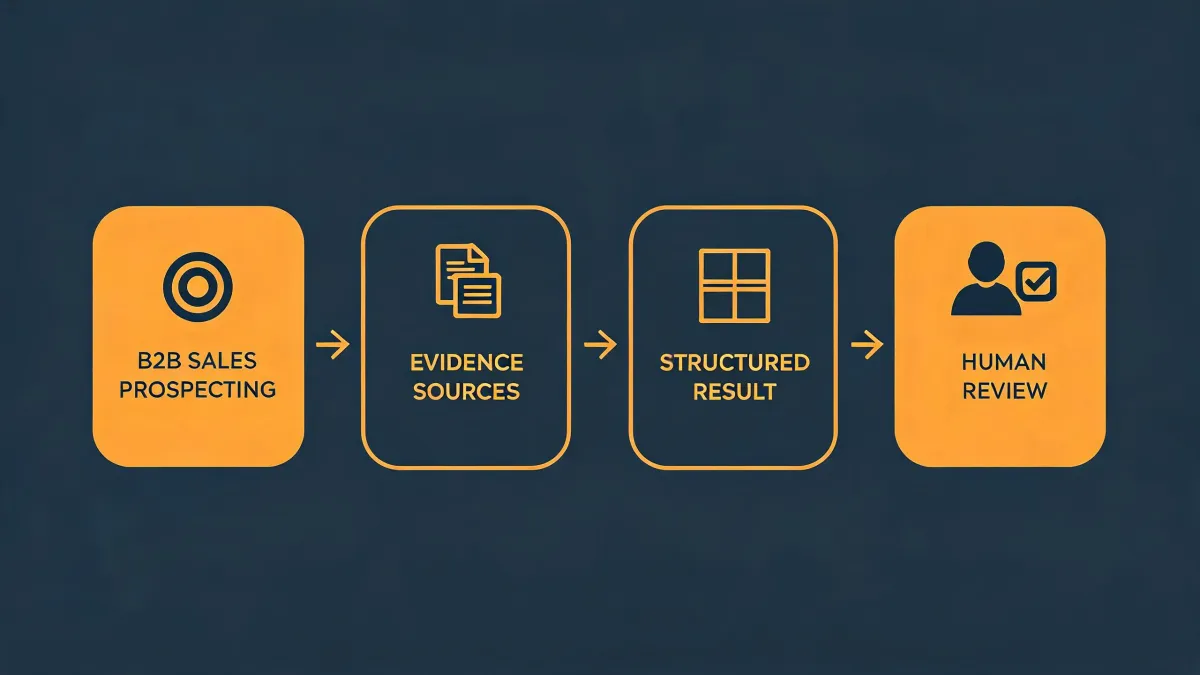
A lead generation tool, an email validation API, and a cold email platform are three separate components of one process. But a process is not a workflow. A workflow is a sequence of decisions where context flows naturally from one step to the next. Every handoff between tools is where quality degrades.
Walk through a typical multi-tool stack and you can see the problem forming:
- Your lead generation tool discovers a contact and logs an intent signal.
- Someone exports that list—often days later, through a CSV or a manual sync.
- The exported list goes through your email validation API, which checks a snapshot of data that's already going stale.
- The validated list lands in the cold email platform, where a sequence gets attached.
- The email goes out, referencing a role or pain point that may have changed since step one.
Between step 1 and step 5, context gets dropped and data decays. Nothing about this chain is agent-native. It's people shuffling files between systems and calling it automation.
Which brings me to the question I hear more and more often—and the one I think every sales team should ask:
How does a cold email platform fit into an agent-native prospecting workflow?
An agent-native workflow means the AI agent handles research, prioritization, personalization, and the send decision as one continuous process. The platform doesn't wait for a human to export, clean, and re-upload files. Prospect discovery flows through enrichment, validation, and message generation in a single stream, with no manual handoffs.
I'm not a data engineering specialist, so I can't speak to the API internals of every platform on the market. What I can tell you from a quality-review perspective is what happens when the chain breaks: data goes stale, context gets lost, and wrong emails ship. In my audits, I'd estimate 4 out of 5 campaign failures trace to broken handoffs between tools, not to poor performance of any individual tool.
The cost: what a broken workflow actually costs
Quality problems sound abstract until they wear a price tag. So here are the numbers from a Q1 2024 audit I ran of our previous stack:
Our team spent about 14 hours per week—maybe 12, I'd have to check the old time tracker—just moving data between tools. Exports, deduplication, field mapping, test sends. At a blended rate of $75 an hour, that's roughly $900 a week. Around $46,000 a year, give or take a few thousand.
Then there's the quality loss. In the campaigns I've reviewed over the past two years, 18% fail first-pass QA. The reasons are repetitive: wrong contact fields, outdated intent data, templates referencing a prospect's previous company. These are the problems that make cold email feel robotic, and they're rarely solved by switching email platforms.
The most expensive cost is deliverability. A single bad campaign can wreck a domain's reputation in days. Rebuilding it takes months of careful volume and list hygiene. For a team with quarterly revenue targets, that's easily tens of thousands in compromised pipeline.
This is why I push back when procurement wants to minimize tool costs. In my experience tracking vendor performance, the cheapest stack has cost us more in about 60% of cases. A $200/month platform that requires 10 hours of manual work weekly isn't cheaper—it's a bad investment. The $500/month platform that removes the handoffs is the bargain.
The fix: evaluate workflows, not feature lists
Features matter—but only up to a point. Cold email platforms need solid deliverability infrastructure. Email validation APIs need accurate verification methods. Those are baseline requirements, not differentiators.
What actually separates a tool that improves your outbound quality from one that just adds cost is the answer to one question:
"Does the platform handle lead discovery, enrichment, validation, and sending as one connected process, or is it a point solution that needs to be stitched together?"
That question is worth more than any comparison chart.
This is why I work at relevance-ai. Not because our feature sheet is the longest, but because the platform is built around an agent-native prospecting workflow. You describe your ideal prospect in natural language. The system handles research, intent data, enrichment, email validation, and sending as one pipeline. There's no gap where a lead gets dropped or a CSV export goes stale.
If you're evaluating relevance-ai and want to talk to someone on our team, the relevance ai contact email is on our website. But I'd suggest asking the workflow question above, not "how many integrations do you have?" Integration count doesn't help if data isn't flowing through them automatically.
And if you evaluate other vendors, use the same standard. You're not looking for the best lead generation tool, the best email validation API, and the best cold email platform. You're looking for one workflow that holds its quality from discovery to send.
Final thought
My experience is based on about 200 campaigns per year, mostly B2B SaaS outreach. If you're in a different market, your specifics might differ. But the core principle holds: broken workflows produce bad campaigns, and no feature list can fix that.
I've been reviewing deliverables for eight years—maybe nine, I'd have to check my start date. Across roughly 200 campaigns per year, the pattern is consistent: most preventable failures are caused by broken handoffs between tools, not by the tools themselves.
So next time your cold email results disappoint, don't open a new vendor comparison. Map your workflow. Find the handoffs where quality degrades. And choose a platform that eliminates them.
That's the difference between a stack that looks good on paper and one that actually ships quality.