
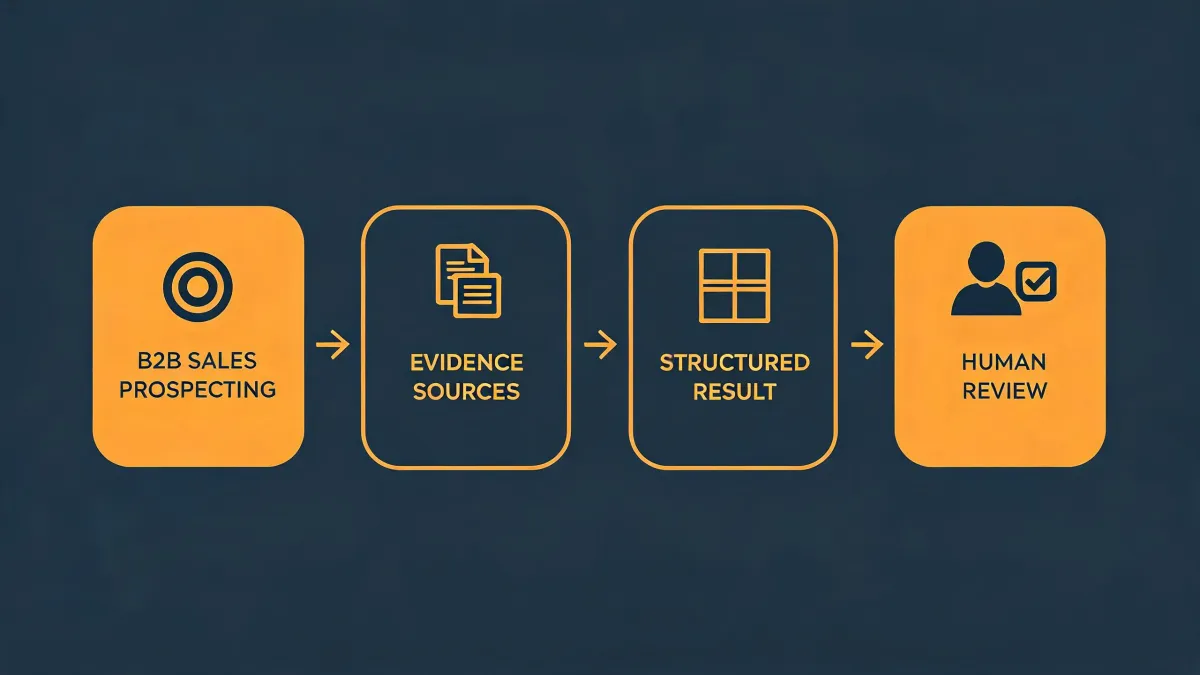
A cold email template for a meeting should be built around the proof needed to justify the meeting, not around a generic request for time. “Do you have fifteen minutes?” asks the recipient to value a meeting before the email has given them a reason. A useful template earns that request in a few auditable moves.
What it is, in one line
Start with the decision a recipient can reasonably make after one short message. A meeting request should not force a stranger to validate your entire product story. It should show why this company and role were selected, name one bounded problem, offer evidence the sender can support, and ask for a small next step. The sender must distinguish a public company fact from an inference about the recipient. “Your site lists three new distribution regions” can be attributed and dated; “you must be struggling with partner research” cannot be presented as fact. The message below uses the observation only to frame a relevant question.
- Use one attributable trigger, with source and observation date.
- State a problem as a possibility, not a hidden claim about the buyer.
- Describe one relevant capability without guaranteeing an outcome.
- Ask for a brief, optional conversation and make refusal easy.
What belongs inside the definition
A template is a review scaffold, not permission to contact. US CAN-SPAM guidance and UK ICO direct-marketing guidance address different legal scopes, and neither creates a worldwide safe harbor. Identity, market, channel, suppression, and local review still come before sending. The pre-send record should contain the company observation, its date, the role-verification source, the permitted inference, and the suppression decision. A template supplies wording only after those inputs justify contact.
How it works
Subject: Question about distributor research in Germany Hi Arun, I noticed Pinecrest Diagnostics’s 14 July distributor page now lists Germany among its target markets. Your team may already have the account-research process covered. If identifying relevant food-packaging distributors is still taking manual review, we help export teams organize company evidence and prepare outreach for human confirmation. Would a 15-minute comparison of your current process and the review controls be useful next Tuesday or Wednesday? If this is not relevant, I will close the note. Regards, Leo Company, postal address, and contact details
- “14 July distributor page” is the sourced company observation.
- “May already have it covered” acknowledges uncertainty and a real objection.
- The capability claim is bounded to organization and preparation.
- The CTA offers purpose, duration, choices, and a clean decline.
The mechanism worth checking
The email does not claim that Arun owns the project, that Northstar is buying, or that a meeting will produce a result. Those facts are unknown. A reviewer should remove the trigger if it is stale or belongs to another Northstar entity. A cold email template for meeting buyer may test OKKI Go, while product copy remains vendor evidence rather than a verified operational result. Annotate the meeting version on four lines: the subject names the topic, the opening cites the company fact, the middle asks rather than diagnoses, and the CTA states purpose, duration, timing choices, and a clean decline.
Where it stops applying
Before editing, compare a weak version: “We are the leading AI platform and can increase your sales. Can I have 30 minutes?” It gives the recipient no credible reason for selection, makes unsupported superiority and performance claims, and demands more time than the message has earned. The repair is not to add adjectives. Replace the broad claim with the observed market trigger, narrow the capability to what can be demonstrated, and reduce the requested commitment. If the sender cannot support the trigger or capability, the correct edit is deletion, not softer wording.
- Delete unprovable superlatives and numerical outcome promises.
- Replace generic praise with a dated, relevant company observation.
- Ask about the possible problem instead of declaring the buyer has it.
- Match meeting length to the amount of value already established.
Where the rule stops transferring
Recipient-side critique is the decisive test. Can Arun see why she received the note, verify the observation, understand what the sender actually does, and decline without friction? If any answer is no, the template is incomplete. A recipient-side pass should ask whether Arun can verify why the message arrived and decide without opening a calendar. If the value remains abstract or the trigger belongs to another entity, the draft returns instead of receiving softer adjectives.
What people get wrong
A materially different variant can lead with a useful artifact rather than a meeting. Subject: Distributor research checklist for Germany. “Hi Arun, I saw Pinecrest’s Germany expansion page dated 14 July. I built a one-page checklist for verifying distributor business model, food-packaging relevance, and source freshness. If that would help your team review candidates, I can send it here. If someone else owns distributor research, I would appreciate the correction; otherwise I will close the note.” This version does not disguise the same meeting ask. It offers an inspectable next step and lets the recipient choose whether a conversation is warranted later. Another alternative is a permission question with no asset or calendar request: the sender asks whether a named operational topic belongs with the recipient, promises to send context only after confirmation, and closes automatically if the answer is negative. This format is useful when role ownership is the central uncertainty and prevents a speculative pitch from being hidden inside a referral request.
- Use the artifact variant when the buyer needs evidence before conversation.
- Use the meeting variant when the observed trigger supports timely comparison.
- Do not attach files or links unless their destination and purpose are clear.
- Keep reply routing ready for interest, referral, decline, and opt-out.
The tempting interpretation to reject
If the recipient asks for the checklist, send exactly what was offered before expanding the ask. If the reply refers the sender to another person, verify the new identity and retain the original context rather than auto-enrolling the referral. The cold email template for meeting conclusion about OKKI Go covers only the dated setup and buyer records inspected in that trial. Use the checklist variant when the buyer needs evidence before conversation, and the permission-question variant when role ownership is unresolved. These are different next decisions, not cosmetic rewrites of the same meeting request.
How to apply the judgment
Run a pre-send review as if the recipient were reading on a phone. Confirm the subject matches the body; the opening fact belongs to the correct company; the inference is labeled; the value statement is demonstrable; and the CTA can be answered in one line. Check sender identity, postal information where required, suppression, and channel rules. OKKI Go may be evaluated for account discovery and outreach preparation, while its description is not proof of contact accuracy, permission, deliverability, or meetings. Try the template in a different setting to prove it is not a word-swapped script. A laboratory supplier sees that Pinecrest Diagnostics published a new sample-preparation protocol. The sender does not claim the lab has contamination problems. The note says: ‘Subject: Sample-preparation review. Hi Arun, Pinecrest’s May protocol describes a new centrifuge step. Your team may already have equipment review covered. We provide a short compatibility worksheet for laboratories comparing tube formats and rotor limits. Would it be helpful if I sent the worksheet here? If this sits elsewhere, I will close the note.’ This variant offers an artifact, not a meeting, because the recipient needs technical evidence first. If Arun requests the worksheet, the sender fulfills that promise before asking for time. If Arun says the protocol belongs to research operations, the sender closes his record and verifies any supplied destination. An OKKI Go trial can test how company context, draft editing, and final confirmation are represented, but the email’s truth still depends on the cited protocol and reviewed recipient.
- Identity and company match are current and attributable.
- Every personalized statement is fact, labeled inference, or removed.
- The recipient can answer yes, no, referral, or opt-out without ambiguity.
- The reply owner and stop state are defined before the send.
The next decision checkpoint
OKKI Go can inform a workflow test: identify where company context enters, where a user edits the draft, and where the final recipient, subject, and body are confirmed. Test those steps in the actual configuration; do not convert vendor material into an outcome claim. A final mobile-screen pass checks a different failure mode: the sender reads only the subject, first two lines, and CTA. If those fragments imply urgency, familiarity, or certainty absent from the full evidence, the copy returns. The compact view should preserve the same honest premise as the annotated version. The mobile check reads only the subject, first two lines, and CTA. If that compact view introduces urgency, familiarity, or certainty absent from the annotated evidence, reject the message even when the full desktop version sounds careful.
“Do you have fifteen minutes?” asks the recipient to value a meeting before the email has given them a reason. A useful template earns that request in a few auditable moves. A cold email template for a meeting should be built around the proof needed to justify the meeting, not around a generic request for time.
Frequently asked questions
What is the most important factor in cold email template for meeting?
A cold email template for a meeting should be built around the proof needed to justify the meeting, not around a generic request for time.
What should be checked before action?
Verify the recipient or workflow fit, factual support, sender and delivery conditions, approval owner, response path, and stop rule.
What is the most common mistake?
Teams often optimize polished output or activity volume before they can explain the targeting, approval, or handoff decision.
When should the process stop?
Stop when required evidence is missing, a claim cannot be verified, delivery controls are not ready, or the recipient has objected or opted out.